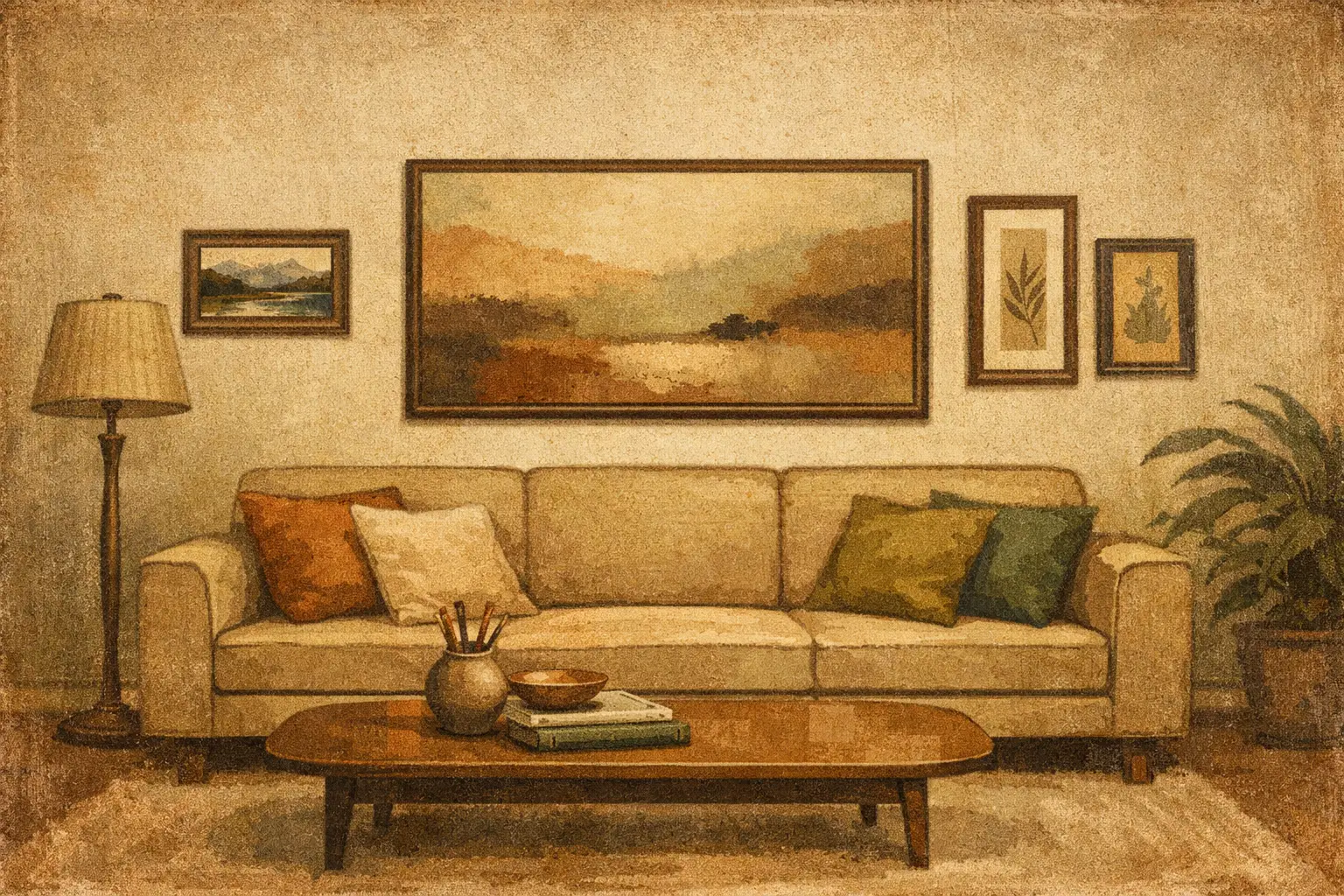
A sofa anchors the room, but the wall above it decides whether the space feels finished or vaguely unresolved. If you are wondering what size art fits above sofa placement, the answer is less about rigid decorating rules and more about proportion, breathing room, and the mood you want the room to hold.
Art above a sofa should feel composed, not crowded. Too small, and the piece looks adrift, like an afterthought. Too large, and it presses down on the seating area, disrupting the calm. The right scale creates visual harmony – a quiet sense that everything belongs where it is.
What size art fits above sofa walls most naturally?
The most reliable guideline is width. In most living rooms, the artwork or grouping should span about two-thirds to three-quarters of the sofa’s width. If your sofa is 90 inches wide, the art should usually measure roughly 60 to 68 inches across. That range feels intentional without matching the sofa too exactly.
This is why small single prints often disappoint above larger seating. A 24-inch-wide piece over an 84-inch sofa may be beautiful on its own, but on that wall it can feel visually isolated. The sofa has presence and mass. The art needs enough scale to speak back to it.
There are exceptions. If the room is very minimal and you want a restrained, contemplative feeling, a smaller work can succeed – but only if the negative space is deliberate and the piece has enough visual gravity. A quiet abstract with depth, texture, or strong tonal contrast can hold more space than its dimensions suggest.
Start with sofa width, then adjust for ceiling height
Width is the first decision, but height shapes the emotional effect. A long horizontal piece often suits a sofa best because it echoes the furniture below and keeps the composition grounded. In rooms with standard 8-foot ceilings, this tends to feel balanced and calm.
In rooms with taller ceilings, however, a more vertical composition or a stacked arrangement may feel better. Otherwise, the space above the art can become too empty, making the wall feel disconnected. This is where diptychs, triptychs, or a salon-style grouping can create rhythm without requiring one oversized piece.
If your sofa has a low back and clean profile, you have more flexibility to go taller. If it has a tall back, tufting, or a visually heavy frame, the art should usually avoid becoming too dominant in height. The goal is conversation between furniture and artwork, not competition.
How high to hang art above a sofa
Even correctly sized art can feel wrong if it is hung too high. Above a sofa, the bottom of the frame should generally sit 6 to 10 inches above the back. This keeps the artwork connected to the furniture and prevents that common floating effect.
People often raise art too far up because they are thinking about the wall as a blank vertical surface rather than as part of a living arrangement. But above seating, art is not standing alone. It is part of a composition that includes the sofa, pillows, side tables, light, and surrounding architecture.
If the sofa back is unusually high, lean toward the 6-inch range. If the sofa is low and streamlined, 8 to 10 inches often feels right. In either case, trust the eye as much as the tape measure. Rooms with softer, more organic styling can tolerate slight asymmetry. Rooms with crisp lines usually need tighter precision.
Single large artwork or a gallery arrangement?
A single large piece creates stillness. It is often the strongest choice in modern, minimal, or Wabi-Sabi interiors because it allows one image, one field of color, or one gesture to shape the atmosphere. This works especially well if the art has subtle tonal depth and enough scale to command the wall.
A gallery wall offers more narrative energy. It can feel collected, layered, and personal, but it is harder to do well above a sofa because the arrangement can easily become busy. If you choose multiple works, treat them as one visual unit. Measure the total width of the grouping, not each frame separately, and keep that total within the same two-thirds to three-quarters rule.
Spacing matters here. Between frames, 2 to 3 inches is usually enough. Larger gaps can make the grouping fragment into unrelated parts. Tighter spacing helps the arrangement read as a whole.
What size art fits above sofa in common sofa widths?
Most people want a practical starting point, so it helps to translate proportion into real dimensions. Over a 72-inch loveseat, artwork around 48 to 54 inches wide usually feels right. Over an 84-inch sofa, aim for around 56 to 63 inches. Over a 96-inch sofa, look for something closer to 64 to 72 inches wide.
That could mean one oversized framed print, a pair of medium works hung side by side, or a triptych with modest spacing. The exact format matters less than the final visual span.
Height is more variable, but many successful above-sofa pieces land somewhere between 24 and 40 inches tall. A panoramic work may be wider and shorter. A stacked pair may create more height while keeping the width balanced. The room will tell you which direction feels more natural.
When the usual rule should bend
Good interiors are not built from formulas alone. If your sofa sits on a very long wall, the usual width guideline may leave too much emptiness on either side. In that case, adding sconces, flanking smaller works, or using a wider multi-panel arrangement can help the wall feel resolved.
If your room is compact, oversized art can actually be the better choice. One generous piece often feels cleaner than several smaller ones because it reduces visual noise. Small rooms do not always need small art. They need clarity.
Likewise, if the artwork is highly textured, deeply emotional, or visually dense, you may not need as much physical size for it to carry the space. A contemplative composition with restraint can alter a room more profoundly than a louder but larger piece.
Frame, mat, and color also change the perceived size
Dimensions on paper do not tell the whole story. A floating frame, wide mat, or bold border changes how large the art appears once installed. Sometimes a modest print with a substantial frame has exactly the architectural presence needed above a sofa.
Color matters just as much. Pale, atmospheric work can visually recede, which may be beautiful in a serene room but may also require larger scale. Darker or higher-contrast pieces tend to feel more assertive and can read larger than their measurements.
This is one reason art selection should never be reduced to inches alone. Scale is physical, but presence is emotional.
A calmer way to test the size before you buy
Before committing to a piece, map the dimensions on the wall with painter’s tape or kraft paper. Do this at the exact hanging height, not just centered on the wall. Then sit down on the sofa and look at it from across the room.
This simple exercise reveals more than a product listing ever can. You will notice whether the width feels stable, whether the height crowds the room, and whether the composition creates ease. If you are considering a grouping, tape out the full arrangement including the gaps between frames.
For design-minded buyers, this step is less about caution and more about curatorial clarity. It allows you to make a choice that feels spatially aware rather than merely decorative.
Choosing art that fits the room, not just the sofa
The best answer to what size art fits above sofa placement includes the wall, the ceiling, the architecture, and the emotional temperature of the room. A living room meant for conversation may benefit from warmth, softness, and layered forms. A room meant for retreat may call for one expansive piece that introduces stillness.
At Taygeta Gallery, this is often where the most meaningful choice begins – not with matching dimensions, but with the atmosphere you want to live inside. Scale should support that atmosphere.
As a guiding principle, start with art that spans about two-thirds to three-quarters of the sofa width, hang it 6 to 10 inches above the back, and adjust for ceiling height, visual weight, and the quiet intelligence of the room itself. When the proportions are right, the wall stops asking for attention. It simply settles, and the whole space breathes.
Leave a Reply