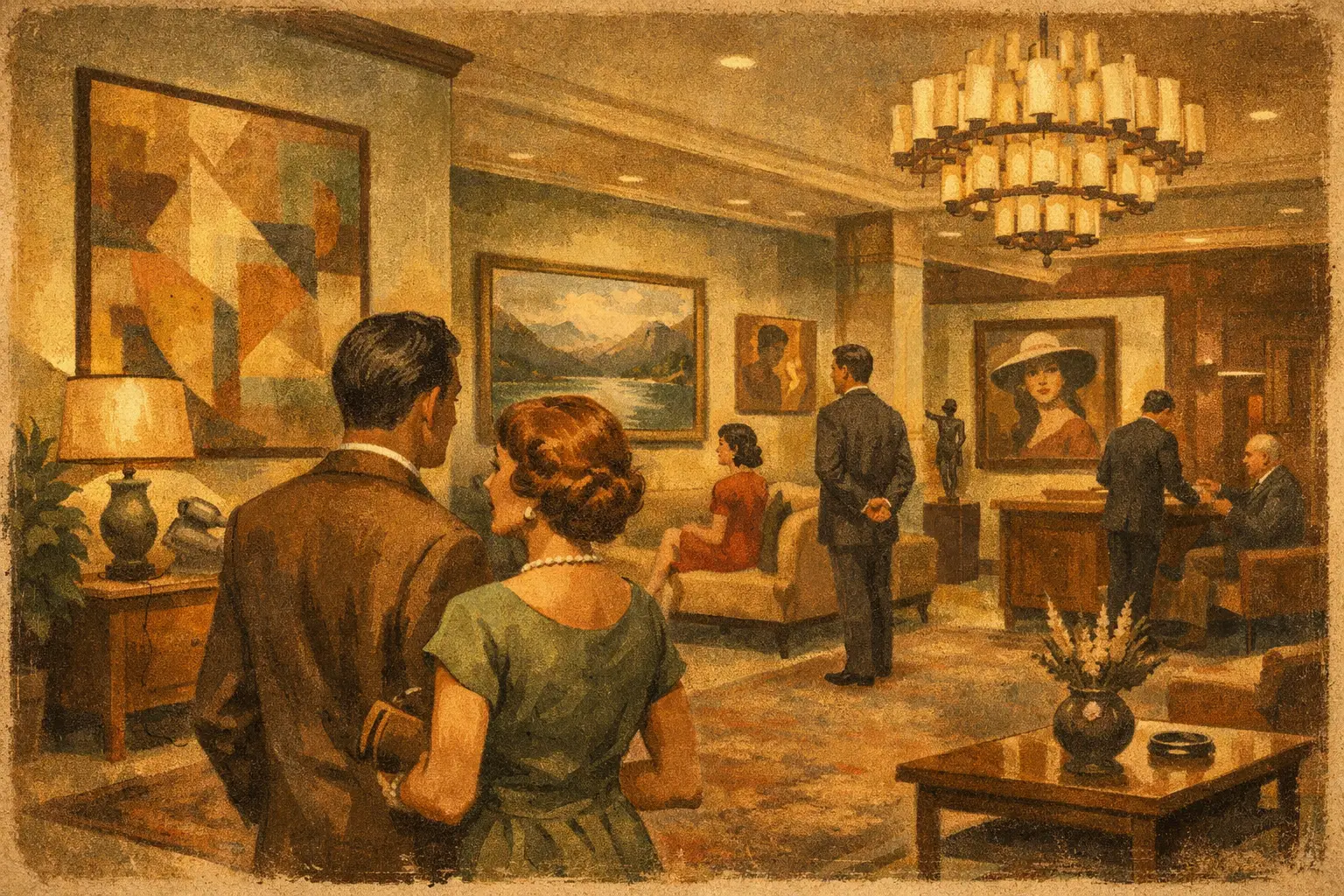
A guest enters your lobby before they enter your brand. The desk, the lighting, the stone underfoot – all of it speaks at once. But art does something the rest of the room cannot. It creates memory. A strong hotel lobby art collection example is not just a set of attractive pieces on clean walls. It is a visual philosophy for arrival.
For hospitality spaces, that distinction matters. Guests may forget the exact chair silhouette or the millwork finish, yet they often remember the painting near the entrance, the quiet tension of a large abstract above a console, or the small work that made a waiting corner feel considered instead of staged. In the best hotels, art is not an accessory. It is part of the emotional architecture.
What a hotel lobby art collection example should actually show
A useful hotel lobby art collection example should do more than present a mood board of expensive objects. It should reveal how a collection builds atmosphere, supports circulation, and reflects the identity of the property without becoming overly literal.
That usually begins with a curatorial premise. A coastal hotel does not need predictable seascapes. A wellness property does not need art that simply repeats the language of calm. The better approach is subtler. Think of erosion, horizon, silence, mineral texture, ritual, memory, or movement. These themes have enough depth to shape a collection while leaving room for interpretation.
In practice, the lobby collection often needs to serve several audiences at once. First-time guests need an immediate impression. Returning guests need visual layers that hold attention over time. Designers and owners need the work to align with interiors, but not disappear into them. This is where many collections fail. They become too decorative to feel memorable, or too concept-heavy to feel welcoming.
A refined hotel lobby art collection example
Imagine a boutique hotel lobby with limestone flooring, dark oak accents, brushed brass details, and a restrained palette of sand, charcoal, and muted clay. The architecture is contemporary, but softened by handmade textures. The goal is not spectacle. The goal is grounded elegance.
The collection begins with a large-scale anchor piece behind the reception area. Rather than a loud signature work, the hotel selects a museum-quality abstract composition in layered neutrals with subtle black gestures and areas of open space. It holds the wall with confidence, yet leaves room for breath. Guests register it immediately, even if they cannot explain why it feels right.
Near the entrance, a pair of vertically oriented works introduces movement. These are not mirrors of each other, but companions. One carries a sense of upward lift through pale tonal shifts; the other is denser, with weathered marks and a slightly darker field. Together, they establish the emotional range of the collection – stillness with tension, refinement with trace elements of imperfection.
A seating nook receives three smaller framed works on paper. This is where intimacy matters. Instead of filling the area with generic hospitality art, the collection shifts scale and asks for slower looking. The pieces might explore natural asymmetry, empty space, or the visual language of Wabi-Sabi. Guests seated with coffee or waiting for check-in notice the details. The corner becomes not just furnished, but inhabited.
A transitional corridor leading from lobby to lounge includes one sculptural or dimensional piece. This is a wise placement because movement changes how art is perceived. Texture, shadow, and material variation can quietly animate the walk without interrupting it. In a hotel setting, that rhythm matters more than many people realize. A lobby is rarely static. Art must hold up to passing glances as well as sustained attention.
Why this approach feels expensive, even when budgets vary
Luxury in art curation is rarely about excess. It is about edit. A collection with six well-related works often feels more assured than one with twenty mismatched pieces trying to fill every available wall.
That is especially true in a lobby, where visual noise can flatten the guest experience. If every surface competes for attention, the room loses its center. A stronger approach is to create intervals of intensity and restraint. One significant work, one quieter grouping, one moment of texture, one breathing wall. This gives the collection cadence.
Budget changes the format, not the principle. An independent hotel may choose a mix of original works and high-quality Giclée prints to preserve curatorial integrity without forcing compromise on scale. A larger property might commission original series or acquire collector editions for consistency across public spaces. Neither path is inherently better. The question is whether the collection feels intentional.
How to curate a hotel lobby art collection example with depth
The first step is to define emotional positioning before selecting any artwork. Ask what the lobby should feel like at 8 a.m., at 3 p.m., and at 9 p.m. Morning hospitality has a different atmosphere than evening arrival. If the art can live across those shifts, it is likely strong enough for the space.
Then consider the architectural tempo. A double-height lobby can absorb scale and negative space differently than a compact urban check-in area. In tall spaces, one oversized work may be more effective than a salon-style arrangement that feels visually scattered. In smaller lobbies, a sequence of medium and small works can create warmth without crowding the room.
Material dialogue matters too. Art should not merely match the palette. It should deepen it. If the interiors include travertine, raw plaster, smoked wood, or matte textiles, the artwork can echo those sensibilities through tonal layering, imperfect geometry, restrained contrast, or tactile framing. Harmony does not mean sameness.
This is also where a gallery with a curatorial point of view becomes valuable. Brands like Taygeta Gallery are compelling in this context because they do not treat art as filler. Their emphasis on contemplative abstraction, Eastern aesthetics, and emotionally resonant collections is naturally aligned with hospitality environments that want to feel composed rather than overdesigned.
Common mistakes in hotel lobby collections
The most common mistake is choosing art too late in the design process. When artwork is treated as the final decorative step, the result often feels disconnected from the architecture. Art needs to be considered while sightlines, lighting, furniture placement, and guest movement are still being shaped.
Another misstep is leaning too hard on local storytelling in the most obvious way. It is understandable to want regional relevance, but a collection does not need to illustrate the city to belong there. In many cases, subtle references to landscape, craft, atmosphere, or cultural memory create a more sophisticated sense of place.
There is also the issue of scale. Pieces that are too small can make an expensive lobby feel timid. Pieces that are too dominant can overwhelm service functions and social areas. The right scale depends on distance, ceiling height, and where the eye naturally lands when guests enter.
Finally, there is the temptation to make every work equally dramatic. This rarely succeeds. A collection needs hierarchy. Without it, nothing truly stands out, and the room feels restless.
A hotel lobby art collection example is really a lesson in mood
What makes a memorable lobby collection is not only what hangs on the wall. It is the relationship between visual silence and visual presence. The best collections understand that hospitality is a choreography of first impressions, waiting, passing, pausing, and returning.
That is why contemplative art often performs so well in these spaces. It does not exhaust the room. It allows guests to project themselves into it. Abstract work, minimalist compositions, and pieces informed by impermanence or natural texture can feel deeply luxurious because they do not demand a single fixed reading. They remain open, and that openness creates calm.
If you are studying a hotel lobby art collection example to guide your own project, look beyond style alone. Ask whether the collection gives the space a center of gravity. Ask whether it can hold both traffic and stillness. Ask whether it feels curated, not merely purchased.
A good lobby welcomes people. A thoughtful art collection gives them a reason to remember how it felt to arrive.
Leave a Reply