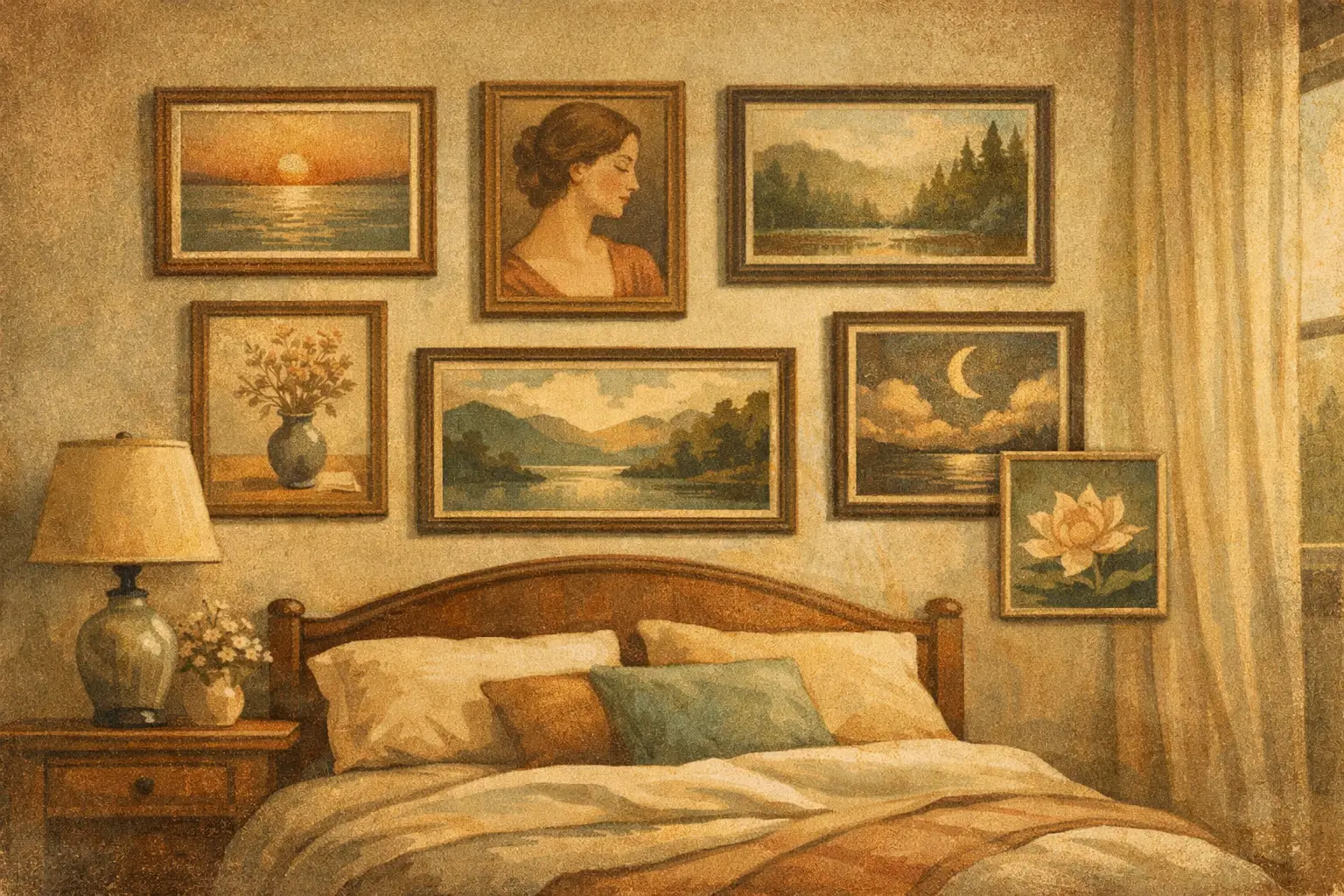
A bedroom can look beautiful and still feel restless. The difference is often not the furniture or the paint color, but the visual rhythm of the room – what the eye lands on before sleep and what it meets again in the morning. When people search for the best art styles for serene bedrooms, they are usually looking for more than decoration. They are trying to shape a quieter state of mind.
Art has an unusual kind of authority in a bedroom. It does not just fill a wall. It sets the emotional temperature of the space, sometimes more powerfully than textiles or lighting. The most calming choices tend to share a few qualities: restraint, spaciousness, softness, and a sense that nothing is trying too hard to impress.
What makes art feel restful in a bedroom
Serenity is not a single style. It is a relationship between image, scale, palette, and placement. A work can be minimal and still feel cold. It can be detailed and still feel peaceful. What matters most is whether the composition allows the eye to settle.
Bedrooms benefit from art that leaves room for silence. Gentle tonal variation, open space, natural forms, and balanced asymmetry often work better than sharp contrast or visually crowded scenes. That does not mean the room must become bland. A serene bedroom still needs character. It simply asks for character expressed with restraint.
Best art styles for serene bedrooms
Wabi-Sabi inspired art
If serenity had a visual philosophy, Wabi-Sabi would be one of its clearest expressions. Rooted in the beauty of impermanence, irregularity, and simplicity, this style brings a grounded calm that feels especially right in bedrooms. Think weathered textures, earthy neutrals, soft grays, muted clay tones, and forms that feel organic rather than polished.
Wabi-Sabi art often carries a quiet emotional depth. It can appear spare at first glance, yet the longer you live with it, the more it reveals. This makes it ideal for a room meant for slowing down. It invites contemplation without demanding attention.
The trade-off is that Wabi-Sabi can feel too austere in spaces that already lean cold or underfurnished. If your bedroom has hard lines, little upholstery, or a monochrome palette, pair this style with warmer woods, linen, or natural texture so the calm does not become severity.
Soft abstract art
Soft abstraction is often one of the safest and most sophisticated answers to the question of the best art styles for serene bedrooms. Unlike highly conceptual abstract work with aggressive color blocking or tension-filled geometry, softer abstract pieces rely on atmosphere. Their effect is felt before it is explained.
Look for paintings or prints with diffused edges, layered washes, misty gradients, and gentle movement. Pale sand, warm ivory, sage, smoke blue, and faded rose can all work beautifully, depending on the room. These compositions create a visual exhale. They offer presence without narrative noise.
This style is particularly useful if you want the art to harmonize with the room rather than dominate it. It also suits a wide range of interiors, from contemporary to Japandi to transitional spaces. The only caution is scale. A piece that is too small can feel tentative. In a bedroom, a larger work with breathing room often creates more calm than several smaller pieces competing for attention.
Minimalist line art
There is a reason minimalist line art appears so often in peaceful interiors. A single gesture, a restrained contour, or an abstracted botanical form can carry elegance without visual weight. Good line-based work feels deliberate and unforced, which mirrors the emotional quality many people want from a bedroom.
Minimalist line art is especially effective in smaller rooms, where heavy imagery might make the walls feel closer. It keeps the atmosphere open. Black on warm white is a classic pairing, though softer charcoal or taupe linework can feel more relaxed.
Still, this category depends heavily on quality. Generic line art can quickly feel decorative in the least interesting way. If the piece lacks conviction, the room will feel thinner for it. The best works have compositional intelligence and a sense of hand, even when they are visually spare.
Nature-based landscape art
Not every serene bedroom needs abstraction. Landscape art can be deeply calming when it avoids spectacle. The key is choosing scenes that suggest stillness rather than drama. Foggy horizons, quiet water, distant hills, winter branches, and open skies tend to support rest more than sunsets with high saturation or seascapes with crashing waves.
A bedroom is not the place for visual adrenaline. Nature imagery works best here when it restores scale and perspective. It reminds the viewer of space beyond the self, which can make a room feel more breathable.
Muted photography, painterly landscapes, and contemporary interpretations of natural forms all have a place. If your interior already includes many neutral materials, a subtle landscape can also prevent the room from feeling overly abstract or emotionally detached.
Japanese ink and wash influences
Art influenced by sumi-e or ink wash traditions brings an extraordinary sense of economy. A branch, a mountain suggestion, a drifting form, a few measured strokes – these can carry more calm than a densely finished image. The beauty lies in what is omitted.
For serene bedrooms, this style works because it respects emptiness. Negative space becomes part of the composition, and that spaciousness translates directly into the room. It suits interiors that appreciate Zen sensibility, natural texture, and disciplined simplicity.
This is not a style to mix casually with everything. In rooms filled with ornate furniture or loud pattern, its subtlety may be lost. But in a considered space, it can be transformative. Taygeta Gallery’s curatorial point of view naturally aligns with this kind of visual restraint, especially for buyers who want contemporary rooms with philosophical depth.
Tonal botanical art
Botanical art can go in two very different directions. One feels serene, the other feels busy. For bedrooms, tonal botanicals usually work best. These are not bright, decorative florals shouting from the wall. They are quieter studies of leaves, stems, seed forms, and organic silhouettes, often rendered in subdued palettes.
What makes them effective is their familiarity. Plants are associated with care, growth, and domestic calm, but when translated through a restrained lens, they avoid sentimentality. A monochrome palm study, a softened fern print, or a faded floral composition can add life while keeping the room composed.
This style is especially useful if you want softness without full abstraction. It gives the eye something recognizable, but not overly specific. The result is gentle engagement rather than stimulation.
Textural neutral art
Some of the most peaceful bedroom art is less about image and more about surface. Textural neutral work – whether created through layered pigment, plaster-like effects, or subtle mixed-media depth – brings warmth in a very quiet register. It is ideal for those who want a room to feel refined, tactile, and deeply settled.
In these pieces, cream, stone, taupe, ash, and soft mineral tones often do the work. The art becomes part of the architecture of the room, almost like an extension of light and material. This can be especially compelling above a bed, where an overly descriptive artwork might feel intrusive.
The nuance here is contrast. If every element in the room is equally pale and low-contrast, the space may drift into flatness. Textural neutral art works best when supported by at least a few points of definition – darker wood, sculptural ceramics, or shadow-rich textiles.
How to choose the right serene bedroom art for your space
The most successful choice depends on the kind of calm you want. If you are drawn to emotional warmth, soft abstract or tonal botanical work may feel right. If you prefer clarity and restraint, minimalist line art or ink-inspired pieces may suit you better. If your room needs grounding, Wabi-Sabi and textural neutral works often bring the most depth.
Also consider what your bedroom already says. Art should not repeat the room so exactly that it disappears, but it should not argue with it either. A serene bedroom usually benefits from one strong visual statement rather than many small accents. Let the piece hold the room together.
Above all, choose art that slows your gaze. That is the real test. If a work gives you a sense of pause each time you see it, it belongs in a bedroom. Calm is not created by emptiness alone. It is created by presence without pressure.
A serene bedroom does not need perfect styling. It needs one or two decisions that feel deeply right, and art is often the most powerful of them.
Leave a Reply