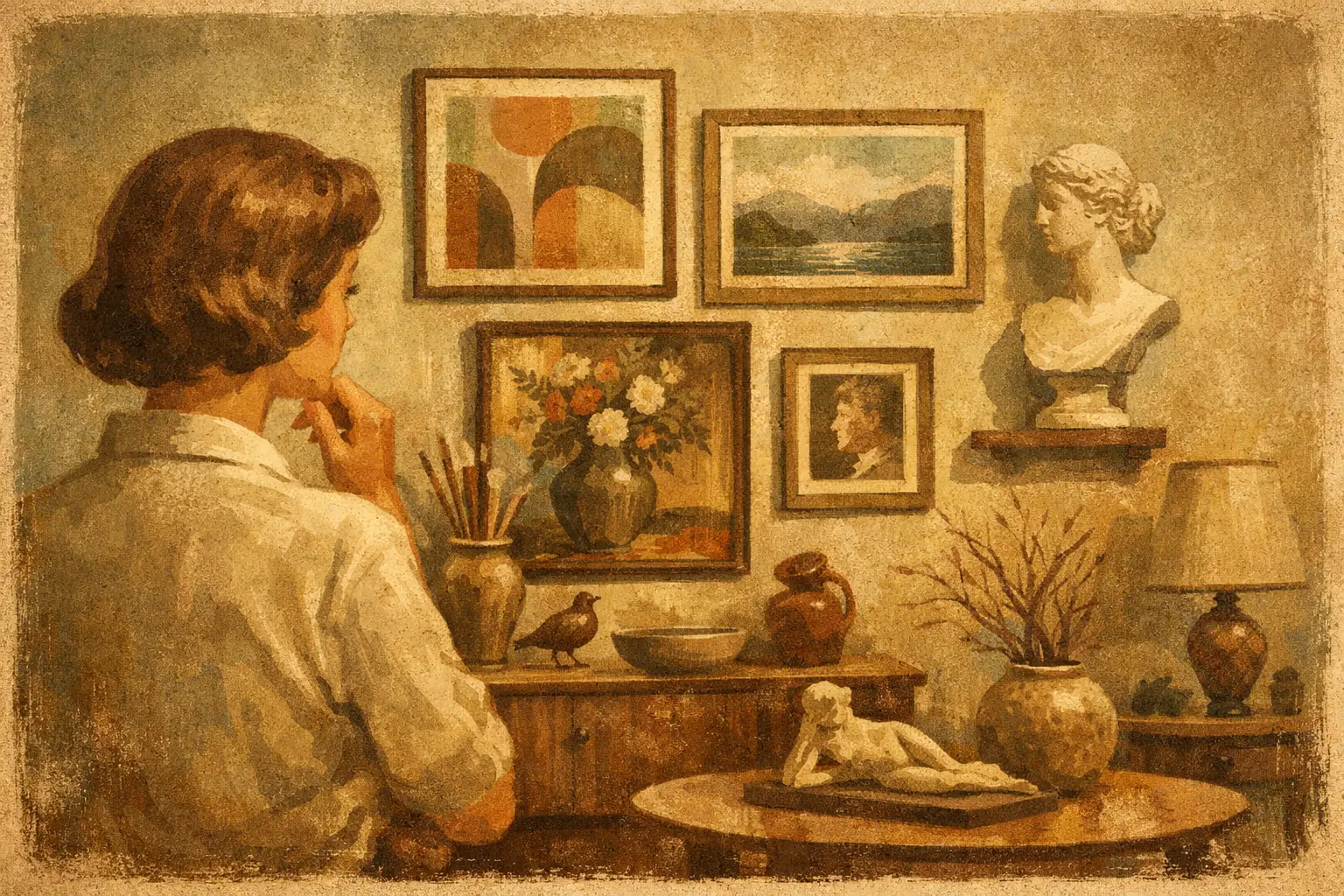
A room can hold expensive art and still feel undecided. It can also hold one modestly sized print, placed with care, and feel complete. What makes art feel curated is not simply rarity, price, or the number of works on the wall. It is the quiet sense that each choice belongs to a larger way of seeing.
Curated art creates an atmosphere before it announces itself. A visitor may not be able to name the visual logic immediately, but they can feel it: a measured relationship between color and space, tension and calm, material and meaning. The room seems to have a point of view.
For collectors, homeowners, and designers, this is reassuring. A curated home does not require a vast collection or a perfectly matched set. It asks for attention, editing, and enough confidence to let an artwork carry its own presence.
What Makes Art Feel Curated Rather Than Decorated?
Decoration often begins with a practical question: what will fill this wall? Curation begins with a more revealing one: what should this space make us feel? Neither approach is wrong. A bright, decorative work can bring pleasure and energy to a room. But when art is selected only to match a sofa, repeat a color, or occupy an empty area, it can lose its independent voice.
Curated art is allowed to be more than an accessory. It may echo the room’s palette, but it also introduces a new note. It may offer visual quiet in a layered interior, or a moment of strangeness in an otherwise orderly one. The work is not there to obey the room completely. It is there to enter into conversation with it.
This distinction matters most in minimal interiors, where each object carries greater weight. A spare room can make an arbitrary choice feel especially visible. Yet minimalism does not demand sterile restraint. A single surreal image, a weathered abstraction, or a deeply saturated field of color can become the emotional center of a calm space precisely because it has been chosen with intention.
A Point of View Creates Coherence
The strongest collections are not always uniform, but they are legible. There is a thread running through them, even when the works come from different artists, periods, or mediums. That thread might be an attraction to imperfect surfaces, contemplative negative space, unexpected figuration, or colors that feel softened by time.
A point of view is different from a rigid rule. You do not need to buy only black-and-white photography or only abstract paintings to create cohesion. In fact, strict matching can make a collection feel like a showroom. A more compelling approach is to identify the recurring feeling behind your preferences. Perhaps you are drawn to images that hold stillness and movement at once. Perhaps you respond to asymmetry, earth tones, or a sense of mystery.
Wabi-Sabi offers a useful lens here. Its appreciation of impermanence, irregularity, and quiet depth can guide choices without turning a home into a theme. A slightly off-center composition, a faded tonal range, or an artwork that leaves room for ambiguity may resonate more deeply than a polished image designed to please everyone at first glance.
The Role of Restraint in a Curated Art Collection
Curation is as much about what is left out as what is included. This is not an argument for empty walls. It is an invitation to resist the impulse to solve every blank surface at once.
When artworks are given breathing room, their details become more available. A fine-textured Giclée print can reveal its tonal subtleties. A collector edition can feel more distinct. A small work can become a deliberate pause rather than an overlooked object competing with furniture, lighting, and other images.
Restraint also means avoiding too many competing messages within one sightline. If a large, expressive abstract work is the anchor of a living room, nearby objects do not need to repeat its intensity. Let a sculptural chair, a quiet ceramic vessel, or open wall space support the experience instead. The goal is not emptiness. It is hierarchy.
There are exceptions. Salon-style hangs can feel deeply curated when they are built around a clear rhythm and genuine affinity. A dense arrangement may reflect a collector’s curiosity, travel, or intellectual range. But it needs internal order: a consistent frame treatment, a disciplined spacing system, a shared tonal family, or a meaningful contrast between works. Without that structure, abundance can read as accumulation.
Scale Is a Form of Respect
Scale is one of the least romantic parts of art selection, and one of the most consequential. A work can be visually beautiful yet feel misplaced when its dimensions do not acknowledge the architecture around it.
Over a sofa, a work that is too small may appear apologetic. On a narrow wall, an oversized piece can crowd the room’s natural rhythm. Before choosing, consider the wall as an active surface rather than an empty backdrop. Notice nearby doorways, ceiling height, furniture mass, and where the eye naturally rests when entering the room.
A large work is not automatically more important, and a small work is not automatically intimate. What matters is proportion and purpose. Large-format art can establish a strong sense of place in an entryway, hospitality setting, or open-plan room. Smaller pieces can reward close looking in a bedroom, reading corner, or passage between rooms. The scale should support the encounter you want the viewer to have.
Framing contributes to this relationship. A refined frame can give a digital artwork or museum-quality print the physical authority it deserves, while a generous mat can create visual silence around a detailed image. Conversely, a heavy frame can overwhelm a delicate composition. The frame should extend the work’s character, not distract from it.
Visual Dialogue Matters More Than Matching
A curated room rarely relies on exact repetition. Matching every artwork to the same shade of blue in the rug can make a space feel controlled, but also predictable. Visual dialogue is more nuanced. It asks how works respond to one another and to the environment.
Consider pairing a pale, atmospheric abstraction with dark wood, linen, and hand-finished ceramics. The contrast between the art’s lightness and the room’s tactile weight can create balance. Or place a vivid contemporary work in a restrained setting, where its color can act as a deliberate interruption rather than another layer of noise.
The same applies to multiple works. Two pieces need not share a subject to belong together. One might be gestural and the other geometric, but both may contain a similar tension between softness and structure. A figurative work can sit beside an abstract one if their emotional temperatures align.
Color is useful, but it is only one language. Texture, line, density, cultural reference, and mood can be equally persuasive. Sometimes the most elegant pairing comes from contrast: an austere monochrome beside a lively work, or a contemporary digital composition near an aged, handmade object. Curated interiors make room for these conversations.
Meaning Gives a Collection Its Lasting Presence
An artwork becomes more than decoration when it holds a story that matters to the person living with it. That story does not need to be dramatic or academic. It may be a memory of a city, an affinity with an artist’s process, or a feeling the work makes possible at the end of a long day.
This is why collecting from a single trend can feel limiting over time. Trends can be useful entry points, especially when you are learning what you love. But a collection gains depth when personal recognition guides it. Ask not only, “Will this work fit here?” but also, “Will I continue to find something in it?”
For design professionals, meaning can extend to the project itself. Art in a hotel lobby, wellness space, or private residence may reflect the history of a location, the pace of a guest experience, or the values of the people who inhabit it. A considered art program gives a space emotional continuity. It signals that the environment was shaped, not merely furnished.
Taygeta Gallery approaches art in this spirit: as an object of visual distinction and a source of atmosphere. Whether the choice is an original work, a framed digital composition, or a limited collector edition, the value lies in the relationship it creates with the room and the person who returns to it.
A curated collection is never fully finished. It changes as your eye becomes more discerning and your life adds new references. Leave space for that evolution. The most convincing rooms do not display perfect certainty. They reveal a way of looking that is still alive.
Leave a Reply