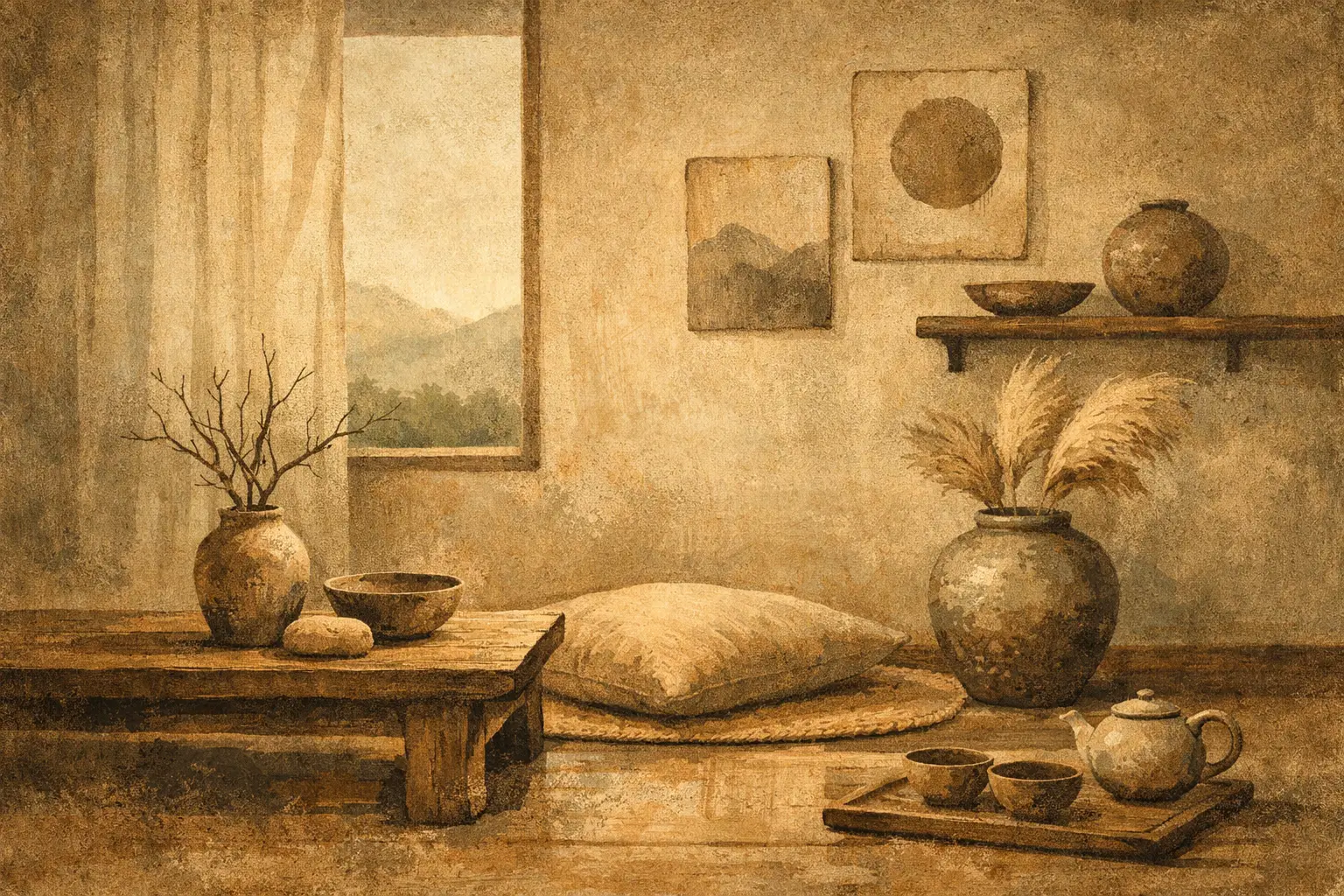
A room can be technically beautiful and still feel unsettled. The proportions may be right, the furniture expensive, the palette restrained, yet something remains too polished to be restful. Wabi sabi lifestyle art answers that tension with a different kind of presence – one rooted in irregularity, quiet texture, and the beauty of what feels lived rather than perfected.
For design-minded collectors and thoughtful homeowners, this is not simply an aesthetic category. It is a way of choosing art that softens a space without making it bland, and deepens a room without crowding it. Wabi-sabi asks for less performance and more honesty. In art, that honesty becomes visible through muted color, asymmetry, raw surfaces, negative space, and forms that suggest time, weather, and touch.
What wabi sabi lifestyle art really expresses
The phrase is often reduced to rustic minimalism, but that misses its emotional range. Wabi-sabi is not about making things look old, rough, or intentionally incomplete for effect. At its core, it reflects impermanence, modesty, and the quiet dignity of things that are not flawless. When translated into contemporary art, that philosophy can appear in many forms – abstract compositions with softened edges, gestural marks that resist control, weathered tonal fields, or digital works that carry the feeling of stone, paper, ash, linen, and earth.
What makes wabi sabi lifestyle art distinct is not only its visual restraint, but its attitude toward space. It does not demand constant attention. It creates atmosphere. A strong piece in this mode often slows the room down. It gives the eye a place to rest and the interior a sense of breath.
That quality is especially compelling now because many modern spaces are saturated with sharp finishes, bright screens, and visual speed. Wabi-sabi art offers a counterbalance. It introduces depth without noise.
Why it belongs in contemporary interiors
There is a reason this aesthetic resonates so deeply with architects, stylists, and private collectors. In well-designed interiors, the most memorable rooms are rarely the ones with the most decoration. They are the ones with the clearest feeling. Art plays a decisive role in that feeling.
Wabi sabi lifestyle art works beautifully in contemporary homes because it is versatile without becoming generic. In a minimal interior, it prevents sterility. In a warmer, layered home, it reinforces intimacy. In hospitality settings, it can make a space feel more grounded and contemplative, which is often harder to achieve than simple visual luxury.
There is also a practical advantage. Art in this sensibility tends to age well. It is less tied to trend cycles than louder graphic styles, and it can move with you from one home to another. A quiet abstract work in mineral tones can live above a low sofa today, then later find new life in a bedroom, entryway, or study. Its value is atmospheric as much as decorative.
The difference between calm and emptiness
One common mistake is assuming that a quiet artwork should disappear. It should not. Good wabi-sabi art carries tension within its restraint. It may use a reduced palette, but the surface, rhythm, or composition should hold your attention over time.
That distinction matters when sourcing art online. A piece can look neutral in a thumbnail and still feel emotionally flat in person. The strongest works reveal subtle movement, tonal complexity, and material sensitivity. They do not merely match the room. They change its mood.
How to choose wabi sabi lifestyle art for your space
Start with atmosphere, not color matching. Ask what the room needs more than what the wall needs. Does the space feel too cold, too formal, too busy, too resolved? Wabi-sabi art is often most successful when it answers an emotional imbalance.
In a living room with clean architectural lines, look for a piece that introduces softness through washed neutrals, organic forms, or layered textures. In a bedroom, quieter compositions with generous negative space can support a sense of retreat. For entryways and dining areas, works with stronger contrast or more visible gesture can create presence while still feeling composed.
Scale is equally important. This style benefits from breathing room. An undersized piece can feel timid, while an oversized work can become deeply immersive if the composition remains open and balanced. If you are choosing for a large wall, consider whether the artwork carries enough subtle variation to hold that amount of space. Silence at scale is powerful, but only when it is intentional.
Material presence matters
Wabi-sabi lives in surface as much as image. Even when a work is reproduced as a museum-quality Giclée print, the success of the piece depends on how faithfully tone, depth, and texture are conveyed. Flat production weakens this category quickly because the emotional language of the art often resides in nuance.
This is where curatorial trust matters. Buyers are not only purchasing an image. They are purchasing atmosphere, fidelity, and the confidence that the work will feel refined in person. Taygeta Gallery approaches this territory with unusual clarity, presenting Eastern-influenced contemporary works in formats that preserve their contemplative force while remaining accessible to private collectors and design professionals alike.
The visual language of wabi-sabi art
There is no single formula, but certain characteristics appear again and again. Earth tones, ash whites, soot black, clay, sand, stone, and muted green or rust create a grounded palette. Irregular linework suggests human presence without overt narration. Asymmetry introduces life. Empty space is treated not as absence, but as active composition.
Texture can be literal or implied. In original works, it may come through layered pigment, grain, scratching, or matte surfaces. In digital and print-based works, texture may be translated through subtle tonal shifts or forms that evoke plaster, fog, textile, erosion, or weather. The result should feel sensory, even when the medium is highly controlled.
This is one reason the style appeals to collectors who want contemporary art with soul. It does not rely on spectacle. It invites a slower reading.
Wabi sabi lifestyle art and the discipline of restraint
Restraint is often misunderstood as limitation. In reality, it is a form of precision. A room furnished with intention can be undone by artwork that is too literal, too glossy, or too eager to explain itself. Wabi-sabi art resists that urge. It leaves room for interpretation.
That does not mean every collector should choose the palest or quietest piece available. It depends on context. Some interiors need a whisper. Others need a grounding presence with darker weight, denser texture, or more dramatic contrast. The common thread is not softness alone, but integrity. The work should feel distilled rather than decorative.
For design professionals, this makes the category particularly useful. It can bridge materials within a room – stone, wood, linen, limewash, brushed metal – without becoming overly thematic. For homeowners, it offers something equally valuable: an art language that supports daily life instead of competing with it.
When this style may not be the right fit
Wabi-sabi art is not universal. If a space is built around high saturation, pop references, or sharply graphic energy, a contemplative abstract piece may feel disconnected. It can still work, but usually through contrast that is carefully considered rather than casually added.
It is also worth being honest about personal temperament. Some buyers want art to energize, provoke, or narrate. Others want it to steady the room. Neither instinct is better. The point is alignment. The right artwork should feel like an extension of how you want to live in the space.
Collecting art that changes with time
One of the quiet strengths of wabi sabi lifestyle art is that it tends to deepen with familiarity. Because it is not based on novelty, it does not reveal itself all at once. A work you first loved for its palette may later become meaningful for its rhythm, its stillness, or the way it shifts with morning and evening light.
That quality makes it particularly well suited to long-term collecting. The art does not exhaust itself quickly. It remains companionable. In interiors, that is not a minor virtue. We live with art differently than we encounter it in a gallery. Pieces that continue to open over time often become the ones we keep closest.
The best homes are not assembled as finished statements. They are shaped through attention, editing, and a willingness to leave some things unresolved. Wabi-sabi art belongs to that process. It reminds us that beauty does not need to be pristine to feel complete, and that a room can become more powerful when it allows a little quiet to remain.
Leave a Reply