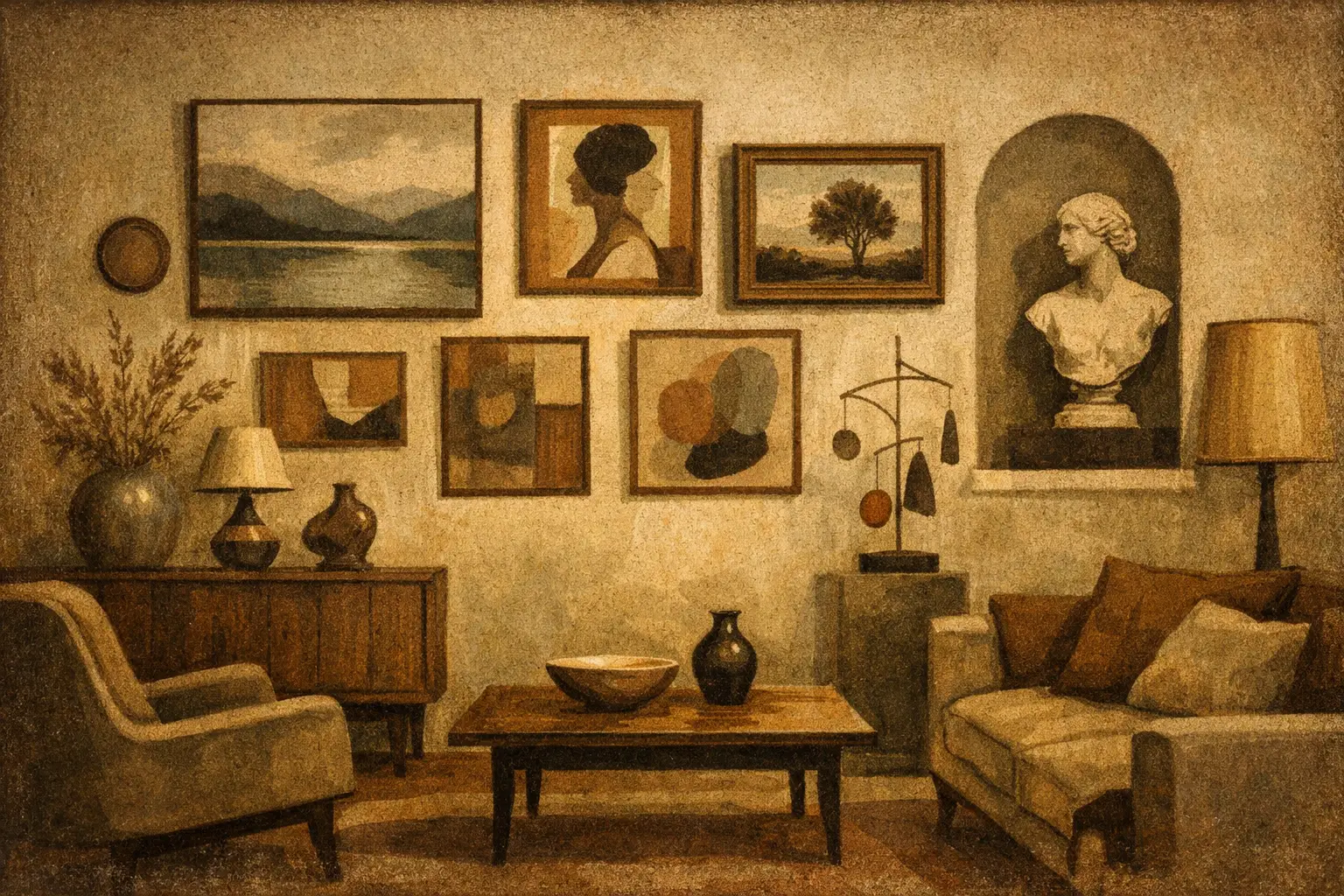
A work of art changes when it leaves the screen, the studio, or the shipping box and enters a room. Its colors begin speaking to daylight, its surface meets the grain of a floor, and its scale becomes physical. The most resonant art display ideas begin here: not with the question of what should fill an empty wall, but with the atmosphere you want a space to hold.
A considered display does not need to be formal or expensive. It needs attention. Whether you are placing one museum-quality print above a sofa, arranging a collection of originals in a hallway, or specifying work for a quiet hotel lobby, the aim is the same: let art feel intentional rather than merely installed.
Art display ideas that begin with stillness
Before choosing frames or measuring wall space, pause with the room. Notice its strongest line, its source of natural light, and the places where the eye already comes to rest. An artwork can create a focal point, but it can also soften one. The best choice depends on whether the room asks for energy, contemplation, or a little visual distance.
1. Let one substantial work carry the room
A single large artwork can bring a sense of calm that a crowded wall cannot. Above a low sofa, bed, or sideboard, choose a piece that occupies meaningful visual territory without extending wider than the furniture beneath it. As a general guide, art spanning roughly two-thirds to three-quarters of the furniture width often feels balanced.
This approach is especially effective with abstract work, where gesture, texture, and negative space can set the emotional temperature of an entire room. Give the piece room around its edges. Empty wall is not an absence of decoration. It is part of the composition.
2. Build a salon wall with a unifying thread
A salon-style arrangement can feel collected over time, even when assembled at once. The key is not perfect symmetry but a shared logic. That logic may be a restrained color palette, black frames, warm oak, a repeated paper tone, or a common subject such as figures, landscapes, and architectural forms.
Lay the arrangement on the floor first and find its center before hanging anything. Keep the gaps between works consistent, usually two to three inches, so the wall reads as one gesture. Varied sizes add life, but too many competing frame finishes can turn a personal collection into visual noise.
3. Create a quiet axis above a console
A console table offers a natural place for an artwork that feels almost ceremonial. Center one vertical piece above it, then allow a sculptural lamp, vessel, or branch to sit slightly off-center below. This small asymmetry prevents the arrangement from becoming stiff.
For interiors shaped by Wabi-Sabi sensibility, look for work with weathered color, imperfect geometry, or a spacious composition. Pair it with tactile materials: limestone, aged wood, handmade ceramic, linen. The dialogue between surface and object matters as much as the image itself.
4. Lean framed art where permanence is not the point
Leaning artwork is often treated as a casual choice, but it can be deeply composed. A large framed piece resting on a credenza, mantel, or floor can create an intimate, studio-like mood. It also makes room for change, which is useful when a collection is still finding its shape.
Use this method thoughtfully. A frame should be stable, protected from foot traffic, and never placed where a child or pet could knock it over. Layering two pieces works well when the front work is smaller and distinct enough not to obscure the larger image behind it.
5. Treat the hallway as a slow encounter
Hallways are ideal for art because they offer repeated, close-range viewing. Rather than filling every available section, create a deliberate rhythm with evenly spaced works. A linear series of small prints can feel like a visual poem, especially when each piece carries a related color or motif.
Hang the center of each work near eye level, typically around 57 to 60 inches from the floor. In a narrow passage, slim frames and works on paper often feel more generous than heavy, projecting forms. They preserve movement through the space.
6. Use a diptych to shape a wider wall
When a wall is broad but a single oversized work feels too declarative, a diptych offers proportion with breath. Two related artworks, hung with a narrow and consistent gap, create a measured interval that is almost architectural.
The pairing need not be identical. One panel may hold density while the other offers quiet. This tension can be especially compelling in contemporary abstract art, where the space between images becomes part of the work. Keep the two frames identical so the relationship remains clear.
7. Place art where people pause, not only where they pass
The space above a sofa is familiar, but a reading chair, breakfast nook, or landing may offer a more personal setting for a meaningful piece. Art rewards lingering. A work with subtle detail, soft tonal shifts, or layered symbolism often belongs near a place where someone can return to it slowly.
In these smaller zones, modest scale can be more powerful than an oversized statement. One framed print beside a chair can create a private world within a larger room.
8. Make the bedroom less literal
Bedrooms benefit from images that do not ask to be solved immediately. Avoid treating the wall above the bed as a place for decorative filler. Instead, choose work that changes your pace: a muted abstraction, an open horizon, a surreal composition, or a piece whose color feels like an extension of evening light.
If you hang art above a headboard, secure it carefully and leave a clear visual gap between frame and furniture. A horizontal piece can echo the width of the bed, while two smaller works can introduce balance without the weight of one large object.
9. Let a shelf become a changing exhibition
Picture ledges and deep shelves offer a flexible alternative to traditional hanging. Mix framed work with a small edition, art book, ceramic form, or found object, but edit with restraint. The shelf should feel like an exhibition, not a storage surface.
Vary the heights and leave occasional intervals of open space. If everything overlaps, the individual works lose their presence. This is a particularly useful display for renters or collectors who enjoy rotating pieces with the seasons.
10. Use color as an echo, not a match
A common mistake is selecting art that repeats every color already in the room. A more refined approach is to let a work echo one subtle note: the rust in a textile, the blue-gray of a shadow, the cream of plaster walls. The rest of the palette may introduce a needed surprise.
Art with a contrasting color field can awaken an otherwise neutral interior. The contrast should feel emotionally appropriate, not simply loud. A saturated red may animate a spare dining room; a pale, misted composition may bring relief to a space rich in dark wood.
11. Frame for the work, not for the trend
Frames are visual thresholds. A thin black frame can give a digital or photographic work crisp definition, while natural wood may add warmth to an image with cooler tones. Float mounting can honor the deckled edge of fine art paper, allowing its material character to remain visible.
There is no universal right choice. A minimal frame may suit a highly expressive artwork, while an ornate frame can create an intriguing contrast around a restrained contemporary piece. What matters is that the frame supports the work rather than competing for attention.
12. Light the surface with care
Good lighting reveals an artwork’s depth, but poorly placed light can flatten it with glare. Position adjustable picture lights or ceiling fixtures so illumination reaches the piece at an angle, rather than reflecting directly toward the viewer. Warm light usually feels most natural in residential interiors.
Protect works on paper and photographs from prolonged direct sun, even when they are produced with archival materials. Light is part of the display, but it is also a condition to manage. In hospitality and commercial projects, lighting should be considered early, alongside sightlines and wall finishes, rather than added as an afterthought.
A display can evolve with your collection
There is no need to resolve every wall at once. Leaving a space open for a future work can be an act of discernment, not indecision. As your eye becomes more certain, the relationship between pieces becomes more interesting: a limited edition beside a vintage object, a quiet print near an original painting, an unexpected surreal image within an otherwise restrained room.
Taygeta Gallery approaches art not as a final layer of decoration, but as a presence that gives a room its inner life. Choose slowly, hang with care, and allow the work to meet you differently as the light moves through the day.
Leave a Reply