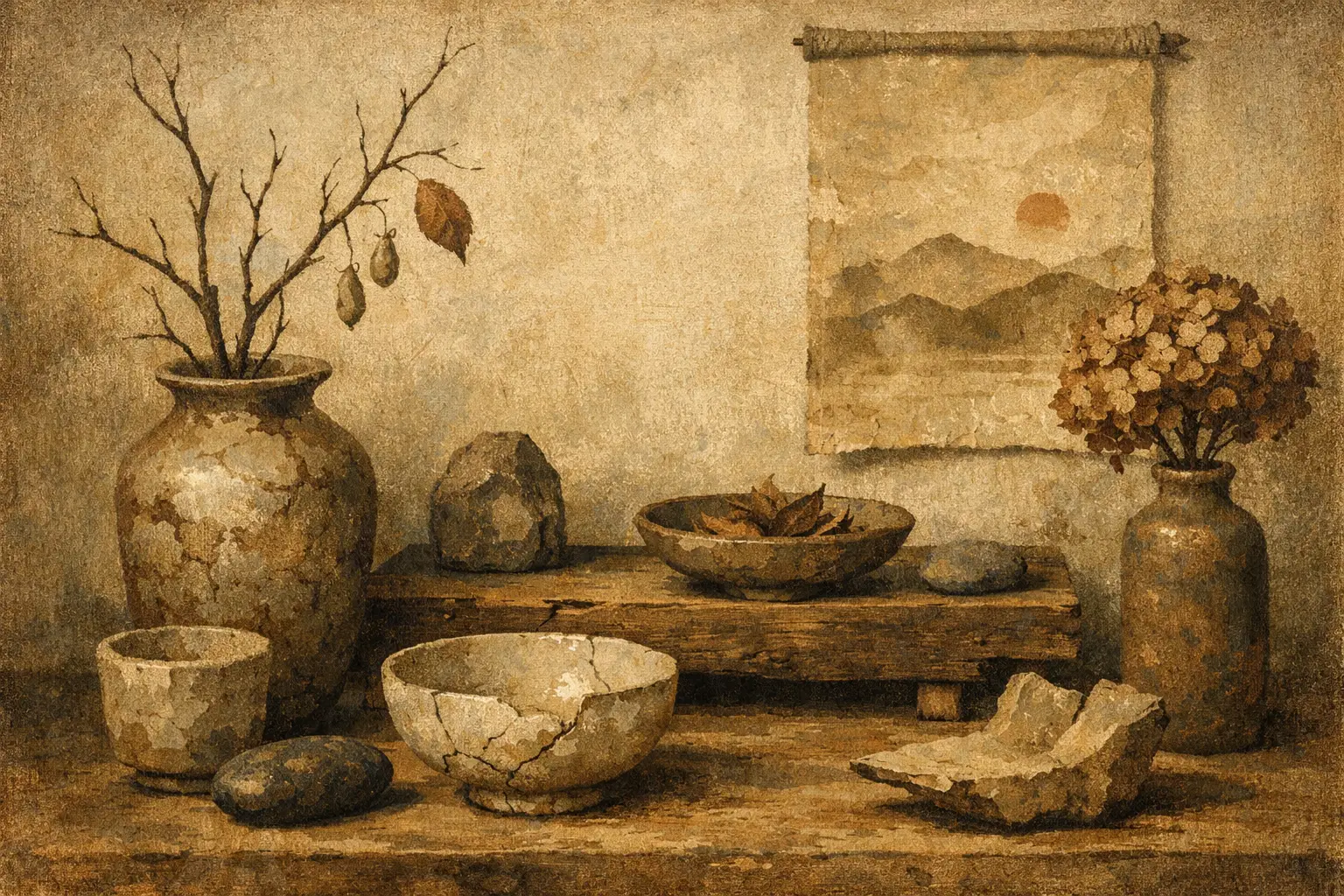
A weathered ceramic vessel, a field of softened charcoal, a composition that leaves room for silence: these works ask for a slower kind of looking. What is wabi sabi art? It is art shaped by an aesthetic that finds beauty not in flawless finish or permanent certainty, but in impermanence, irregularity, restraint, and the quiet evidence of time.
For collectors and design-minded homeowners, wabi-sabi art offers something increasingly rare: visual stillness without emptiness. It can bring depth to a pared-back interior, but it is not simply a decorating style for beige rooms. At its best, it is a way of seeing – one that allows a mark, a shadow, a fracture, or an unfinished edge to carry feeling.
What Is Wabi Sabi Art?
Wabi-sabi art is work that expresses, or is viewed through, the Japanese aesthetic of wabi-sabi. The phrase joins two ideas whose meanings have shifted over centuries. Wabi once suggested the solitude and austerity of life apart from society; sabi referred to the patina, loneliness, and beauty that arrive with age. Together, they came to describe an appreciation for modesty, natural materials, asymmetry, and transience.
This sensibility is closely associated with the Japanese tea tradition, where an irregular hand-formed bowl could be more moving than a perfectly symmetrical one. Its uneven rim, subdued glaze, and signs of use were not defects to disguise. They made the object particular. They revealed the hand, the material, and the passage of time.
In art, wabi-sabi is less a fixed visual category than an orientation. A painting, photograph, sculpture, or digital work may feel wabi-sabi when it resists excess, honors material character, and leaves space for ambiguity. It may show erosion, weather, organic forms, faded pigment, sparse gesture, or imperfect geometry. Yet none of these features alone makes a work wabi-sabi. The emotional register matters: humility rather than spectacle, presence rather than polish.
The Difference Between Wabi-Sabi and Rustic Style
Wabi-sabi is often reduced to distressed wood, cracked pottery, and deliberately aged surfaces. Those objects can be part of the language, but the philosophy is more demanding than an aesthetic of wear. A factory-made object with artificial cracks may resemble wabi-sabi visually while missing its central quality: an honest relationship to material, making, and time.
Likewise, wabi-sabi is not synonymous with minimalism. Minimalism may pursue reduction, precision, and immaculate control. Wabi-sabi can be spare, but it makes room for the uneven, the tender, and the unresolved. A nearly blank abstract artwork with a single wavering line may feel more aligned with wabi-sabi than a highly polished monochrome surface, depending on how it holds attention.
There is also a useful distinction between wabi-sabi and repair as decoration. Kintsugi, the Japanese practice of repairing broken ceramics with lacquer and metal powder, is often used as shorthand for celebrating imperfection. Its deeper meaning is not that every break should be made conspicuous. It is that repair can become part of an object’s continuing life. In art, this may translate into layered revisions, visible joins, altered surfaces, or imagery that acknowledges fragility without turning it into a slogan.
How Wabi-Sabi Appears in Contemporary Art
Contemporary artists work with wabi-sabi principles in ways that extend far beyond traditional Japanese forms. Some use earth pigments, mineral tones, raw canvas, ink washes, or handmade paper. Others build atmospheric abstractions from blurred edges, accumulated marks, and open fields of color. In digital art, the same sensibility can emerge through restrained palettes, grain, atmospheric texture, imperfect repetition, and compositions that do not explain themselves all at once.
Look for works where the process remains perceptible. A dry brush that skips across paper, a scraped layer beneath a painted surface, an off-center form, or a muted shift between gray, clay, stone, and smoke can make the act of making feel present. The artwork does not need to look old. It needs to feel alive to contingency.
This is why wabi-sabi art often rewards time. A decorative image may deliver its effect immediately and then recede. A more contemplative work can change with the light, the season, and the viewer’s own state of mind. Its apparent simplicity becomes a vessel for attention.
Imperfection Is Not Carelessness
The most persuasive wabi-sabi work is rarely accidental. A seemingly effortless composition may be the result of disciplined editing, technical knowledge, and a sensitive understanding of balance. Imperfection here is not an excuse for weak craftsmanship. It is the refusal to erase every trace of risk and human presence.
That distinction matters when buying art. Ask whether an irregularity creates tension, warmth, or rhythm. Does a faded area deepen the image? Does an asymmetrical composition feel settled rather than arbitrary? A work can be rough and still be precise in its intention.
Why Wabi-Sabi Art Changes a Room
Art affects a room not only through color and scale, but through pace. Wabi-sabi art can lower the visual volume of a space while giving it greater emotional texture. In a home with clean-lined furniture and hard architectural surfaces, a tactile, weathered, or softly abstract work introduces relief. It keeps restraint from becoming sterility.
It also offers a counterpoint to interiors built around instant perfection. A hand-like mark or imperfect form can make a carefully designed room feel inhabited rather than staged. For hospitality settings, it can create a quieter kind of luxury: one grounded in material sensitivity and atmosphere rather than ornament.
That said, the approach depends on context. A dramatic, high-contrast room may benefit from a wabi-sabi piece that is darker or more gestural, rather than pale and quiet. In a small apartment, one well-scaled work with tonal depth can feel more expansive than a gallery wall of competing images. The goal is not to make every surface subdued. It is to create a considered pause.
Choosing a Wabi-Sabi Artwork for Your Space
Begin with the feeling you want the room to hold. If you want calm, consider expansive compositions with soft mineral colors, open space, or slow transitions in tone. If you want warmth, seek earthy umber, rust, sand, moss, or faded rose, especially in work with visible texture. If the room already feels quiet, a more assertive gestural piece may add necessary energy without breaking the mood.
Scale is essential. Large wabi-sabi art can act like an architectural surface, especially above a sofa, bed, dining console, or reception area. Its restraint gives the eye room to rest. Smaller works create intimacy and are especially effective in entryways, reading corners, and beside shelves where viewers can approach them closely.
Framing should support the work rather than over-explain it. Natural oak, walnut, dark wood, black, or warm white frames can each be appropriate, depending on the image and surrounding materials. A museum-quality Giclée print can preserve fine tonal shifts and subtle texture beautifully, but the source image and production matter. Look for clarity in the print process, edition information when relevant, and a presentation that feels deliberate.
Avoid buying a work merely because it contains cracks, circles, neutral colors, or a Japanese-sounding label. Cultural sensitivity begins with attention. Wabi-sabi is not a visual costume to apply to any object. Choose art that feels genuinely measured, materially aware, and emotionally resonant to you.
Living With an Art of Transience
Wabi-sabi does not ask you to romanticize deterioration or abandon discernment. It asks for a more generous standard of beauty. A work may be modest in gesture yet profound in atmosphere; it may leave questions unanswered; it may become more meaningful because it does not demand to be admired all at once.
In a home, the right piece can become a quiet companion. Let it sit with changing daylight, the shadows of plants, the movement of people through the room. The longer you live with art that honors impermanence, the more it may teach you to notice what perfection tends to conceal: texture, change, and the grace of things becoming.
Leave a Reply