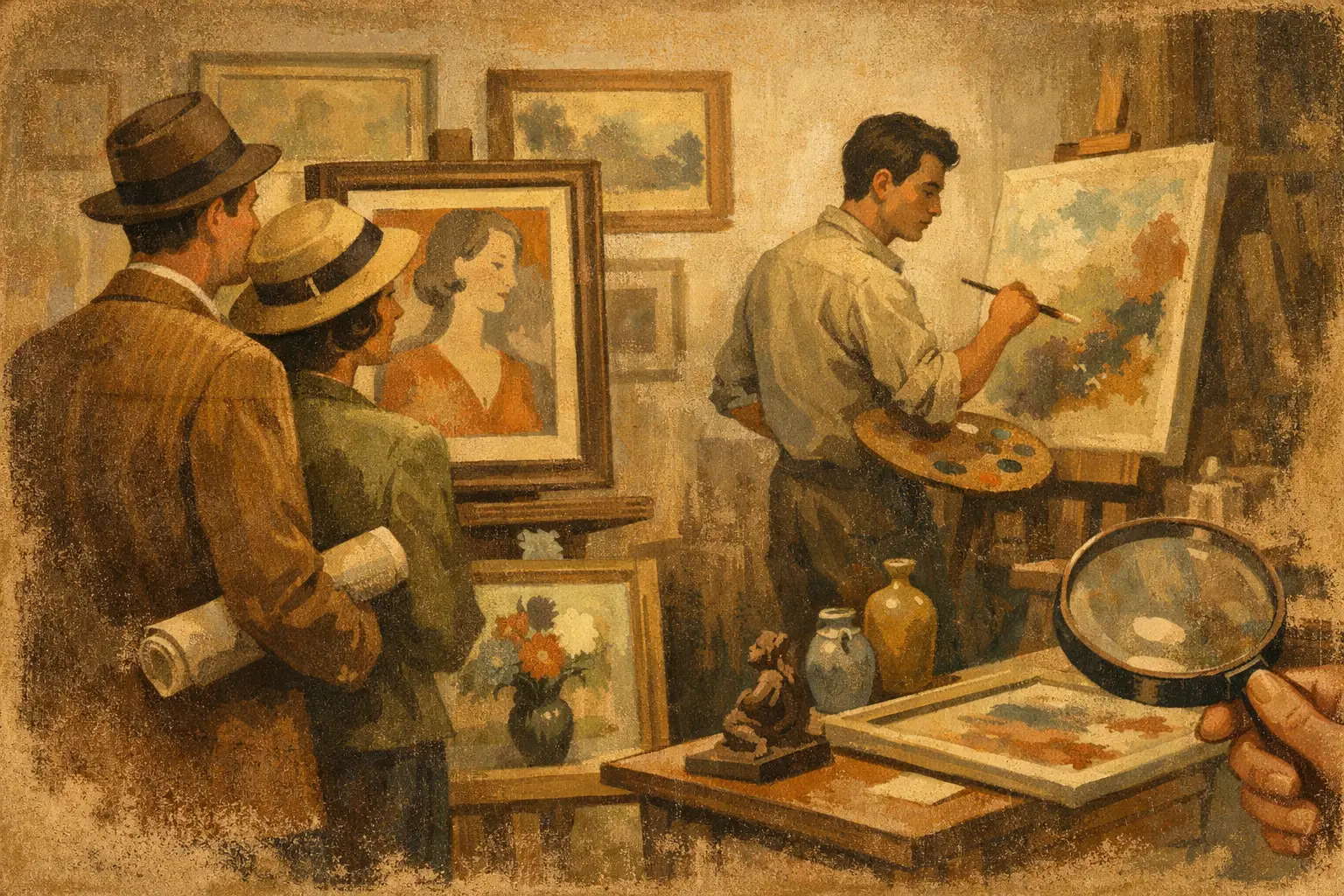
A first artwork rarely begins with a market chart. More often, it begins with a pause: a color that changes the temperature of a room, a strange silhouette that stays in the mind, or a quiet surface that makes the rest of the day recede. This emerging artist collector guide is for learning how to honor that instinct while making choices with clarity.
Collecting work by an emerging artist is not a shortcut to future value, nor should it be treated as a gamble disguised as culture. It is an opportunity to live alongside an artist’s developing language – to recognize attention, rigor, and emotional force before they become widely familiar. The most satisfying collections are built not through urgency, but through looking closely and returning to what continues to matter.
Begin With the Work, Not the Prediction
The question most new collectors ask is whether an artist’s work will increase in value. It is understandable, but it can narrow the experience too soon. No one can guarantee a future market, and a purchase made only for possible resale can leave little room for the work itself to reveal its depth.
A better first question is more personal: would you still want to live with this piece if its financial value never changed? Consider what holds your attention after the first impression. It may be the restraint of the composition, the tension between gesture and stillness, or the artist’s ability to make an ordinary subject feel newly present.
This does not mean ignoring professional signals. Exhibition history, thoughtful curatorial context, a coherent body of work, and careful production all offer useful evidence of commitment. But they should support your response, not replace it. Art collecting has an interior dimension. The work should feel persuasive before it feels strategic.
Learn to Read an Emerging Artist’s Practice
An emerging artist is not simply someone early in their career or priced below an established name. The term can describe an artist whose practice is gaining definition, visibility, or institutional attention. Some may be recent graduates; others may have worked quietly for many years before reaching a larger audience.
Look beyond a single image. A strong practice usually reveals continuity across several works, even when the artist experiments with subject matter or medium. You might notice a recurring concern with memory, architecture, landscape, fragmentation, material, or the human figure. The visual vocabulary can evolve, but the underlying questions tend to remain recognizable.
Read the artist statement with a little skepticism and a lot of openness. Grand language is not a substitute for substance, yet concise words can illuminate decisions that are not immediately visible. Ask whether the ideas expressed in the text are actually present in the work. Does the artist’s stated interest in impermanence appear in their faded layers, broken forms, or shifting light? Does an interest in place become visible through texture, scale, or palette?
It is also worth noticing whether the work feels derivative. Influence is natural and often necessary. The distinction lies in whether an artist uses influence as a doorway to their own perspective, rather than as a finished answer.
Emerging Artist Collector Guide: Choose the Right Format
The format of an artwork shapes both its presence in a room and the nature of your ownership. An original painting, drawing, collage, or sculpture carries the direct trace of the artist’s hand. It may have a singular material character that cannot be repeated: a raised pigment edge, a revision beneath the surface, a delicate variation in paper or glaze.
Limited-edition prints offer a different, often more accessible path into collecting. A museum-quality Giclée print can preserve fine color transitions and intricate detail with remarkable fidelity, particularly when it is produced on archival paper and accompanied by clear edition information. The value is not in pretending that a print is an original. It lies in owning an authorized work in a defined format, with a considered relationship to the artist’s image.
Before purchasing an edition, ask about the edition size, whether it is signed or numbered, the printing process, paper type, and whether artist proofs exist. A smaller edition is not automatically better, but transparency matters. Open editions can be ideal for decorative flexibility and budget, while limited editions offer a more bounded collector format.
Scale deserves equal attention. A small work can create intimacy over a bedside table or within a layered salon wall. A larger work may become the visual center of a living room, lobby, or dining space. Rather than choosing according to a wall’s empty dimensions alone, consider the work’s emotional weight. A quiet monochrome composition often needs surrounding space. A dense, energetic image may thrive where it can animate a restrained interior.
Ask Questions That Build Confidence
Buying art online requires trust, but confidence does not have to depend on blind faith. A well-presented work should come with enough information for you to understand what you are acquiring. Confirm the medium, dimensions, year, edition details where relevant, and the condition of the piece. For originals, ask whether the work is signed and whether a certificate of authenticity is included.
Provenance simply means an artwork’s ownership history. For a newly released work, that history may be brief, but documentation still matters. A receipt, certificate, and accurate description form the beginning of the artwork’s record. Keep these materials together, along with any correspondence about framing, condition, or shipping.
If an image is shown in an interior, remember that styling can alter your sense of scale. Measure with painter’s tape on the wall, then stand back at different times of day. Notice nearby wood tones, textiles, and light sources. Art does not need to match a room, but it should enter into a meaningful conversation with it.
For design projects, the practical questions become more layered. Lead times, framing consistency, edition availability, and shipping coordination may matter as much as visual selection. A series of related works can bring rhythm to a hospitality space, while a single large-format piece may establish calm in a reception area. The appropriate choice depends on how people will move through the space and how long they will spend with the work.
Set a Budget With Room for Curiosity
A budget is not a limit on taste. It is a way of collecting with freedom from regret. Decide on a comfortable range before you begin, then leave a little room for framing, taxes, shipping, and conservation-quality materials. A modest work thoughtfully framed can possess more presence than a larger piece presented carelessly.
Avoid assuming that the lowest price is the wisest entry point. If a work feels generic, it may become visual noise quickly. At the same time, there is no virtue in stretching beyond your means for a name or a perceived opportunity. Emerging art rewards patience. Artists develop, editions sell through, and other works will appear.
You can also build a collection gradually across formats. An original work on paper might sit beside a limited edition, a small sculpture, or a framed digital artwork. What unites them need not be medium or price. It may be a shared sense of atmosphere: luminous restraint, surreal interruption, earthy imperfection, or an insistence on peace.
Care for the Relationship After the Purchase
Once the work arrives, give it time before deciding whether it belongs in its first location. Light changes art. So does proximity. A piece that seems reserved in the morning may become magnetic in evening shadow. Move it if needed, but resist the impulse to judge too quickly.
Protect originals and prints from direct sunlight, high humidity, and unstable temperature. Use archival framing materials when framing on paper, and retain all documentation in a dry, organized place. These are practical habits, but they also express respect for the artist’s labor and for the object that has entered your life.
The deepest pleasure of collecting emerging artists is not the feeling of having found something before everyone else. It is the quieter experience of becoming more perceptive – of recognizing a visual voice as it grows, and allowing that voice to shape the atmosphere of your own rooms.
Leave a Reply