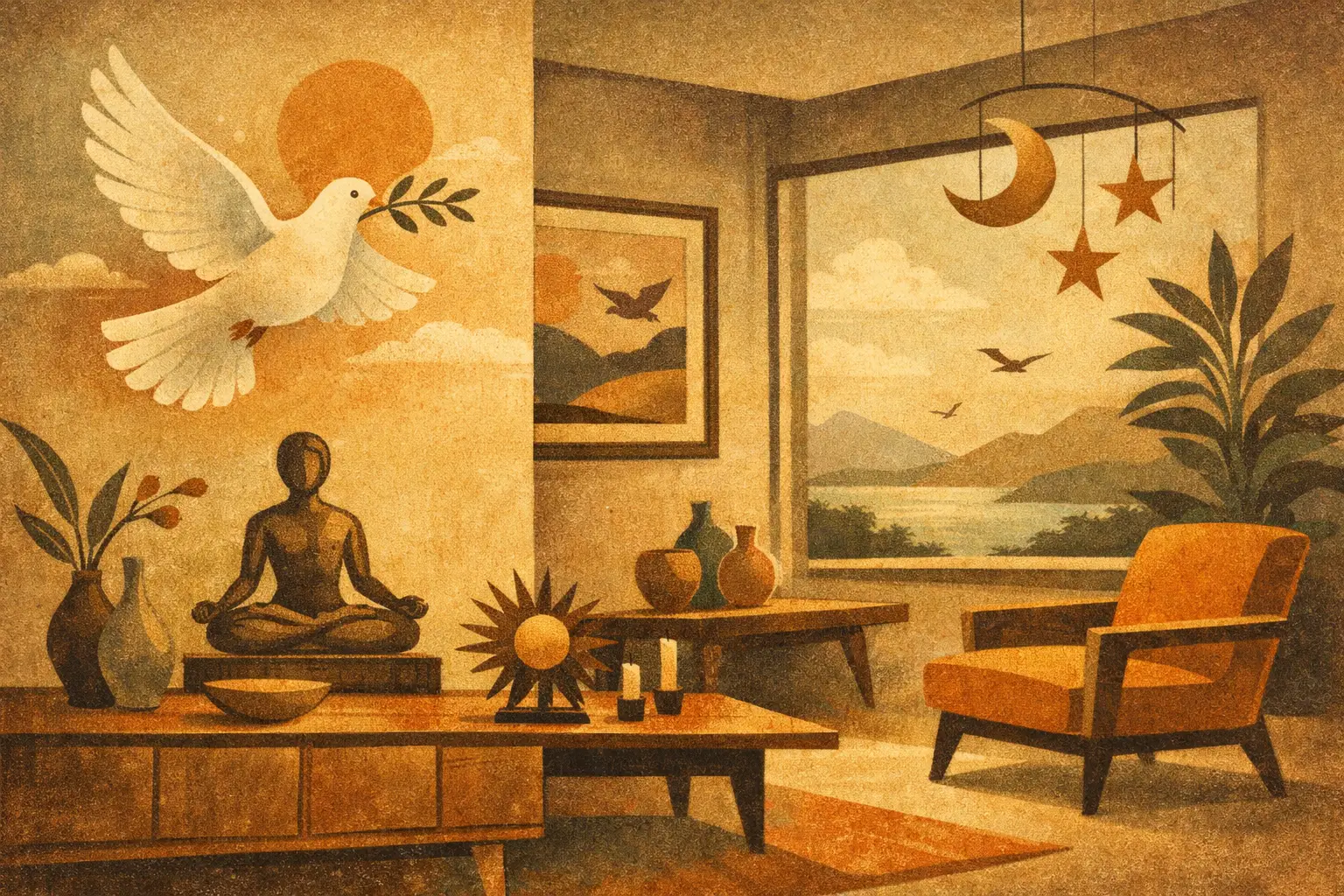
A room can be visually perfect and still feel restless. The furniture may be resolved, the palette restrained, the lighting soft, yet something remains unsettled. Peace and freedom art answers that tension with a different kind of presence – not louder, not busier, but more spacious. It gives a wall emotional gravity, and in doing so, changes how a space is lived in.
For design-conscious buyers, this category is not simply about serene imagery or symbolic gestures. It is about selecting work that holds a deeper equilibrium: calm without passivity, openness without emptiness, beauty without excess. In contemporary interiors, that balance matters. Art is often the element that decides whether a room feels styled or truly inhabited.
What peace and freedom art really expresses
Peace and freedom art is often misunderstood as purely gentle or decorative. In stronger work, peace is not the absence of conflict. It is composure earned through tension, reduction, and release. Freedom is not visual chaos or total spontaneity. It is space – psychic, spiritual, and formal space – where thought can move and feeling can settle.
That is why this theme appears across very different visual languages. In abstraction, peace may emerge through soft intervals, generous negative space, or a restrained color field that lets the eye rest. Freedom may appear in the looseness of a brushstroke, an asymmetrical composition, or a gesture that resists over-control. In figurative work, the same themes can live in an open horizon, a solitary body in motion, a bird form, a rising line, or a face held in quiet self-possession.
The most compelling works do not explain themselves too quickly. They leave room for interpretation. That openness is part of their emotional intelligence. A collector may read liberation in an untethered form, while a designer may respond to the same piece for its visual lightness and atmospheric calm. Both readings are valid.
Why this theme resonates in contemporary spaces
Modern interiors often pursue clarity – fewer objects, cleaner silhouettes, more intentional materials. Yet minimalism can become cold when every element is solved only at the level of style. Peace and freedom art introduces a human counterpoint. It softens strictness, adds emotional texture, and restores a sense of inwardness.
This is especially true in homes where people want more than visual polish. A bedroom asks for exhale, not performance. A living room benefits from artwork that invites lingering rather than constant stimulation. In a home office, a piece grounded in stillness can act almost like architecture for attention, shaping the mental atmosphere of the day.
In hospitality and commercial settings, the effect is equally relevant but slightly different. A hotel suite, wellness studio, or private office often needs art that feels sophisticated without becoming demanding. Themes of peace and freedom communicate refinement and ease. They create emotional access. Guests and clients may not name the philosophy behind the work, but they feel its pacing.
There is also a cultural reason this category continues to matter. Many buyers are moving away from art that functions only as trend or backdrop. They want work that reflects a value system: presence, openness, simplicity, dignity. Peace and freedom are not abstract ideals in that context. They become lived qualities, expressed through visual form.
Peace and freedom art in a curated interior
Art built around peace and freedom works best when the surrounding interior allows it to breathe. That does not mean every room must become austere. It means the composition of the space should respect the artwork’s rhythm.
In rooms with natural wood, stone, linen, plaster, or matte finishes, this art often feels especially at home. The shared language is one of restraint and material honesty. Soft neutrals, earth tones, mineral blues, charcoal, faded black, and muted whites tend to support the theme without flattening it. If the piece includes stronger color, the surrounding palette can remain calm so the artwork carries the emotional charge.
Scale matters as much as palette. A small work with delicate presence can be exquisite in an intimate reading corner or quiet entryway, but it may disappear over a large sofa or expansive bed. Conversely, an oversized piece centered on peace and freedom can transform a room precisely because it resists noise at scale. Large, quiet art has a particular authority. It does not compete. It steadies.
Framing also shapes interpretation. A museum-quality print with a clean frame can feel architectural and contemporary. A float-mounted or minimally framed work may emphasize air and openness. Heavier framing can add formality, though sometimes at the cost of immediacy. It depends on the room, the artwork, and whether the goal is contemplative softness or collector-level structure.
How to recognize quality in this genre
Because peace and freedom are popular themes, the market is crowded with work that looks agreeable but feels generic. The difference usually appears in nuance.
Strong pieces have intentional composition. Even when they feel effortless, there is control beneath the quiet. Color relationships are resolved, not arbitrary. Space is used with confidence. Symbolism, if present, supports the work rather than dominating it. A bird, branch, horizon, or abstract field should not function as a shortcut for meaning.
Texture is another marker. In original works, surface variation can hold the eye and deepen the sense of stillness. In museum-quality Giclée prints and framed digital works, production becomes essential. Fine tonal transitions, subtle layers, and delicate contrasts need accurate reproduction or the emotional depth collapses into flat decoration. Buyers who care about atmosphere should care just as much about print fidelity, paper quality, and framing finish.
Editioning can matter too. Limited or curated collector formats often give a work greater presence, not only because of scarcity but because the piece has been treated as art rather than wall filler. That distinction is felt.
Choosing peace and freedom art for your space
The right piece depends on what kind of quiet you are seeking. Some collectors want stillness that is meditative and almost monastic. Others want a feeling of release – movement, sky, breath, the suggestion of something opening. Both belong to the same theme, but they create different rooms.
Start with the emotional function of the artwork before considering style labels. Ask what the room needs more of. If the space already contains strong lines and sculptural furniture, a softer abstract composition may provide balance. If the room is very muted, a more dynamic expression of freedom can keep serenity from becoming bland.
Consider viewing distance. In a hallway or transitional space, simpler compositions often read best because they must communicate quickly. In a sitting room or bedroom, more layered work can unfold slowly over time. This is one of the pleasures of living with art that is contemplative rather than merely decorative – it continues to reveal itself.
It also helps to resist overmatching. Art does not need to repeat the exact tones of a rug or upholstery to belong in the room. In fact, a little tension can be desirable. A charcoal gesture in an otherwise pale space, or a washed indigo field against warm plaster, can create a more memorable interior than perfect coordination.
For buyers sourcing online, confidence often comes down to curation and production standards. A gallery with a clear aesthetic point of view offers more than inventory. It offers context, which is especially valuable when selecting pieces meant to hold emotional meaning as well as visual weight. That is part of why thoughtfully curated collections, including those at Taygeta Gallery, resonate with buyers who want art to feel intentional from first viewing to final placement.
The lasting appeal of peace and freedom art
Some art is built for impact in a single glance. Peace and freedom art tends to work differently. It stays. It becomes part of the room’s emotional architecture, shaping light, pacing, and perception over weeks and years.
Its lasting appeal comes from this quiet endurance. The best pieces do not depend on novelty. They remain relevant because the needs they answer are not temporary. People continue to want spaces that restore rather than deplete them. They continue to seek objects that reflect discernment without hardness, beauty without spectacle, meaning without insistence.
That is why this category belongs not only in minimalist homes or contemplative interiors, but anywhere a room is meant to hold life with more grace. A well-chosen work can suggest calm in a city apartment, dignity in a professional setting, or spaciousness in a house filled with family movement and daily noise.
When you choose peace and freedom art, you are not only filling a wall. You are deciding what kind of atmosphere deserves a permanent place in the room.
Leave a Reply