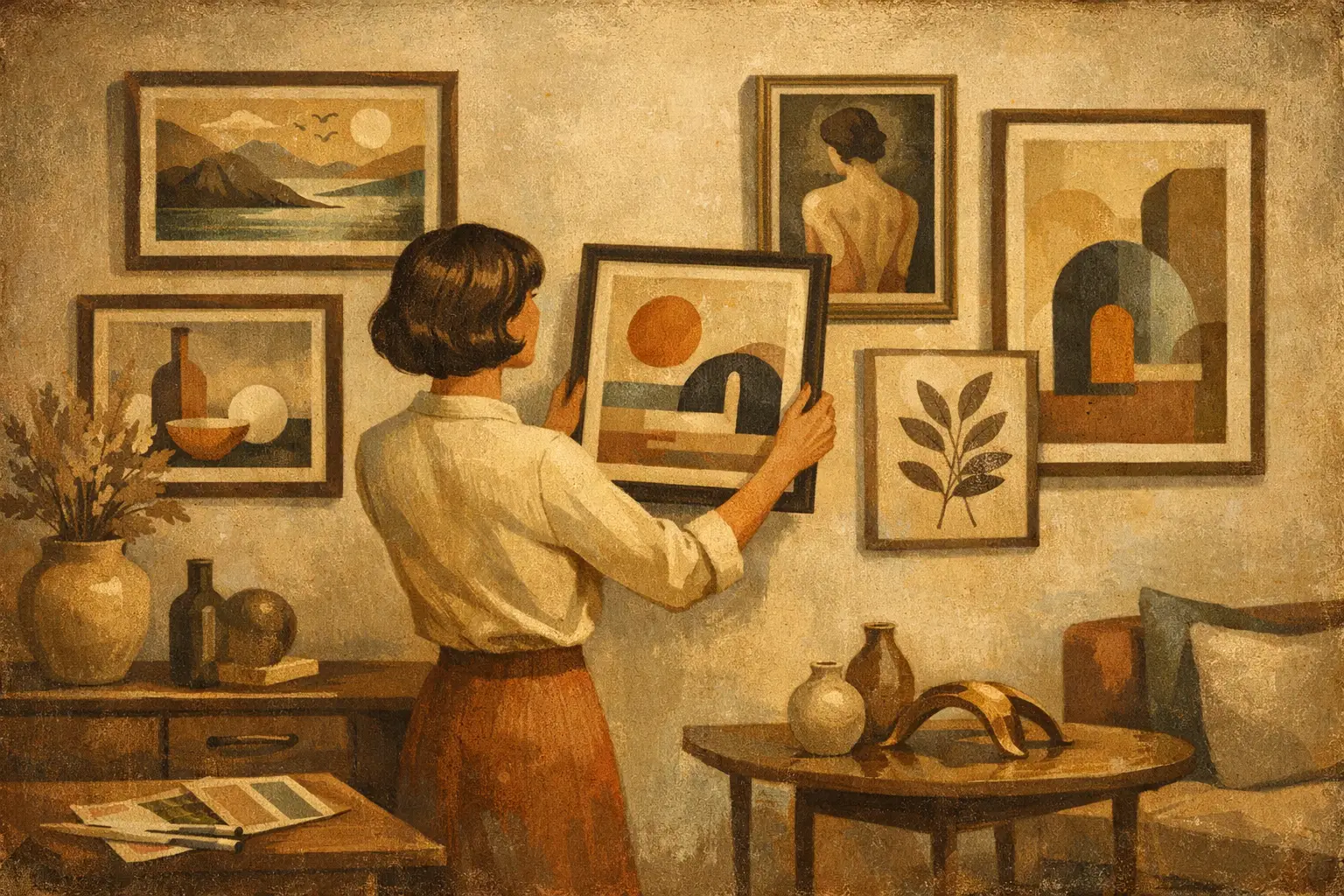
A room can be fully furnished, carefully lit, and materially resolved – and still feel unfinished. Often, the missing element is not another object but a visual presence that gives the space an inner life. That is why art for interior designers is never a decorative afterthought. It is one of the clearest ways to establish mood, pacing, and emotional depth.
Designers know this instinctively. The challenge is not whether to use art, but how to choose work that feels integral rather than applied. The best interiors do not treat art as filler for empty walls. They let it guide the atmosphere of a room, sometimes quietly, sometimes with force, but always with intention.
Why art for interior designers matters so much
Art changes the reading of space faster than almost any other element. A restrained abstract can make a minimal room feel contemplative instead of cold. A textured print can soften architecture that is technically beautiful but emotionally distant. A single unexpected piece can introduce tension into a polished scheme and keep it from becoming predictable.
This is especially true in contemporary interiors, where palettes are often edited and furnishings are selected for line, texture, and proportion. In those spaces, artwork carries unusual weight. It may be the only element that introduces ambiguity, narrative, or emotional contrast.
That does not mean every room needs a statement piece. Sometimes the most successful art is modest in scale and quiet in tone. What matters is that it creates relationship – with the materials in the room, with the light, and with the life of the people who will inhabit the space.
Good art placement starts long before installation
Many art mistakes happen before a piece is ever framed. A designer may wait until the project is nearly complete, then search for work that matches the sofa or echoes a paint color. That approach can produce something coordinated, but coordination is not the same as resonance.
A stronger method is to think about art while the room is still taking shape. At that stage, the questions are more useful. What should this room feel like at 8 a.m.? What kind of silence should it hold at night? Should it invite reflection, conversation, appetite, drama, rest? Once those answers become clear, the selection process gains direction.
Art does not need to match a scheme to belong within it. In many cases, a piece becomes more compelling when it introduces a slightly different rhythm. A warm neutral interior may benefit from something cooler and more spacious. A sharply modern setting may need work with evidence of hand, grain, or imperfection. This is where Wabi-Sabi thinking becomes so relevant to design. A room often feels more complete when one element resists over-resolution.
How to choose art for interior designers without making it feel staged
The most persuasive spaces balance discipline with surprise. Art plays a central role in that balance because it can either deepen a room’s character or flatten it into a concept. When every piece is too literal, the interior starts to feel styled for approval rather than lived with.
The better approach is to select work that expands the room’s emotional register. In a serene bedroom, that may mean abstract art with subtle tension beneath a calm surface. In a hospitality setting, it may mean a series that creates continuity without becoming repetitive. In a residential living area, it may mean one work that anchors the room and smaller pieces that create intervals of discovery.
Scale matters, but not in a simplistic bigger-is-better way. Oversized work can be transformative when architecture supports it, but smaller pieces can create intimacy that a large canvas cannot. It depends on ceiling height, sightlines, furniture placement, and how slowly the viewer will encounter the room. Art seen from a hallway needs a different presence than art encountered at arm’s length beside a reading chair.
Medium matters too. Original works carry a particular charge, especially in spaces where clients want singularity and collector value. Museum-quality Giclée prints and framed digital editions, however, can be equally powerful when the image selection is strong and production standards are exacting. For many projects, the question is not original versus print in absolute terms. It is where originality is most needed, where editioned work is more practical, and how quality can remain consistent across both.
The difference between decorative art and spatial art
There is nothing wrong with art that is decorative. Beauty has its own legitimacy. But interior designers often need more than visual pleasantness. They need work that shapes spatial experience.
Decorative art tends to confirm what the room is already saying. Spatial art adds a new layer of meaning. It can create stillness in a busy environment, gravity in a light-filled room, or softness in a space dominated by stone, metal, and glass. It participates in the architecture instead of merely accompanying it.
This distinction is especially important in luxury residential and hospitality projects. Guests and residents may not articulate why a room feels elevated, but they register the difference. They feel when the art has been chosen with curatorial intelligence rather than used as a color echo.
Eastern aesthetics offer a useful lens here. Simplicity, asymmetry, emptiness, and impermanence are not absences of design. They are forms of presence. Artwork informed by those ideas can bring unusual clarity to contemporary interiors because it leaves room for contemplation. It does not crowd the eye. It allows the room to breathe.
Sourcing art with confidence and nuance
For designers, sourcing is part aesthetic judgment and part risk management. A beautiful image is not enough. The work needs to arrive as expected, hold its quality in person, and make sense within budget, timeline, and project scope.
This is one reason curated galleries remain valuable. A thoughtful gallery does more than present inventory. It frames context, helps narrow visual direction, and offers formats that suit different project needs, from authentic artworks to limited editions and museum-quality prints. That range matters because real projects rarely operate under one condition. A collector’s home, a boutique hotel, and a staged penthouse all ask different things of the art.
Designers also benefit from looking beyond trend language. Terms like organic, minimalist, or contemporary can describe almost anything. Better sourcing comes from paying attention to gesture, tonality, composition, and emotional temperature. Is the work meditative or graphic? Does it create distance or intimacy? Will it sharpen the room or quiet it?
At Taygeta Gallery, this kind of curatorial approach is especially meaningful for designers drawn to calm, philosophical interiors. Work shaped by Zen and Wabi-Sabi sensibilities can offer distinction without noise – a quality many contemporary spaces need.
What clients are really asking for when they ask for art
Clients do not always know how to speak about art, even when they care deeply about it. They may say they want something neutral, something modern, or something that goes with everything. Usually, they are asking for reassurance. They want the room to feel finished, but they also want it to feel like theirs.
That is why the designer’s role is partly interpretive. A client asking for safe art may actually want calm. One asking for bold art may want identity. One asking for black-and-white may be afraid of choosing something that will date too quickly. Once those deeper motivations are understood, better options emerge.
This is where storytelling helps. Not inflated stories, but real context. Why this piece in this room? Why this texture against plaster, or this washed palette near walnut, linen, and stone? When art is presented as part of the room’s emotional architecture, clients respond with more confidence.
Art for interior designers in residential and hospitality settings
Residential projects usually ask for intimacy. Even in large homes, the art must live with a person’s routines, moods, and changing attention. Pieces that reveal themselves slowly often work best. They age well because they do not exhaust the eye.
Hospitality projects need a different rhythm. The art still needs depth, but it must also read quickly and hold presence across repeated viewings by many people. Series, thematic cohesion, and strong placement become more important. Durability and production consistency matter too, especially when specifying multiple rooms or public spaces.
In both settings, the strongest results come from resisting formula. Not every dining room needs something dramatic. Not every bedroom needs softness. Sometimes the memorable choice is the one that introduces a subtle emotional counterpoint.
Art is one of the last things many people notice in a room, but it is often what they remember. It lingers after furniture details fade. For interior designers, that makes it more than a finishing layer. It is the element that can turn a well-designed space into one that stays with you – quiet, exact, and fully alive.
Leave a Reply