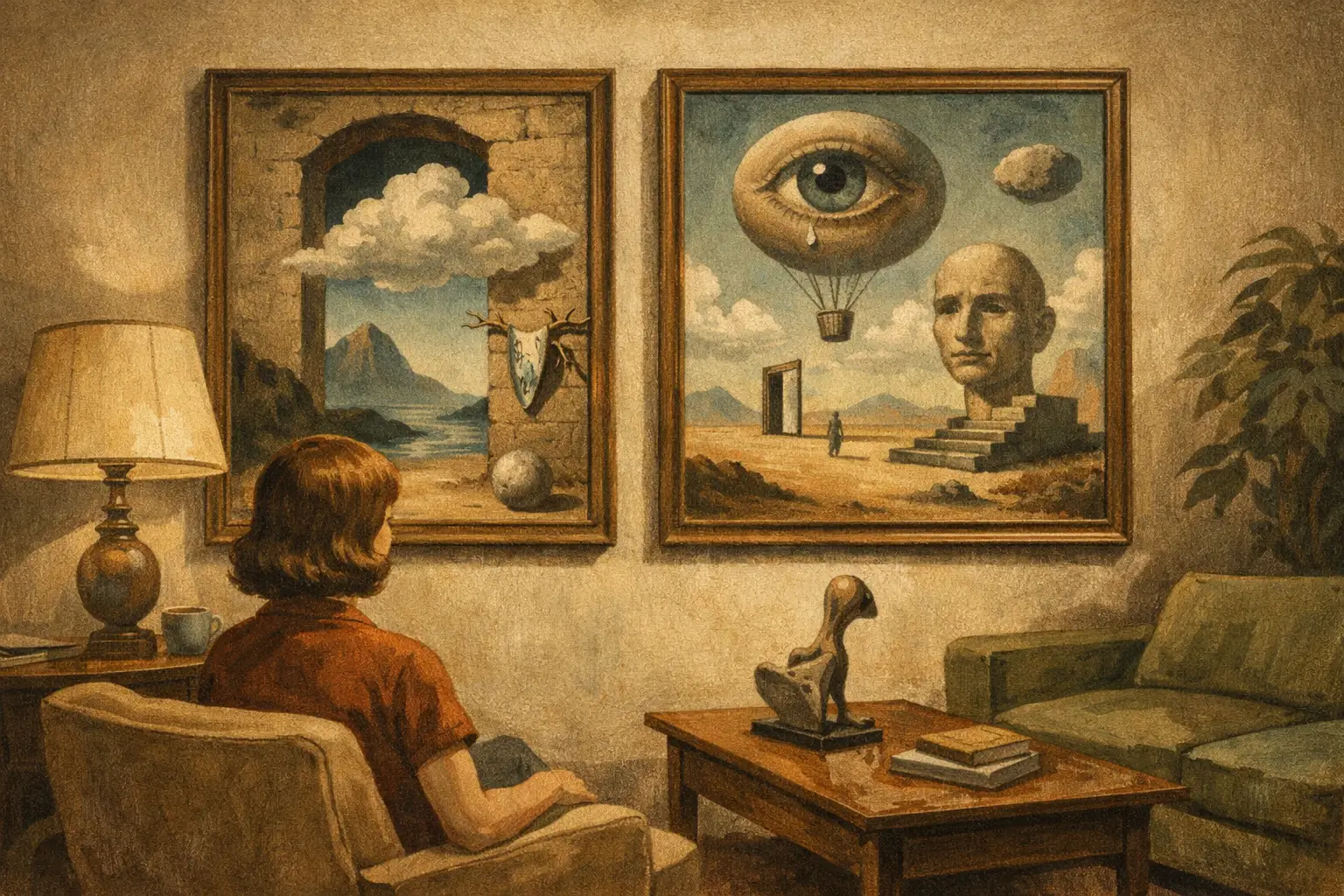
A room can be technically beautiful and still feel finished too soon. The sofa is right, the palette is restrained, the lighting is warm – yet nothing interrupts the expected. This is where surrealism wall art prints begin to matter. They introduce a slight shift in reality, a visual pause that makes a space feel less decorated and more awake.
Surrealism has always lived in that fertile area between dream and structure, symbol and silence. In an interior, it does something few other styles can do so effortlessly. It holds elegance and strangeness at once. A floating figure, an altered landscape, an impossible object, a face divided by shadow or symbolism – these images do not simply match a room. They alter its emotional temperature.
Why surrealism wall art prints feel so relevant now
Many contemporary interiors lean toward calm restraint. Natural textures, softened neutrals, sculptural furniture, and uncluttered layouts offer relief from visual noise. But calm can slip into sameness when every object behaves too politely. Surrealism introduces a necessary counterweight.
The appeal is not only aesthetic. It is psychological. Surreal imagery invites interpretation without forcing a single answer. That ambiguity gives the viewer room to return, notice, and reflect. In a bedroom, that can feel intimate. In a living room, it can become conversational. In a hospitality setting, it can create a memorable identity without resorting to spectacle.
This is one reason surrealism has moved beyond niche collecting and into more design-conscious homes. Buyers are looking for work that feels curated rather than generic, expressive rather than loud. A well-chosen print can offer that tension beautifully.
What surrealism brings to an interior
Surrealist imagery has range. Some works are cinematic and dramatic, built around contrast, symbolism, and dream logic. Others are sparse and meditative, using surreal displacement in a quieter register. That distinction matters, because not every room asks for the same kind of intensity.
In a minimal interior, surrealism can act as the one controlled disruption that keeps the space from feeling sterile. In a layered, eclectic room, it can unify disparate objects by introducing a conceptual center. The artwork becomes less of an accessory and more of a lens through which the room is read.
There is also a useful trade-off to consider. Bold surreal works can command a room instantly, but they may leave less space for surrounding objects to speak. More restrained surreal compositions – especially those with negative space, muted color, or symbolic simplicity – often have greater longevity in interiors that evolve over time. The right choice depends on whether you want the art to dominate, anchor, or quietly haunt the space.
Scale changes the emotional effect
A large print above a sofa or bed creates immersion. It gives surrealism room to breathe, which is often essential. Symbolic imagery loses some of its power when compressed too much. If the composition relies on subtle details, dreamlike transitions, or spatial distortion, scale helps the viewer enter the work rather than glance past it.
Smaller prints can be equally compelling, but they tend to work best in intimate zones – an entryway niche, a reading corner, a hallway moment where surprise is welcome. In these settings, the viewer encounters the piece at closer range, and the surreal element feels more private.
Color matters more than style labels
People often shop by genre first and palette second, but interiors tend to work the other way around. Two surrealist prints may belong to the same visual family while behaving very differently in a room. A piece with warm umber, rust, ash blue, or faded black will settle into a contemplative interior. A print with acid green, crimson, or electric cobalt may create beautiful friction, though it will ask more of the room around it.
Neither direction is better. It depends on your threshold for tension. If your home is built around stillness, choose a surreal piece that deepens that mood rather than breaking it completely. If the room needs one gesture of risk, then a sharper color contrast may be exactly what gives it life.
Choosing surrealism wall art prints with intention
A strong print should reward both immediate attraction and sustained attention. The first response may be emotional – intrigue, recognition, unease, tenderness. The second response is slower. Why does this image stay with you? What atmosphere does it create? Does it expand the room, soften it, unsettle it, clarify it?
This is especially important when buying online. The most successful surrealism wall art prints are not chosen only because they are unusual. They are chosen because their visual language aligns with the life of the space. A dreamlike desert scene may bring stillness to a neutral bedroom. A fragmented portrait may add psychological depth to an office or study. A symbolic composition built around moon, water, bird, or stone imagery may resonate strongly in interiors shaped by Zen, Wabi-Sabi, or quiet minimalism.
Material quality matters just as much as image selection. Surreal work often depends on tonal subtlety, shadow detail, and fine transitions between color fields. Museum-quality Giclee printing helps preserve those nuances. Cheap reproduction tends to flatten the very qualities that make surrealism compelling in the first place.
Framing also changes the reading of the work. A thin black frame can sharpen the image and give it modern clarity. Natural wood softens and humanizes more atmospheric pieces. A white frame can work well in bright interiors, though it may reduce the dramatic edge of darker compositions. Floating presentation often suits surreal work because it gives the image a sense of suspension, which is fitting for the genre.
Where surreal prints work best
Living rooms are the most obvious placement, but not always the most interesting. Because surrealism invites introspection, it often feels especially resonant in spaces where the mind slows down. Bedrooms, libraries, studies, and quiet corridors can all hold this kind of work beautifully.
In dining spaces, surreal art introduces a subtle theatricality. It can shift the room away from pure function and toward ritual. In entryways, it creates immediate identity. For designers and hospitality buyers, surreal prints are also useful because they can give a project a distinct voice without the budget threshold of acquiring singular originals for every wall.
There are practical considerations, of course. If a room already contains strong patterned textiles, expressive lighting, or highly sculptural furniture, the artwork may need more visual restraint. If the architecture is plain, the art can carry more complexity. A room should not become a competition between statements.
Pairing surrealism with quiet interiors
One of the most elegant uses of surrealist art is in rooms built around softness and space. Limewash walls, linen upholstery, travertine, aged wood, smoked glass, and hand-finished ceramics create a tactile field that welcomes conceptual contrast. The art becomes the single element that bends reality while everything else remains grounded.
This pairing works because surrealism is not always excess. At its best, it is disciplined. The image may be strange, but the composition is often controlled, precise, and deeply considered. That makes it surprisingly compatible with refined interiors.
For collectors and design-oriented buyers, this is part of the pleasure. A print can be accessible in format while still feeling intellectually and emotionally rich. It offers the atmosphere of serious collecting without requiring that every purchase begin at the level of a rare original.
At Taygeta Gallery, this approach resonates because the work is framed not simply as decoration, but as a meaningful visual presence – something to live with, not just look at once.
The difference between decorative surrealism and lasting art
Not all surreal imagery carries the same weight. Some pieces rely on novelty alone: an odd juxtaposition, a dream symbol repeated without depth, a technically polished image that fades after the first impression. Others hold tension longer. They suggest a world rather than a trick.
A lasting piece usually has one or more of the following qualities: formal balance, emotional ambiguity, symbolic intelligence, and restraint. It does not explain itself too quickly. It leaves a little silence around the image.
That silence is valuable in a home. We live among enough objects that demand immediate comprehension. Art can offer another rhythm. Surrealism, in particular, allows a room to keep a private layer. It lets beauty remain slightly unresolved.
If you are choosing your first surreal print, trust the work that continues to draw you back after the novelty has worn off. If you are choosing for a project, think about how the piece will feel after six months, not six minutes. Strong art does not merely complete a wall. It changes the pace at which the room is experienced.
The best surreal print is not the strangest one. It is the one that makes your space feel more inward, more distinct, and a little less predictable.
Leave a Reply