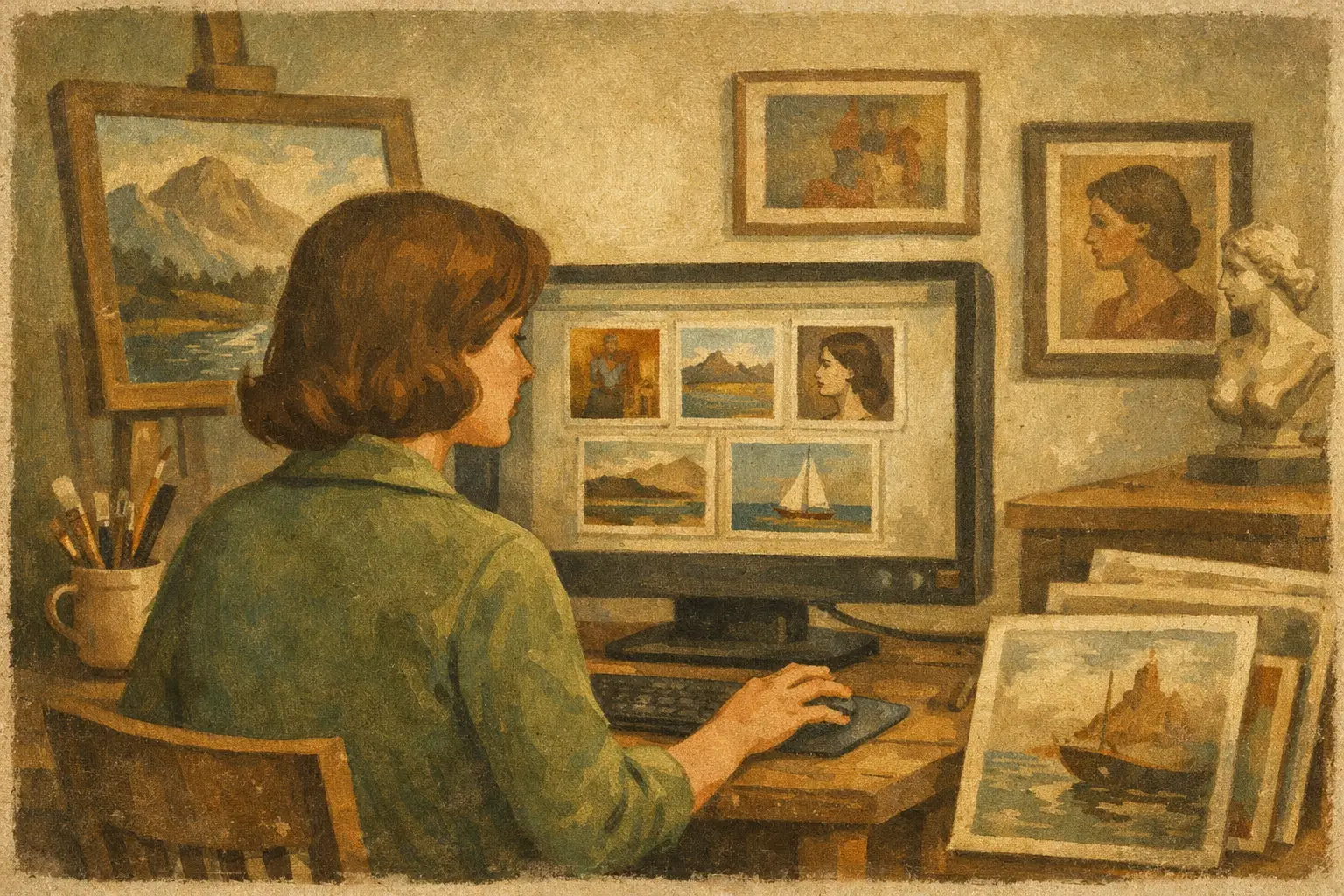
The difference between a room that looks finished and one that feels alive is often a single work of art. Not simply something that fills a wall, but something that changes the air around it. When people search for original art for sale online, they are rarely looking for decoration alone. They are looking for presence, atmosphere, and a piece of visual language that reflects how they want to live.
Buying art online has become more natural for collectors, homeowners, and designers alike, yet the experience can still feel uncertain. A screen flattens scale, texture, and nuance. Prices vary wildly. The word original is used loosely in some corners of the market and with great care in others. The challenge is not only finding something beautiful. It is learning how to recognize work with integrity, and how to choose art that will continue to speak to you once it arrives and enters your daily life.
Why original art for sale online feels different now
The online art market has matured. Buyers are no longer choosing between elite gallery culture and anonymous mass-market decor. There is now a meaningful middle ground where contemporary artworks, museum-quality prints, and curated editions can be discovered with clarity and confidence. That shift matters because it has opened collecting to people with strong aesthetic instincts, even if they are not traditional collectors.
Still, not every online gallery offers the same experience. Some present art as inventory. Others frame it as part of a visual and cultural conversation. That distinction shapes everything from trust to taste. A thoughtfully curated platform helps buyers understand why a piece matters, how it was made, and what kind of interior life it can create. For design-conscious buyers, that context is not extra. It is part of the value.
What to look for before you buy
The first question is not price. It is authorship. If a work is presented as original, the artist, medium, dimensions, and process should be clearly stated. You should know whether you are looking at a one-of-one painting, a mixed-media work, or a digitally created original presented as a limited collector edition. Originality can take different forms, but it should never be vague.
The second question is quality of presentation. Good online galleries do more than post an image and a price. They show close-up views, accurate dimensions, framing details where relevant, and language that reflects knowledge rather than sales pressure. If the photography is careless or the material information is thin, hesitation is reasonable.
Authenticity also deserves attention. Certificates of authenticity, edition numbers for limited works, and transparent production standards all help establish confidence. This is especially true when buying higher-value pieces or museum-quality Giclée prints. A print can be an exceptional acquisition when it is produced with archival care and released with curatorial intention. The trade-off is that buyers need to know exactly what they are purchasing.
How to judge whether a piece is right for your space
A beautiful artwork can still be wrong for a room. This is where many online buyers make hurried decisions. They fall in love with the image on screen but do not consider scale, mood, or spatial rhythm.
Start with the emotional register of the piece. Does it quiet a room, sharpen it, soften it, or energize it? In minimal interiors, subtle art often carries more power than loudly decorative work. A restrained abstract composition, a meditative monochrome, or a piece informed by Wabi-Sabi sensibility can create depth without crowding the architecture. In other rooms, a surreal or expressive work may be exactly what gives the space tension and character.
Scale matters just as much as feeling. One medium-sized artwork can disappear over a large sofa, while an oversized piece can anchor an entire room with almost architectural force. Measure the wall, but also consider visual weight. Dark works feel denser than pale ones. Heavy texture advances. Open negative space recedes. A strong online gallery helps you imagine these relationships instead of leaving you to guess.
Framing changes the equation too. A float frame, a natural wood frame, or a minimal black edge can alter how contemporary, quiet, or formal a work feels. Buyers often focus on the artwork itself, but presentation determines how the piece lives in the room.
Price, value, and the question buyers often avoid
Many people are comfortable asking what a sofa costs and reluctant to ask the same of art. Yet pricing is part of understanding the work. Original art for sale online can range from accessible entry-level pieces to serious collector acquisitions, and neither end of that range is inherently more valid. What matters is whether the price reflects authorship, medium, scale, rarity, and production quality.
An original painting by an emerging artist may be priced more accessibly than buyers expect. A limited-edition print may be a better choice than a lower-quality original if what you value most is refinement, archival production, and curatorial coherence. It depends on the role the piece will play. If you want singular material presence, an original may matter most. If you want a highly resolved visual statement for a carefully designed interior, a collector edition or museum-quality print may be the smarter purchase.
The word investment is often overused in art marketing. Most buyers should not approach art as if it were a short-term financial instrument. The more useful idea is lasting value. Will this piece hold its visual power over time? Will it continue to belong in your space as your taste evolves? Will you still want to live with it five years from now? Those are better questions than whether it might appreciate.
The advantage of curatorial point of view
One of the quiet luxuries of buying from a strong online gallery is that you are not left alone with infinite choice. Curation narrows the field in a meaningful way. It creates relationships between artworks, ideas, and interiors. It helps buyers move beyond impulse toward discernment.
This is especially valuable for those drawn to art that carries philosophical or atmospheric depth. Work influenced by Zen, impermanence, stillness, or material simplicity asks to be seen differently than trend-driven decor. It is not trying to match a pillow or echo a paint color. It is shaping mood, time, and attention. For many contemporary interiors, this kind of art offers a rare form of calm.
That is part of why galleries with a distinct aesthetic language matter. Taygeta Gallery, for example, approaches art not just as product but as placement, narrative, and presence. For buyers who want more than generic wall decor, that curatorial lens can make the online experience feel far more personal and exact.
Common mistakes when buying art online
The most common mistake is rushing. Art asks for a slower form of looking. If a piece still feels compelling after several returns to the page, that usually means something. If the attraction fades quickly, it may have been novelty rather than connection.
Another mistake is buying only for color matching. Harmony matters, but art should not be reduced to palette management. A room often becomes more sophisticated when the artwork introduces tension, contrast, or a different emotional temperature.
Buyers also underestimate practical details. Shipping policies, return terms, framing methods, and lead times deserve attention, especially for international orders or design projects. A gallery can be visually elegant and operationally unclear. Both sides matter.
Finally, many people assume online buying must feel impersonal. It does not. The best galleries make space for questions about sizing, placement, editions, and project needs. That dialogue is part of the service, whether you are choosing one piece for a bedroom or sourcing multiple works for a hospitality setting.
Buying original art for sale online with confidence
Confidence does not come from knowing everything about art history. It comes from learning how to look and from choosing a source that respects the intelligence of the buyer. When the information is transparent, the curation is thoughtful, and the work itself has emotional clarity, buying online can feel less risky than wandering through a crowded fair or a generic marketplace.
The right artwork does more than complete a wall. It shifts proportion, mood, and attention. It becomes part of the private architecture of your life. That is why patience matters, and why quality matters, and why curation matters.
Buy the piece that continues to hold your gaze after the screen goes dark.
Leave a Reply