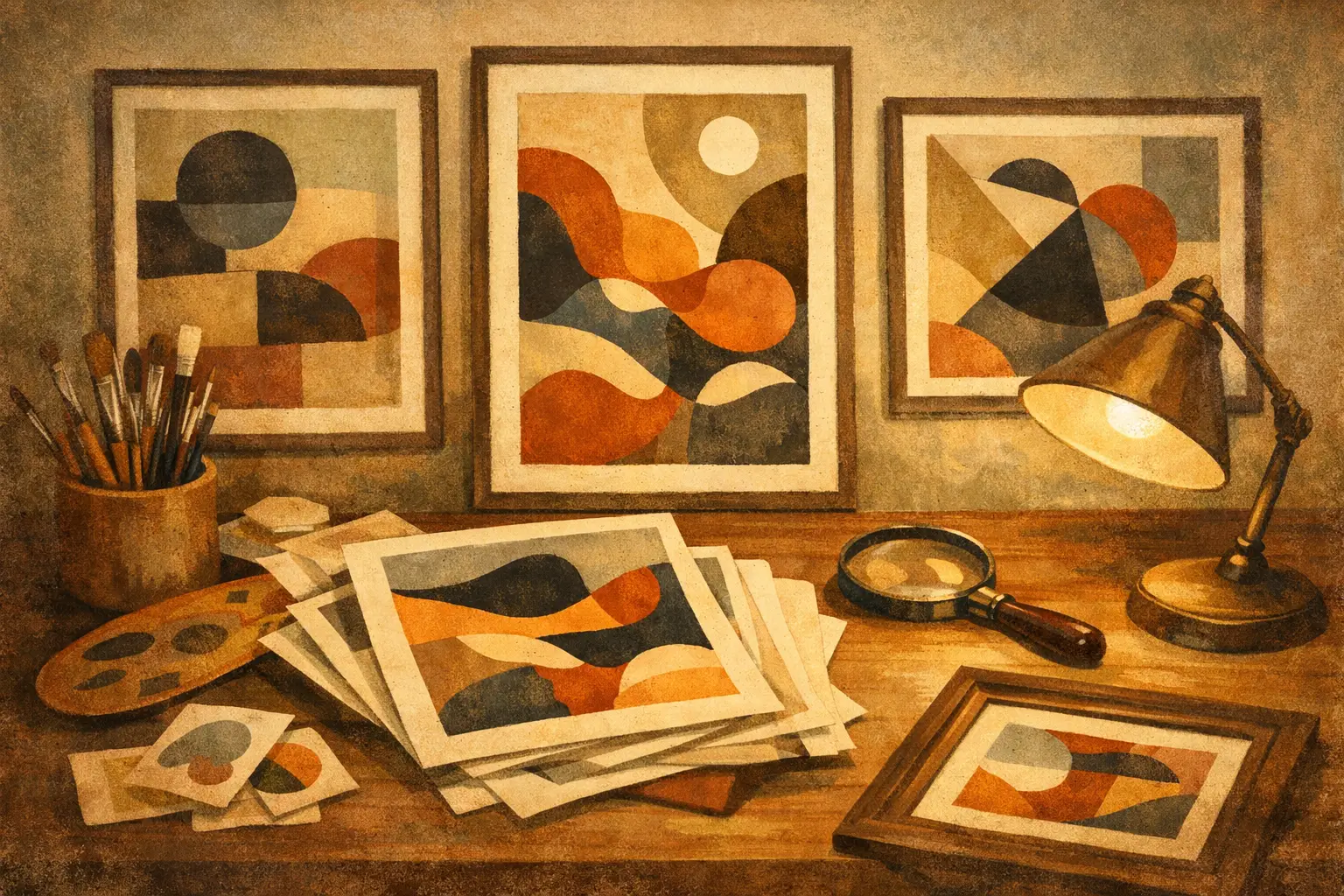
The moment an abstract print holds your attention a little longer than expected, collecting begins. Not with a spreadsheet or a grand plan, but with recognition – a pause, a felt response, a sense that a work understands something about your space or your inner life. This guide to collecting abstract prints is for buyers who want more than wall coverage. It is for those looking for work with atmosphere, conviction, and lasting visual intelligence.
Abstract prints occupy a distinctive place in contemporary collecting. They can be more accessible than original paintings, yet they still offer authorship, aesthetic rigor, and the pleasure of living with art that changes as the light shifts and your eye matures. The best ones do not simply match a room. They deepen it.
Why abstract prints reward close collecting
Abstract art asks something subtle of the viewer. It does not explain itself all at once. Instead, it offers rhythm, tension, texture, quiet, interruption. Over time, those qualities become part of daily life. A print that first read as minimal may begin to feel meditative. Another that seemed energetic may reveal structure and restraint.
This is one reason abstract prints are so compelling for new and seasoned collectors alike. They leave room for interpretation without becoming vague. In a home, they can create stillness in a busy room or introduce movement into a pared-back interior. In a hospitality or design setting, they help establish mood without dictating meaning.
That said, abstraction is not automatically sophisticated, and not every print deserves a place in a collection. The difference often comes down to intention, production quality, and whether the work continues to offer something after the first impression.
A guide to collecting abstract prints with discernment
A strong collection does not start with trends. It starts with your eye. Before thinking about sizes, framing, or edition numbers, pay attention to what consistently draws you in. Is it gestural monochrome work? Fields of softened color? Geometric tension? Organic forms with a Wabi-Sabi sensibility? Your preferences are not random. They are the beginning of coherence.
This does not mean every piece must look alike. In fact, collections become more interesting when there is variation. What matters is a shared emotional or aesthetic logic. Some collectors are guided by stillness. Others by contrast, materiality, or spatial ambiguity. Knowing your thread helps you buy with confidence instead of impulse.
When you are evaluating a print online, resist the temptation to judge only by how it will fill a blank wall. Ask what the piece is doing visually. Where is the tension? How does the composition breathe? Is the palette flat and decorative, or does it have depth? Does the image feel resolved? These questions help separate art from generic design.
Understand editions before you buy
One of the most practical parts of any guide to collecting abstract prints is understanding editions. Not all prints are issued in the same way, and edition structure affects both value and collectability.
An open edition can be produced without a fixed limit. It may still be beautiful, but it is generally less scarce. A limited edition is produced in a set quantity, often signed or accompanied by documentation. Collector editions may include elevated production details, special sizing, or greater rarity. None of these formats is inherently right or wrong. It depends on your goals.
If you are buying for personal enjoyment and spatial impact, an open edition with exceptional print quality may be perfect. If scarcity, artist authentication, and longer-term collectability matter to you, a limited edition is worth closer attention. The key is transparency. You should know the edition size, the print method, the paper or substrate, and whether the work is signed or certified.
Print quality matters more than many buyers expect
A compelling composition can lose its presence if the print quality is poor. This is especially true with abstract work, where tonal nuance, edge definition, and surface character carry much of the experience.
Museum-quality Giclée printing is often preferred because it can capture subtle gradations and maintain color integrity with greater precision. Archival inks and fine art papers also matter. They support longevity, but they also change how the work feels in person. A velvety matte paper can lend softness and depth. A smoother surface may sharpen contrast and line.
Framing should be considered part of the artwork’s presentation, not an afterthought. The right frame gives the piece breathing room and anchors it in the architecture of the room. Natural wood, black, white, or restrained metallic finishes tend to serve abstract work well, though the best choice depends on the print’s energy and your interior palette.
Buy for the room, but not only for the room
Many collectors arrive through interior design, and that is a valid way to begin. A print lives in space. It should relate to scale, light, furniture, and atmosphere. But art chosen only to coordinate often has a short life. Once the room changes, the connection disappears.
A stronger approach is to buy work that holds two truths at once: it belongs in the room, and it would still matter to you elsewhere. This is where enduring collections are formed. The print may echo the quiet mineral tones of your home, but it should also have enough inner life to outlast a future move or redesign.
Scale deserves careful thought. Oversized abstract prints can create a profound sense of calm when the composition has openness and restraint. Smaller works ask for closer viewing and can feel intimate, especially when grouped thoughtfully. Neither is better. A narrow hallway, a serene bedroom, and a dramatic double-height living area each ask for a different kind of presence.
Learn the artist’s language
Even when buying prints rather than originals, authorship matters. The artist’s conceptual world, process, and recurring themes all shape how a work will live in your collection.
Spend time with the artist’s wider body of work. Does the print feel central to their practice or peripheral to it? Are you seeing a meaningful translation of their visual language, or simply a market-friendly fragment? Artists with a clear point of view tend to produce works that remain interesting over time.
This is also where collecting becomes richer than decorating. When you understand an artist’s concerns – impermanence, memory, gesture, silence, rupture, balance – the print gains dimension. It becomes not just an image, but a conversation. For collectors drawn to contemplative interiors, this depth is often what makes abstract work indispensable.
Trust emotion, then test it
An emotional response is not naive. It is often the clearest signal that a work has power. The mistake is not feeling too much. The mistake is buying too quickly.
When a print draws you in, sit with it. Revisit it at different times of day. Imagine it in your home, but also ask whether it would still move you outside that setting. If possible, compare it with several other works rather than deciding in isolation. Strong pieces tend to hold their charge even after comparison.
It also helps to notice what kind of emotion is present. Some works energize. Others settle the nervous system. Some create productive friction. The right choice depends on the life of the room and the role you want art to play in it.
Start small, collect slowly
There is no prize for building a collection quickly. In fact, pace is one of the collector’s great advantages. A slowly formed collection usually has more integrity because each addition teaches you something.
Your first purchases do not need to be definitive. They simply need to be sincere and well made. As your eye sharpens, you will begin to notice stronger composition, finer production, and more nuanced curation. You may also become more selective about edition size, framing, or artist continuity.
For many buyers, the most satisfying path is to begin with one or two prints that establish a tone, then add works that either deepen or gently challenge that atmosphere. A home does not need constant visual noise. It needs pieces that can be lived with.
This is where a carefully curated gallery can make a real difference. When the selection reflects a clear aesthetic philosophy rather than volume for its own sake, buyers can collect with more confidence and less fatigue. Taygeta Gallery, for example, approaches abstract work with a sensibility shaped by stillness, imperfection, and contemporary spatial awareness – qualities that help a print feel both refined and deeply inhabitable.
What to avoid when collecting abstract prints
The most common mistake is confusing neutrality with sophistication. Beige-on-beige work can be elegant, but it can also be visually empty. Another mistake is buying prints that rely on scale alone. Large size cannot compensate for weak composition.
Be cautious with anything that feels overly derivative or optimized only for trend appeal. If a piece looks designed to mimic a mood board rather than express a distinct visual intelligence, it may date quickly. Also be wary of incomplete information. If the seller is vague about editioning, materials, or print method, hesitation is wise.
Collecting asks for both openness and standards. You do not need academic training to buy well. You need attention, patience, and a willingness to let your taste become more precise.
A good abstract print does something rare. It leaves space in the room and in the mind. If you choose work that continues to reveal itself, your collection will not just decorate your walls. It will quietly shape the way you live with beauty.
Leave a Reply