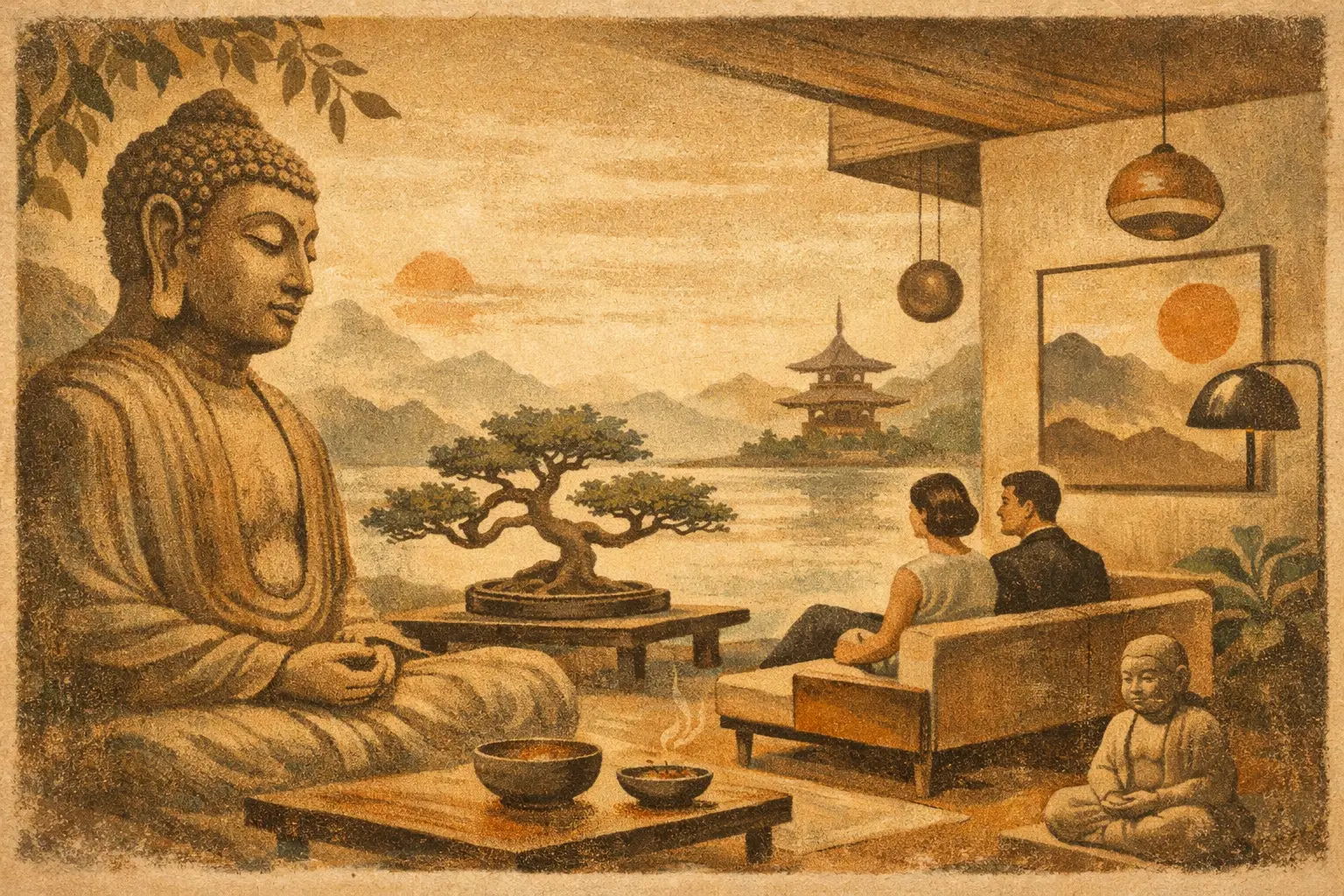
A room can be visually complete and still feel restless. That tension is often what draws people toward eastern philosophy in art: not simply for its look, but for its ability to create stillness, space, and emotional clarity. In the best works, philosophy is not added as decoration. It is embedded in composition, restraint, texture, and the way an image allows the eye to rest.
For collectors and design-minded buyers, this matters because art does more than fill a wall. It sets the rhythm of a space. Eastern thought has shaped that rhythm for centuries, offering a visual language grounded in impermanence, balance, humility, and presence. When translated into contemporary painting, printmaking, or digital abstraction, those ideas can feel deeply current rather than historical.
What eastern philosophy in art really means
The phrase can sound broad, and it is. Eastern philosophy includes many traditions, regions, and lineages, from Zen Buddhism and Taoism to broader ideas of harmony, emptiness, and natural order found across Asian aesthetics. In art, these ideas rarely appear as literal symbols alone. More often, they shape how a work is made and how it is experienced.
Zen, for example, values directness and awareness. In visual terms, that can appear as disciplined simplicity, spare gestures, asymmetry, and a respect for negative space. Taoist influence often appears in the sense of flow, softness, and alignment with natural movement rather than force. Wabi-Sabi, though often simplified in Western design culture, centers on imperfection, transience, and modest beauty. A weathered surface, an irregular mark, or a muted tonal field can carry more emotional truth than polished perfection.
This is why eastern-inspired art often feels calming without becoming passive. It does not demand attention through excess. It earns attention through depth.
The visual qualities that carry the philosophy
In many contemporary works, the philosophical foundation is felt through a few recurring qualities. Space is one of them. Empty space is not emptiness in the sense of lack. It is active, intentional, and necessary. It gives form to what remains and invites contemplation rather than visual overload.
Materiality is another. Textured surfaces, faded tones, raw brushwork, and restrained palettes suggest time, touch, and impermanence. These qualities can make a work feel more human and less manufactured. Even in digital art, when handled with sensitivity, layered texture and tonal quiet can preserve that sense of authenticity.
Then there is balance. Not symmetry for its own sake, but equilibrium. A composition may feel centered emotionally while remaining formally uneven. That subtle instability is often what gives the work life. It mirrors nature, where balance is rarely rigid.
Why it resonates in modern interiors
Contemporary interiors often struggle with a familiar problem: abundance. Too many objects, too much visual information, too little room for reflection. Art informed by eastern philosophy offers a counterpoint. It helps shape an atmosphere that feels grounded rather than staged.
In a minimal home, such work adds soul without clutter. In a layered interior, it can create a pause between stronger elements. For hospitality and commercial spaces, it often supports the kind of mood people remember but cannot always name – calm, spaciousness, and ease.
This is also where buyers become more discerning. A mass-produced print may imitate a neutral palette or abstract brushstroke, but it rarely carries the internal coherence of a thoughtfully made piece. The difference is subtle at first and unmistakable over time. Art with philosophical integrity continues to reveal itself.
Zen, Wabi-Sabi, and the shift from trend to meaning
Some eastern aesthetics have become popular design shorthand, especially Zen and Wabi-Sabi. That visibility has benefits, but it also creates confusion. Not every beige abstract is Zen. Not every distressed surface expresses Wabi-Sabi.
The distinction lies in intention. Zen-influenced art tends toward concentration, reduction, and presence. Wabi-Sabi accepts irregularity, age, and incompletion as part of beauty. Both ask the viewer to slow down. Both resist the polished certainty of purely decorative art.
For a collector, this means choosing work that does more than match a palette. The strongest pieces contribute a psychological dimension to the room. They soften perfection, deepen atmosphere, and make the space feel lived with rather than merely styled.
At Taygeta Gallery, this curatorial approach is part of the appeal. The eastern-aesthetic foundation is not treated as a trend layer, but as a serious visual and philosophical framework for contemporary living.
How to choose art with this sensibility
The first question is not whether a work looks eastern. It is whether it creates a particular state of attention. Does it feel quiet but not empty? Restrained but not cold? Is there tension, softness, and room for interpretation?
Look closely at scale and placement as well. Art rooted in stillness needs space around it. A modest work can be powerful if it is allowed to breathe. Larger pieces can anchor a room beautifully, especially when their composition avoids noise and their palette supports the architecture rather than fighting it.
It also helps to notice your own pace in front of the work. If you feel compelled to linger, that is often the sign of substance. Philosophically grounded art does not always announce itself immediately. It unfolds.
For those building a home collection or sourcing for a design project, eastern philosophy in art offers something rare: visual refinement with emotional intelligence. It allows a space to feel composed, but also alive to time, silence, and the beauty of what is unresolved. That may be its most lasting value – not that it completes a room, but that it changes how the room is felt.
Leave a Reply