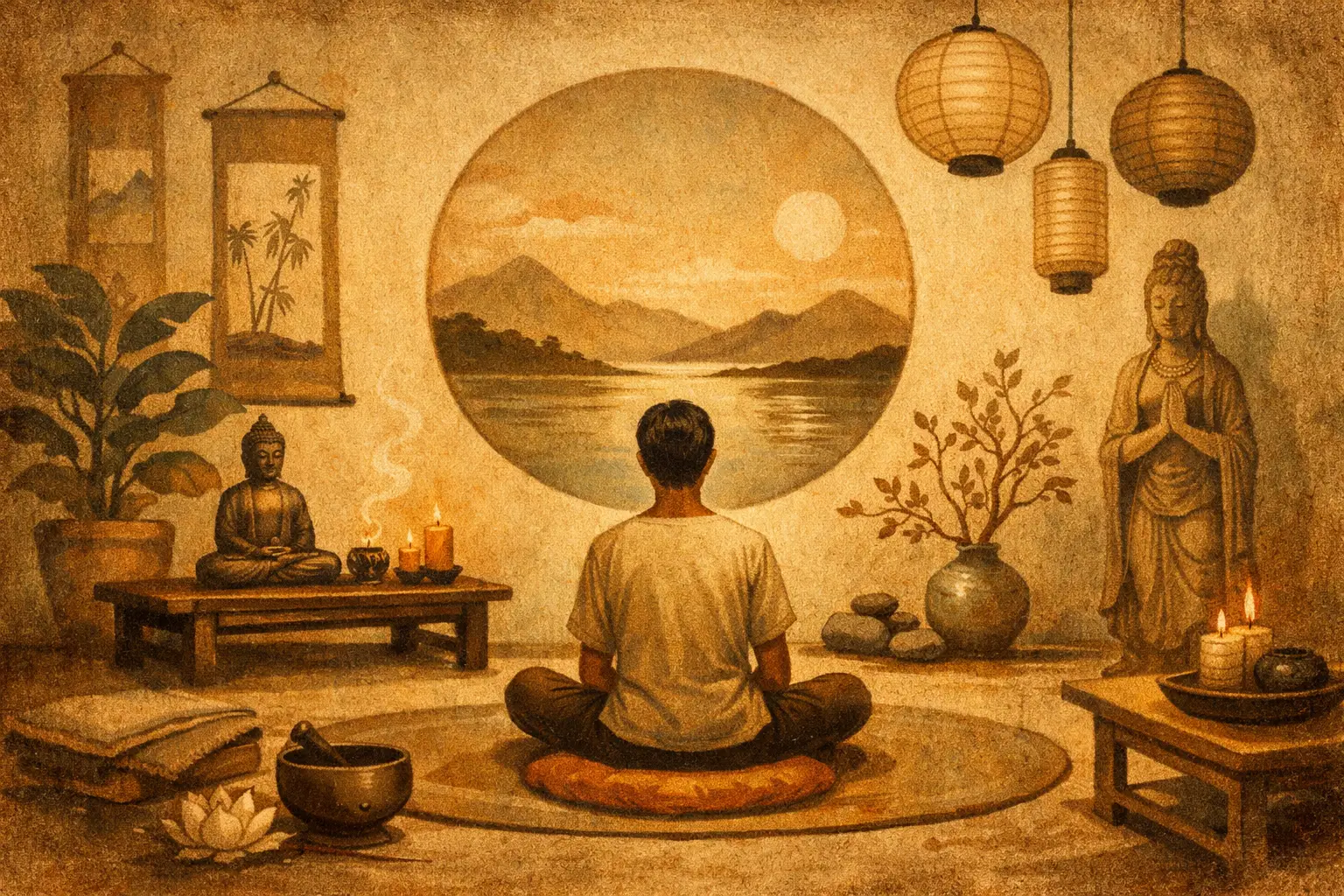
A meditation room asks very little of its art, yet the right image can shape everything. Among the best meditation room art ideas, the most enduring are not necessarily the quietest or most neutral. They are works that give the eye somewhere to rest without demanding an answer, creating a visual threshold between the pace of the day and the slower rhythm within.
Art in a contemplative space is not simply decoration. It can be a reminder of breath, impermanence, spaciousness, or the beauty of a changing season. The question is less, “What looks peaceful?” and more, “What helps this room feel true to the way I want to be?”
Begin With the Room’s Emotional Temperature
Before choosing a subject, notice the emotional temperature already present. A sunlit room with pale wood, linen, and woven fibers may welcome a restrained ink-like composition or a weathered abstract in mineral tones. A darker corner designed for evening practice may need a work with greater depth: midnight blue, charcoal, umber, or a dusky horizon that makes the room feel held rather than closed in.
Meditation spaces do not need to be entirely beige, white, or spare. Stillness has many palettes. Deep red can feel grounding; moss green can suggest renewal; a concentrated field of ultramarine can bring the mind inward. The useful test is whether the artwork steadies the room. If it feels like a visual interruption, even a beautiful one, it may belong elsewhere.
10 Best Meditation Room Art Ideas
1. Wabi-Sabi Abstracts With Visible Imperfection
Wabi-sabi honors the incomplete, weathered, irregular, and temporary. An abstract with softened edges, uneven washes, traces of texture, or imperfect geometry can bring this philosophy into the room without illustrating it too literally. These works feel especially at home beside natural plaster, oak, clay vessels, and handmade textiles.
Look for art that leaves breathing room around its marks. A composition does not need to be empty to feel spacious, but it should resist the impulse to fill every corner. The small irregularity in a line or surface can become a gentle invitation to release perfection during practice.
2. Minimal Zen-Inspired Ink Gestures
A single brushstroke, a quiet circle, or a spare arrangement of black and gray forms can carry surprising presence. Zen-influenced art is often powerful because it suggests movement and stillness at once. Its restraint makes it particularly suitable for compact apartments, where one artwork may need to establish a sense of calm without visually shrinking the room.
Choose pieces with real tonal variation rather than flat black-and-white graphics. A softened edge, a wash that thins into paper-like space, or a gesture that reveals the artist’s hand gives the work a living quality.
3. Abstract Landscapes That Suggest Distance
A horizon has an instinctive calming effect. It gives the gaze a place to travel, which can be useful for people who find silent sitting difficult at first. Rather than a highly detailed scenic print, consider an abstract landscape that evokes mist, water, stone, a distant field, or an early sky.
The best versions offer atmosphere rather than escape. You are not trying to decorate the room with a vacation fantasy. You are creating an image that quietly expands the walls and makes space for reflection.
4. Water Imagery Without the Cliché
Water is a natural companion to contemplation, but it does not need to arrive as a predictable beach scene. Consider photographic abstraction, layered blue pigment, rain-like marks, dark reflective pools, or a river suggested through gesture and color. Such work can bring fluidity to a room that otherwise feels overly controlled.
There is a trade-off here. Cool water palettes often feel serene, but in a north-facing room they can become chilly. Balance them with a warm wood frame, a natural-fiber mat, or earthen accents nearby.
5. Celestial Art for Evening Rituals
For a room used at dawn or after dark, celestial imagery can be deeply resonant. A moon rendered as a pale, imperfect disc, a star field reduced to a few points of light, or a cosmic abstract can introduce wonder without overwhelming the senses.
Keep the treatment sophisticated and spare. Meditation is not strengthened by visual spectacle. A work that hints at vastness through shadow, indigo, silver, and negative space will usually hold its meaning longer than one that explains the universe too eagerly.
6. Botanical Forms With a Quiet Pulse
A leaf, branch, seedpod, or unfolding flower can make nature present even in the center of a city. Botanical art works best in meditation rooms when it feels observed rather than ornamental. Think of a single stem against an open ground, a close study of a leaf’s veins, or an abstracted plant form with a limited palette.
If your room already contains several living plants, avoid adding a busy botanical gallery wall. One considered piece is enough. It creates dialogue with the plants rather than competing for attention.
7. Earth-Toned Geometric Compositions
Geometry can be meditative when it is calm, measured, and slightly softened by material texture. Circles, grids, blocks, and subtle symmetry bring order to a scattered mind. In warm tones of sand, sienna, olive, smoke, or muted terracotta, geometric art can feel grounding rather than clinical.
This is a strong choice for contemporary interiors with clean lines. It also suits people who prefer a sense of structure during meditation. If your practice is already highly disciplined, however, a more fluid artwork may offer a welcome counterbalance.
8. Calligraphic or Text-Based Art Used Sparingly
Words can guide a practice, but they can also become another instruction to perform correctly. A single word, a brief phrase, or an expressive calligraphic form may be meaningful if it reflects a personal intention. Choose language you can live with on difficult days, not just language that sounds wise.
For many rooms, nonliteral calligraphy is the more enduring option. It retains the rhythm of written expression while leaving room for the viewer’s own interpretation. If using a text-based work, place it where it can be encountered before or after practice rather than directly in the line of sight.
9. A Monochrome Work for Visual Silence
Monochrome art is often misunderstood as a safe choice. Done well, it is not safe at all. It asks the viewer to attend to shifts in texture, density, shadow, and surface. A nearly all-white, charcoal, rust, or blue work can create a profound field of visual silence.
This approach is especially effective when the meditation room has many tactile elements: wool, wood, ceramics, paper, stone. The art becomes a quiet anchor, allowing those materials to carry their own subtle drama.
10. One Meaningful Figurative Piece
Not every contemplative room needs abstraction. A solitary figure, a seated form, or a portrait with a lowered gaze can offer companionship, especially in a space used for journaling, breathwork, or grief. The key is emotional openness. Avoid imagery that feels overly devotional or prescriptive unless that tradition is genuinely part of your practice.
A figurative work should invite reflection rather than create the feeling of being watched. Softened forms, ambiguous narratives, and gentle color help preserve the room’s inward focus.
Scale, Framing, and Placement Matter as Much as Subject
A small artwork placed too high can feel lost, while a large piece hung directly above a low meditation cushion can become visually dominant. As a starting point, let the center of the work sit slightly lower than standard gallery height when it will be viewed primarily from the floor. Your seated eye line is more relevant than the standing eye line.
One substantial piece often creates more calm than several small ones. A gallery wall can work in a larger studio or wellness setting, but it requires generous spacing and a clear visual relationship among the works. For a personal retreat, a single artwork above a bench, opposite a cushion, or beside a window usually has greater presence.
Framing should support the image without adding noise. Pale oak, natural ash, matte black, and simple white frames are reliable choices, depending on the work and the room. Museum-quality Giclée prints deserve the same attention to scale and framing as original art. A well-produced print with tonal depth and a thoughtful frame can carry genuine visual weight.
Let Art Be Part of the Practice
The most successful meditation-room artwork is not a backdrop. Over time, it becomes familiar in the way a favorite stone or a particular tree becomes familiar: never fully exhausted, yet quietly known. It may hold a different meaning after a restless morning than it does after a clear one.
Choose the piece that gives you a little more room inside yourself. That is the kind of art worth returning to, long after the room has become part of your daily ritual.
Leave a Reply