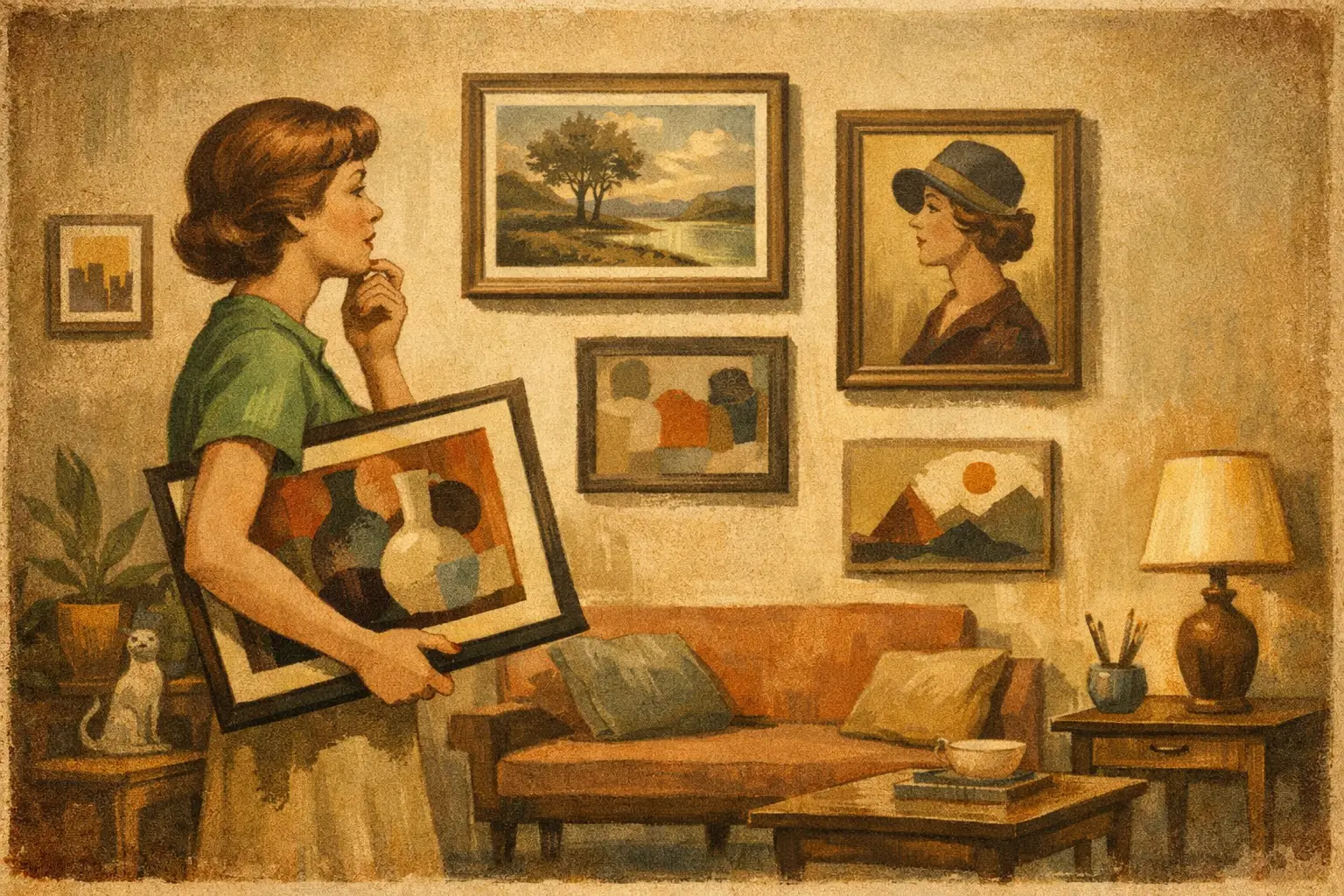
A small apartment does not forgive hesitation. Every object is seen, every wall matters, and one poorly chosen artwork can make a room feel crowded faster than a bulky chair. That is why learning how to choose art for small apartments is less about filling blank space and more about shaping atmosphere with precision.
In a compact home, art carries unusual weight. It can create stillness, add depth, soften hard edges, or introduce a point of tension that keeps a minimal room from feeling anonymous. The right piece does not merely fit the wall. It changes how the room breathes.
How to choose art for small apartments starts with scale
Most people assume small apartment art should also be small. Sometimes that is true, but not always. A single larger work can feel calmer than several scattered pieces competing for attention. When a wall is limited, visual noise becomes more obvious, so restraint often reads as confidence.
A generous vertical piece can make a low-ceilinged room feel taller. A horizontal composition above a sofa or bed can widen the perceived architecture. Smaller works tend to succeed when they are intentionally grouped, not sprinkled. If you have three or four modest pieces, they should act as one composition with a clear structure and shared rhythm.
There is a trade-off here. Oversized art can lend clarity and presence, but if the work is too dominant for the furniture below it, the room may feel top-heavy. Conversely, art that is too timid can disappear into the background and leave the space unresolved. As a general instinct, choose work that has enough visual authority to hold the wall without swallowing it.
Let the room’s emotional temperature guide the work
In small interiors, art does more than decorate. It regulates mood. This matters because compact living often means your bedroom, office, dining area, and retreat are all in close conversation.
Before choosing a piece, ask a quieter question than What matches the rug. Ask how you want the room to feel at 8 p.m. after a long day. If your apartment is already busy with books, textiles, and layered materials, art with open composition and breathing room may restore balance. If the interior is very spare, a more textured or conceptually charged piece can add soul without adding clutter.
Soft neutrals, mineral tones, weathered blacks, muted earth colors, and restrained abstraction often work beautifully in smaller homes because they create depth without agitation. This is one reason collectors and design-minded buyers are drawn to Wabi-Sabi and Zen-influenced art. Such works hold presence without shouting. They allow silence to remain part of the room.
That said, small spaces do not require pale art. A dark, moody piece can be extraordinary in a compact apartment, especially if the rest of the palette is calm. A concentrated field of indigo, charcoal, or rust can add intimacy and gravity. The key is not brightness versus neutrality. It is emotional coherence.
Choose fewer pieces with more point of view
Small apartments suffer when every wall asks for attention. Art selection is often strongest when it is edited with the same discipline as furniture.
Rather than trying to create a gallery wall in every room, choose a few moments that matter. One piece in the entry, one anchoring work in the living area, and one intimate work near the bed may be enough. This gives each artwork room to resonate.
A compact home benefits from curation, not accumulation. If each piece has a distinct voice but no relationship to the others, the apartment can feel fragmented. You do not need everything to match, but there should be a thread – perhaps a shared tonal range, a recurring material sensitivity, or a common interest in stillness, gesture, or impermanence.
This is where quality becomes especially visible. In a smaller room, museum-quality printing, refined framing, and thoughtful paper choice are easier to notice. There is nowhere for mediocre finish to hide. One well-made work often elevates a space more convincingly than several inexpensive, generic pieces.
Placement matters more in a compact layout
How to choose art for small apartments is also a question of where the eye lands first. In a small home, sightlines are compressed. You may see the living room wall from the kitchen, the bedroom art from the hallway, and the entry vignette all at once.
Because of that, placement should account for overlap. A work with strong visual energy should usually occupy the primary focal point, while quieter pieces belong in transitional zones or closer viewing positions. If everything is bold, nothing feels resolved.
Height is another subtle but important detail. Art hung too high can make a small apartment feel disjointed, as though the room and the artwork are having separate conversations. In most cases, align the piece with the lived height of the room – close enough to furniture and human scale that it feels integrated.
Corners, narrow wall fragments, and spaces above consoles can be unexpectedly useful. These areas suit slimmer works, vertically oriented pieces, or art that invites a more intimate reading. A small apartment often rewards attention to these in-between zones.
Framing can either lighten or burden the room
The frame is not a minor detail. In a compact apartment, it can alter the entire visual weight of a piece.
Thin natural wood, black gallery frames, or float-mounted presentations tend to feel clean and architectural. They support the art without adding unnecessary heaviness. Thick ornate frames can be beautiful, but they ask for more spatial generosity and stronger stylistic context.
If your interior leans minimal, choose framing that preserves negative space. A wide mat can help a smaller artwork feel more substantial and composed. It gives the image room to breathe, which is especially useful when wall space is limited.
There are exceptions. In an older apartment with character – plaster walls, vintage moldings, warm wood floors – a more tactile or traditional frame may create welcome tension. It depends on whether you want the room to feel edited and contemporary or layered and storied.
Subject matter should expand the room, not trap it
Art can influence the perceived size of a space in subtle ways. Works with depth, atmosphere, or open composition can make a room feel less bounded. Pieces with dense visual congestion can have the opposite effect, though sometimes that intensity is exactly what gives a small room its charisma.
Abstract art is often effective in apartments because it does not literalize the wall. It opens interpretation and allows mood to lead. Landscapes with horizon, works that imply mist or distance, and compositions built around emptiness can also create a sense of expansion.
Figurative work, surreal imagery, and graphic compositions can be equally successful, but they need conviction. In a small interior, highly specific imagery often sets the tone for the whole room. If you love it, that is a strength. If you are only trying to coordinate it, it may start to feel narrow over time.
Buyers sometimes over-correct and choose safe art for small spaces, fearing anything too expressive. The better approach is to select work with clarity. Calm art is not the same as bland art.
Think about light, material, and daily life
Natural light changes art constantly, and small apartments tend to have uneven light patterns. A bright room can hold subtle tonal work beautifully, while a darker room may need stronger contrast or richer surface texture to keep the piece alive.
Material matters too. Paper-based works, Giclée prints, and framed digital art can be excellent choices for apartments because they offer sophistication without the physical mass of heavily built objects. They are also often easier to scale thoughtfully within tighter layouts.
If the work will hang near a dining nook, radiator, or sun-struck window, consider practical durability alongside beauty. Art should be lived with, not nervously monitored. Refined collecting is not about fragility alone. It is about choosing pieces that suit real conditions.
How to choose art for small apartments without making them feel staged
The most compelling apartments do not look decorated for approval. They feel inhabited by a mind. Art is essential to that feeling because it reveals taste in a way furniture rarely can.
Choose at least one piece that reflects your interior life, not just your palette. Maybe it carries stillness, asymmetry, melancholy, humor, or philosophical tension. Maybe it reminds you of a landscape, a text, or a state of mind you return to. When a work holds meaning, even a very small apartment gains dimension.
This is often where curated galleries earn their place. A discerning selection helps buyers move beyond filler and toward work that feels intentional, emotionally resonant, and well made. At Taygeta Gallery, that curatorial point of view is central: art is not treated as surface styling, but as a way of shaping how a space is felt.
A small apartment asks for discernment, not compromise. If you choose art with sensitivity to scale, mood, material, and silence, even the most modest square footage can feel composed, personal, and quietly expansive.
Leave a Reply