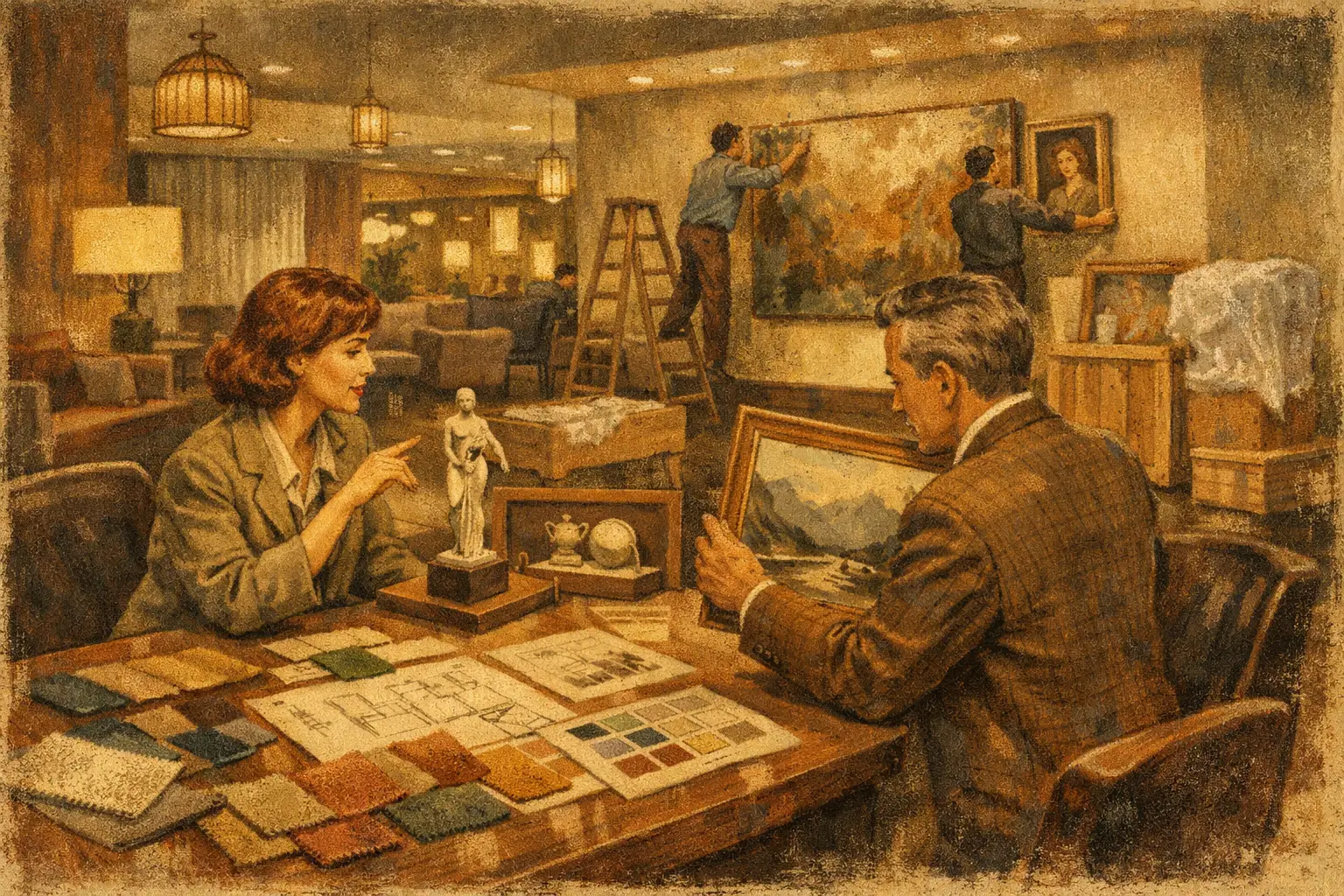
A hotel lobby can be technically flawless and still feel forgettable. The lighting may be warm, the furniture beautifully specified, the materials expensive. Yet without the right art, the space often lacks memory. For teams looking to buy art for hospitality projects, that is the real brief: not simply filling walls, but shaping atmosphere, pace, and emotional recall.
In hospitality, art does more than decorate. It sets the psychological tone before a guest reads signage, speaks to staff, or reaches a room. A restrained abstract in a reception area can quiet visual noise. A contemplative series in guest corridors can soften transition and repetition. A bold work in a restaurant can give the room a social pulse. Good hospitality art is never an afterthought because guests feel when it has been treated that way.
What changes when you buy art for hospitality projects
Buying for a home is intimate and singular. Buying for hospitality asks for a wider intelligence. The work must still have beauty and conviction, but it also has to perform across scale, traffic, maintenance, brand positioning, and diverse audiences.
That shift matters. A piece that feels poetic in a private residence may disappear in a double-height atrium. A highly textured original may be compelling conceptually, but impractical in a humid spa environment or a high-contact public corridor. Art in hospitality lives in a more demanding ecosystem.
This is why selection should begin with spatial intent, not inventory. Before choosing style, ask what each zone needs to do emotionally. Is the lobby meant to energize or settle? Should the bar feel cinematic, intimate, or slightly theatrical? Do guest rooms call for visual rest, or a sharper contemporary edge? Art becomes easier to source when the atmosphere is clear.
Start with feeling, then move to function
The most successful hospitality projects are coherent because they do not treat art as isolated objects. They think in mood, rhythm, and narrative. A property with a quiet luxury identity may benefit from works grounded in negative space, organic texture, and tonal restraint. A lifestyle hotel with a younger social audience may need stronger contrast, more graphic composition, and works that hold attention in photographs as well as in person.
This is where many projects go wrong. They begin with generic categories such as “large abstract for lobby” or “prints for guest rooms.” Those descriptions are practical, but they are not curatorial. They do not define emotional temperature. They do not explain what guests should sense.
A better starting point is language like stillness, imperfection, freedom, luminosity, tension, or ease. These words sharpen decisions. They guide palette, scale, framing, and medium. They also help different stakeholders align, especially when ownership, design teams, and procurement each have different priorities.
Function comes next. Hospitality art must withstand real conditions. That means considering production quality, glazing, framing durability, cleanability, installation method, and replacement planning. Museum-quality Giclée prints can be an excellent fit for many projects because they offer consistency, visual depth, and edition control across multiple rooms. Original works can bring singularity and prestige, but they may be better reserved for focal spaces where their presence can be properly held and protected.
Originals, prints, and editions: choosing the right mix
There is no single correct model when you buy art for hospitality projects. The strongest approach is often a layered one.
Original artworks are powerful in arrival spaces, signature suites, restaurants, and executive areas where distinct identity matters most. They give a property a sense of authorship. Guests may not know why a space feels more credible, but they notice the difference between art chosen with intention and decoration chosen for convenience.
Limited editions and museum-quality prints are often more effective for guestrooms, corridors, and multi-unit applications. They allow a project to maintain aesthetic consistency without flattening the experience into something generic. Repetition is not a problem if the work has integrity and if the framing and placement are handled with care.
The decision usually comes down to budget allocation and visual hierarchy. Not every wall needs a statement. In fact, too many statements create noise. A quiet corridor with measured, contemplative works can be more luxurious than a space crowded with forced impact.
Scale is not only about size
One of the costliest mistakes in hospitality art sourcing is choosing work that is physically large enough, yet visually too weak for the architecture around it. Scale is partly dimensional, but it is also compositional. A minimal piece with subtle tonal movement may need more breathing room and better lighting to register. A dense graphic work may carry farther across a room.
This is why mockups matter. Review art in relation to ceiling height, viewing distance, furniture groupings, and traffic flow. A piece above a headboard behaves differently from one seen across a lobby. Corridor art is experienced in motion. Restaurant art is experienced through conversation, low light, and changing occupancy. The same work can feel meditative in one zone and absent in another.
Framing also affects scale perception. Thin frames can feel refined and contemporary, while heavier profiles can lend presence and structure. Neither is universally better. It depends on the architecture and the role the work needs to play.
Brand identity should guide, not limit
Hospitality teams often speak about “art that matches the brand.” That instinct is understandable, but matching can become too literal. Art should deepen a brand’s atmosphere, not repeat its marketing language.
If a property speaks about calm, the art does not need to show obvious serenity. It may express calm through restraint, asymmetry, empty space, or softened color relationships. If the brand is rooted in cultural sophistication, the collection should reflect discernment rather than trend-chasing. Guests respond to authenticity more than to visual slogans.
A thoughtfully curated collection can also help a property distinguish itself in a crowded market. Many hospitality interiors now share similar materials, similar layouts, similar ideas of contemporary luxury. Art is often where individuality survives. It is one of the few elements that can still feel specific rather than standardized.
For this reason, cultural sensitivity matters. Drawing from Zen, Wabi-Sabi, or other Eastern aesthetic traditions should never become surface styling. These philosophies ask for seriousness, simplicity, and respect. When approached with understanding, they can bring rare depth to hospitality environments – especially in spaces meant to restore attention rather than compete for it.
Budget wisely without flattening the experience
A disciplined budget does not require generic art. It requires clear priorities.
Spend where memory is formed. That often means entrance sequences, concierge and reception zones, elevator lobbies, destination dining spaces, and premium accommodations. In lower-impact areas, consistency and quality may matter more than rarity.
Production quality is one place not to cut too aggressively. Poor print fidelity, weak materials, or careless framing can undermine even a strong concept. Guests may not identify the technical issue, but they will register the result as thin, cheap, or unresolved. Good art deserves good execution.
It also helps to plan for the full life of the project. Can works be replaced if damage occurs? Can editions be reordered for additional rooms in a future phase? Are materials suited to climate and cleaning protocols? The most attractive price at purchase is not always the best value over time.
For design firms and operators managing multiple properties or larger room counts, a gallery partner with trade support, project curation, and volume purchasing can make the process more coherent. The goal is not only efficiency. It is preserving artistic integrity while meeting operational realities. That balance is where a specialist becomes genuinely useful.
A curatorial process creates better outcomes
The practical side of sourcing matters, but hospitality art becomes memorable through curation. A project feels elevated when the collection has internal logic – not rigid sameness, but a quiet relationship between works.
That relationship may come through palette, subject, material restraint, philosophical grounding, or tonal progression across the property. A lobby can hold the boldest gesture, while guest floors move into softer rhythms. Public spaces may carry more contrast and social energy, while private rooms invite exhale.
This kind of sequencing makes a property feel considered. Guests may never articulate it, yet they sense when a space has been composed rather than assembled.
At Taygeta Gallery, this is often where the conversation becomes most interesting: not which piece is “safe,” but which work changes the room without overwhelming it. The best choices tend to create presence slowly. They reward a second look. In hospitality, that quality matters because guests are not only passing through a space. They are measuring whether it deserves their attention.
When you buy art for hospitality projects with that standard in mind, the collection stops being background. It becomes part of the property’s character – quiet, lasting, and difficult to replace once it is right.
A guest may forget the check-in script or the exact fabric on the lounge chair. They usually remember how a space made them feel. Art has a way of holding that feeling in place.
Leave a Reply