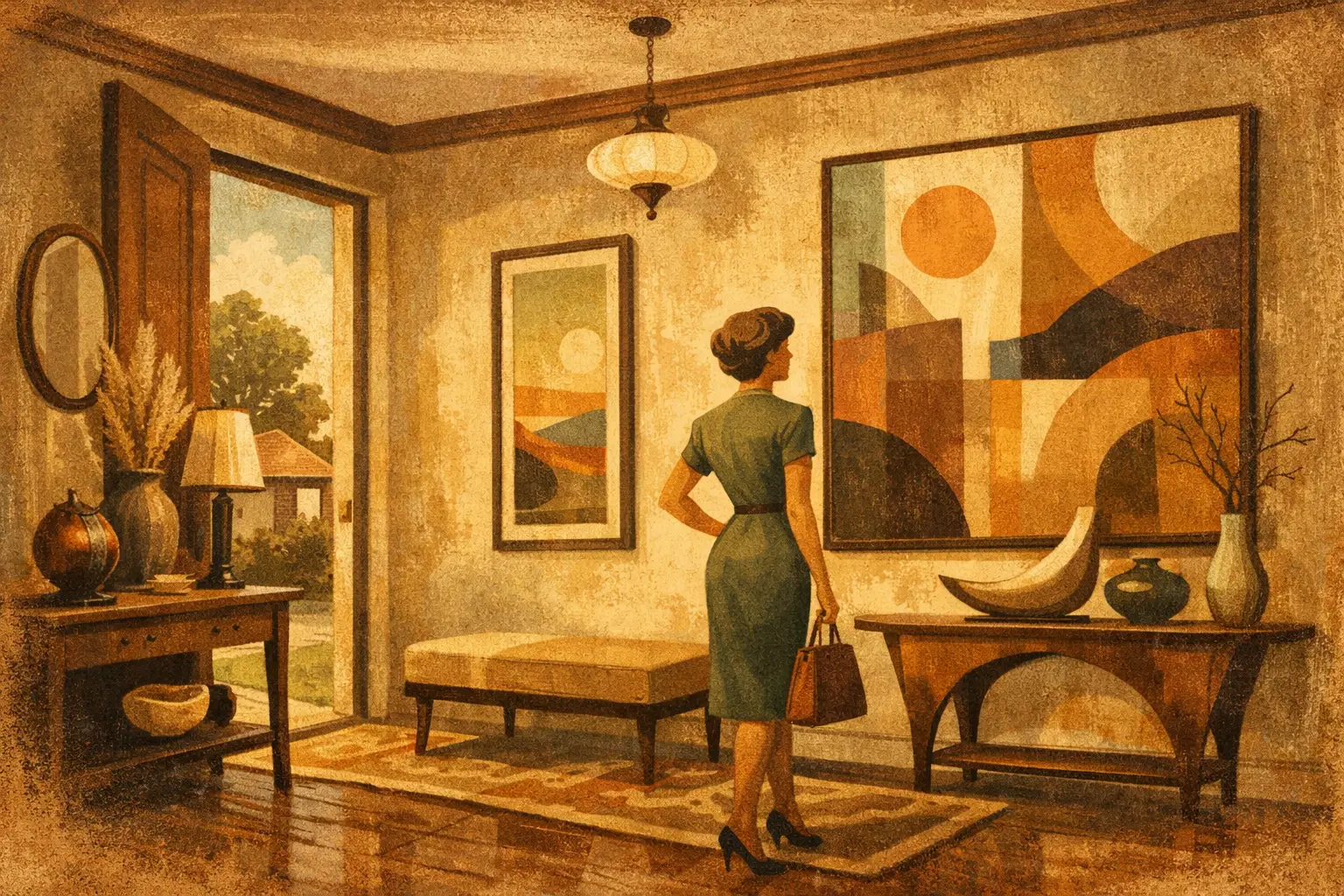
An entryway makes its impression in seconds. Before a room is fully seen, before a chair is touched or a light is turned on, the eye lands somewhere first. That is why contemporary art for entryways carries unusual weight. It does more than decorate a pass-through space. It establishes atmosphere, introduces taste, and gives the home a point of view from the threshold.
Unlike a living room, where layers of furniture and texture can share the work of creating mood, the entryway often has very little to hide behind. A console, a mirror, a bench, perhaps a vessel or lamp – and then the wall. What you place there reads clearly. It can feel abrupt, serene, intellectual, warm, restrained, or overly busy within a moment. This is precisely what makes the category so compelling. The right artwork can transform a narrow architectural transition into a place of presence.
Why contemporary art for entryways matters
The entry is a visual preface. It suggests how the rest of the home will unfold, but it should not reveal everything at once. Good contemporary art holds that tension beautifully. It can be spare without feeling empty, expressive without becoming theatrical, and conceptually rich without overwhelming a functional zone.
This balance matters because entryways are lived spaces, not just styled corners. People move through them while carrying bags, removing shoes, greeting guests, or searching for keys. Artwork here must coexist with movement and routine. It should have enough clarity to anchor the space quickly, yet enough depth to reward repeat viewing.
Contemporary work is especially effective in this role because it speaks in a modern visual language. Abstract compositions, minimalist forms, gestural marks, digital works, and quiet figurative pieces often create a sense of openness rather than nostalgia. For homes shaped by clean lines, natural materials, or a restrained palette, these works feel native to the architecture instead of applied after the fact.
What kind of art belongs in an entryway
There is no single answer, and that is part of the pleasure. The best choice depends on scale, light, ceiling height, and the emotional register you want the space to carry. Still, certain qualities tend to work particularly well.
Calm abstraction creates immediate atmosphere
Abstract art often excels in an entryway because it does not demand narrative before it offers mood. A field of mineral tones, a composition built from negative space, or a work with soft gestural movement can establish calm the moment someone enters. This is especially resonant in homes where the entry opens directly into a larger living area. The artwork acts as a visual exhale.
For collectors and design-minded buyers drawn to Wabi-Sabi or Zen-influenced interiors, abstraction can also hold a sense of impermanence and quiet irregularity. Surfaces that suggest erosion, ink-like forms, imperfect symmetry, or muted tonal shifts bring emotional complexity without visual noise.
Bold graphic works sharpen the architecture
Not every entryway wants softness. Some spaces benefit from a stronger line. In narrow hall entries, city apartments, or interiors with sculptural furniture and polished materials, contemporary art with graphic contrast can create elegant structure. Black and white compositions, geometric digital works, or assertive minimal pieces give the wall a crisp center.
The trade-off is intensity. High-contrast work can energize a small area quickly, but it can also make an already tight space feel more compressed if everything else is equally hard-edged. In those cases, even one warmer tone or a more porous texture can prevent the composition from feeling severe.
Figurative and symbolic pieces add personality
A restrained entryway can benefit from a work that introduces humanity more directly. Contemporary figurative art, symbolic imagery, or surreal compositions can make the threshold feel personal rather than purely architectural. This approach works well when the home itself is minimalist and needs one memorable interruption.
Here, scale and framing become critical. If the piece is psychologically dense or visually active, give it room. Let it hold the wall with intention rather than surrounding it with too many decorative accessories.
Scale is where many entryways go wrong
People often choose art for entryways too timidly. A small piece floating above a console rarely creates the sense of arrival the space deserves. Entry walls benefit from confidence. That does not always mean oversized work, but it does mean visual authority.
A single large artwork can make a modest entry feel composed and expansive. It simplifies the experience. The eye lands, the space gathers itself, and even a compact floor plan feels more deliberate. This is often the strongest option when the architecture is simple and the furnishings are minimal.
On the other hand, a pair or a tightly edited grouping can work beautifully in longer hall-style entries or spaces where vertical proportion is tricky. The key is cohesion. The pieces should speak to each other in palette, spacing, or rhythm. Random assortment reads as afterthought.
If there is a mirror in the entry, art can still play a role. In fact, the combination can be particularly elegant. A smaller work beside a mirror, or art opposite it so the reflection extends the image through the space, often feels more considered than placing the mirror alone.
Color and material should echo the threshold
An entryway experiences transition – from outdoors to indoors, public to private, movement to stillness. The most successful art choices recognize that shift.
Earth tones, charcoal, warm whites, faded greens, rust, soft blues, and stone-like neutrals tend to create a grounded feeling that suits the threshold beautifully. These hues connect well with wood, plaster, linen, blackened metal, and natural stone. They feel calm but not inert.
That said, color can also be used to introduce tension. A single note of saffron, vermilion, cobalt, or deep plum can make an otherwise muted entry feel alive. The question is not whether bold color belongs. It is whether it belongs in your first sentence. Some homes want whispering at the entrance. Others want a clear, memorable voice.
Material presence matters too. Museum-quality Giclée prints, framed digital works, and original artworks each create a different effect. Originals often bring surface variation and singularity. Fine art prints can offer exceptional clarity and scale access, particularly when the image itself has strong compositional depth. What matters is that the production feels intentional. In an entryway, where the art is encountered quickly and closely, cheap printing or weak framing is immediately visible.
How contemporary art for entryways shapes first impressions
First impressions are not only social. They are emotional cues for the people who live there. Returning home should feel like crossing into a chosen atmosphere, not merely passing through a functional zone. This is where contemporary art for entryways becomes deeply personal.
A quiet abstract may remind you to slow your breathing when the day has been loud. A luminous print may catch late afternoon light and briefly soften the mind. A conceptual work may frame the home as a place of thought, not just comfort. These effects are subtle, but they accumulate.
For designers and project specifiers, this is also why the entry is worth curatorial attention. In residential projects, hospitality spaces, and boutique commercial interiors, the threshold often carries the strongest symbolic role. It tells visitors whether the space values calm, edge, intellect, intimacy, or ritual.
Choosing with confidence, not caution
Buying art for an entryway can feel high-stakes because it is so visible. Yet the answer is rarely to play it safe with something generic. Generic art disappears in the very place where presence matters most.
Instead, look for a work that feels distilled. Not crowded, not explanatory, not trying too hard to please. A good entryway piece has conviction. It may be minimal or expressive, but it knows what it is doing. That confidence is what allows the rest of the interior to unfold with ease.
At Taygeta Gallery, this philosophy is central to how contemporary works are curated for modern interiors – as objects of beauty, certainly, but also as emotional architecture. The best piece at the threshold does not shout for attention. It changes the air.
When choosing, imagine the artwork in the most ordinary moment: keys set down, shoes half removed, evening light fading across the wall. If it still feels alive then, it is probably the right one.
A thoughtful entryway does not need many things. It needs proportion, restraint, and one clear gesture of meaning. Art can be that gesture from the very first step inside.
Leave a Reply