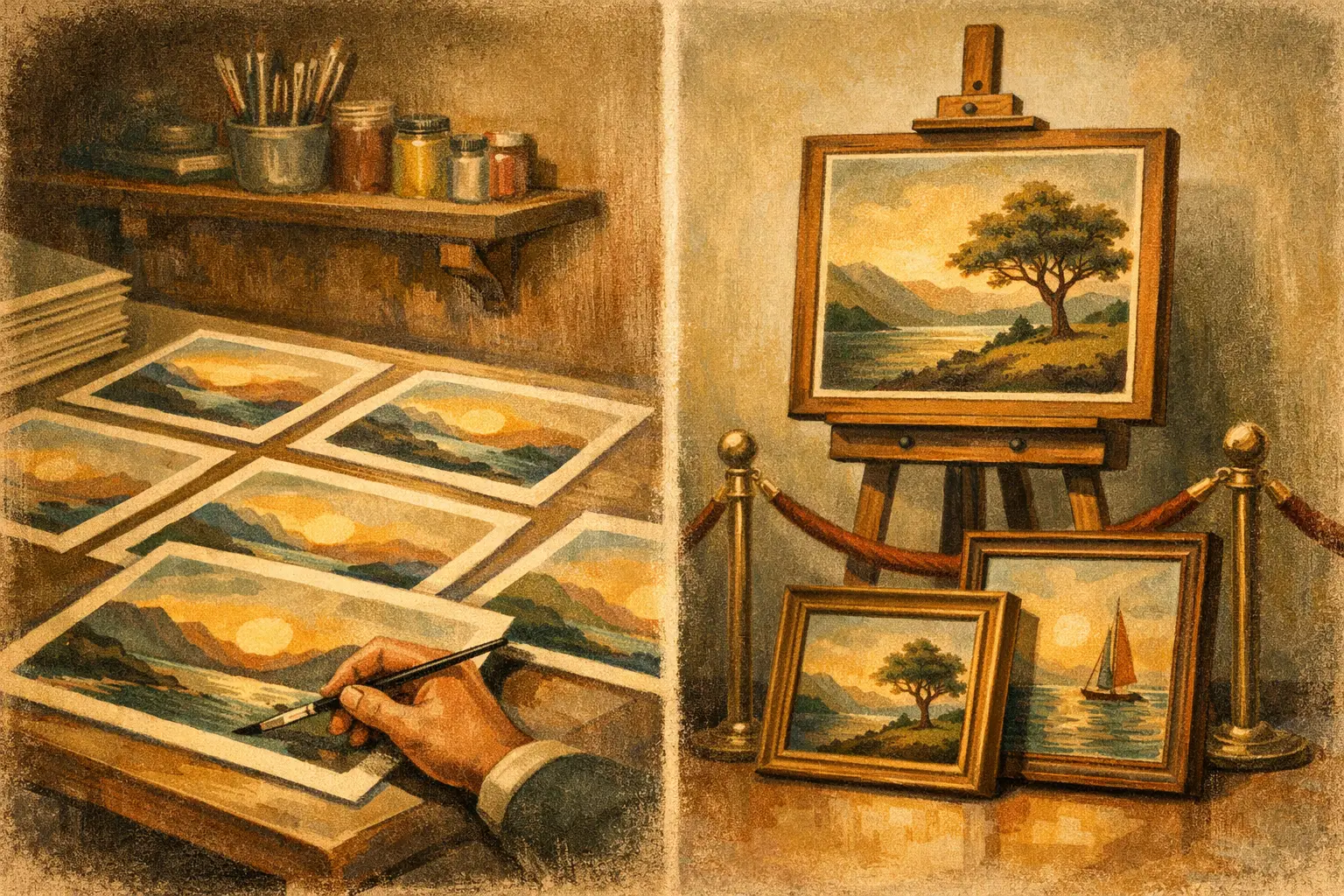
A print can transform a room in an afternoon, but the edition you choose shapes more than the wall. In the conversation around open edition versus limited edition, the real question is not simply rarity. It is how you want to live with art, what kind of value matters to you, and whether you are buying for atmosphere, collecting, or both.
For some buyers, the right work is about quiet presence – a piece that brings balance to a bedroom, gravity to an entryway, or stillness to a hospitality space. For others, the edition itself carries part of the meaning. Scarcity, authorship, and collectibility become part of the artwork’s life. Neither approach is inherently better. Each serves a different kind of relationship between art, home, and buyer.
Open edition versus limited edition: the core difference
An open edition print has no fixed cap on the number produced. If demand continues, more can be printed over time. A limited edition print is released in a set quantity – perhaps 25, 50, or 100 impressions – after which that edition is closed.
That sounds straightforward, but the implications are more subtle. Open editions are often chosen for accessibility. They allow more people to bring a work into their home at a lower price point, often without sacrificing visual quality when the production standard is high. A museum-quality Giclée print can still hold remarkable depth, tonal precision, and material beauty, even when it is not scarce.
Limited editions introduce a different layer. The finite number gives the work a sense of boundary and intention. Buyers are not only choosing the image, but also entering a smaller circle of ownership. In art collecting, that distinction matters because rarity can support desirability, and desirability can influence long-term market perception.
Why edition type changes the feeling of a purchase
Art is emotional, but buying art is also interpretive. The format tells you something about how the work is meant to circulate in the world.
An open edition often feels democratic. It invites broader access. This can be especially appealing for design-minded buyers who care deeply about aesthetic integrity but are furnishing a full home, styling multiple rooms, or sourcing for a project budget. The emphasis is on living with the image itself – its mood, composition, and ability to shape space.
A limited edition tends to feel more ceremonial. There is a sense of occasion in acquiring one. The number on the edition, the signed certificate, the knowledge that availability will narrow over time – these details can deepen attachment. For collectors and specifiers seeking a more distinctive story behind a piece, that added dimension can matter as much as the image.
Pricing, value, and what you are really paying for
The most visible difference in open edition versus limited edition is usually price. Open editions are generally more affordable because the supply is not fixed. Limited editions tend to cost more because scarcity is built into the offering.
Still, price is not only about scarcity. It also reflects print quality, paper choice, framing, artist recognition, curatorial context, and how the work is presented. A poorly produced limited edition is not automatically more meaningful than a beautifully made open edition. In the same way, affordability should not be mistaken for disposability. Some open edition prints become lasting anchors in a home because the image resonates so completely with the space.
What you are really paying for depends on your priorities. If you want visual impact and museum-level production at a more accessible entry point, an open edition may be the wiser choice. If you value rarity, potential collectibility, and a stronger sense of exclusivity, a limited edition will usually justify its premium more clearly.
Which edition is better for collectors?
For buyers building a collection with long-term intent, limited editions often carry more weight. They create a finite pool of ownership, which can strengthen the work’s standing over time, especially when the artist’s profile grows or the release is part of a well-defined series.
That said, collecting is not always about resale. Many thoughtful collectors acquire work because it marks a period in their life, reflects a philosophical interest, or creates dialogue with other pieces in the home. In that context, an open edition can still belong in a serious collection, particularly when chosen with discernment and produced to a high standard.
A useful question is this: are you collecting the image, or are you collecting the edition? Often, the most honest answer is both – but one usually matters more.
Limited editions and long-term perception
Limited editions tend to carry stronger secondary-market logic because scarcity is measurable. If there are only 30 prints, that fact can support future demand. But scarcity alone does not guarantee appreciation. The artist’s reputation, the quality of the work, and the relevance of the edition all matter.
Open editions and aesthetic collecting
Open editions are often ideal for buyers whose collection is rooted in atmosphere rather than investment logic. They allow for a more fluid, interior-driven way of collecting – one where harmony, emotional tone, and spatial composition guide the decision.
Which edition works best in interiors?
For interiors, the answer often depends on scope. If you are designing a single intimate room, a limited edition can create a beautiful focal point with a stronger sense of individuality. In a primary bedroom, study, or refined lounge, that quiet exclusivity can feel especially appropriate.
If you are curating a full home, staging a project, or specifying art across multiple spaces, open editions may offer more flexibility. They make it easier to maintain a cohesive visual language without placing the entire budget into one or two works. For designers and hospitality buyers, this balance is practical and aesthetically sound.
There is also the question of placement. A limited edition may feel best in a space where it can be contemplated, not rushed past. An open edition can perform beautifully in transitional spaces as well as living areas, where its role is to set a mood and support the architecture of daily life.
Quality matters more than many buyers expect
One of the most common misconceptions is that open edition means lower quality. It can, but it does not have to. Edition size and production quality are separate decisions.
A finely made open edition print on archival paper, with excellent color accuracy and thoughtful framing, can feel every bit as elevated as a limited edition at first encounter. The tactile and visual experience matters deeply, especially in minimal interiors where every detail is more exposed.
This is why buyers should look beyond the label. Ask how the work is printed, what materials are used, whether the finish suits the image, and how the piece will sit within natural light, wall color, and surrounding textures. In many cases, the success of the artwork in the room will depend less on edition type than on production integrity.
How to choose between open and limited edition
The clearest decision usually comes from purpose. If your goal is to bring depth, calm, and visual identity into a space without overextending your budget, an open edition is often the most elegant answer. If your goal is to acquire something with a more defined collector profile, or to mark a particular work as significant in your personal collection, limited edition makes stronger sense.
It also helps to think about tempo. Open editions allow you to collect gradually and intuitively. Limited editions ask for more decisiveness because availability can disappear. Neither is superior. They simply reflect different rhythms of buying.
At Taygeta Gallery, this distinction is especially meaningful because many buyers are not choosing between decoration and collection. They want both – art that lives beautifully in the home and still carries curatorial substance. In that space, edition choice becomes less about status and more about alignment.
A more honest way to think about value
Open edition versus limited edition is often framed as access versus exclusivity. That is true, but incomplete. The better lens is intimacy. How close do you want to stand to the artwork’s story? Do you want a beautiful image that changes the emotional temperature of a room, or do you want the added knowledge that your version belongs to a finite group?
Sometimes the right answer is the open edition that lets you live with exceptional work now, rather than postponing the purchase in pursuit of rarity. Sometimes it is the limited edition that feels unmistakably yours. The most satisfying choice is rarely the most formulaic one. It is the one that suits your space, your pace, and the kind of meaning you want art to hold.
A good artwork does not ask to be justified only by scarcity. It asks whether you will keep seeing something new in it, season after season, in the quiet of your own rooms.
Leave a Reply