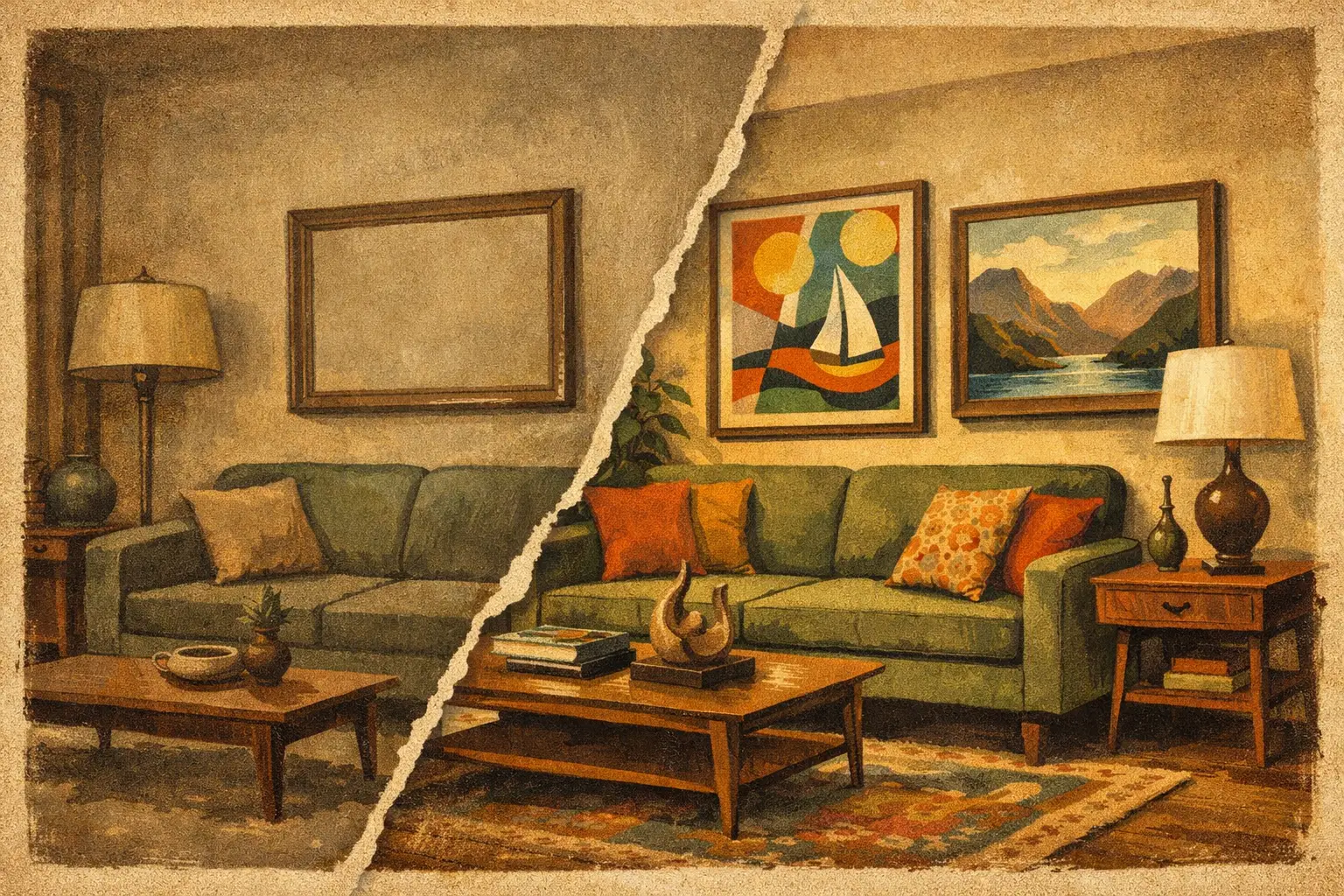
A living room art transformation example rarely begins with a dramatic renovation. More often, it begins with a room that is already functional but somehow unfinished: a sofa facing an empty wall, careful furniture without a center of gravity, light moving across surfaces with nowhere to rest. The right artwork does not simply fill that wall. It changes how the room holds silence, color, and presence.
Consider a common urban living room: warm-white walls, a low oatmeal linen sofa, oak flooring, a black floor lamp, and a textured rug in soft gray. The architecture is restrained and the furnishings are thoughtful, yet the space feels provisional. The wall above the sofa is broad, unmarked, and visually louder for its emptiness. This is not a problem to solve with decoration. It is an opportunity to establish atmosphere.
A Living Room Art Transformation Example in Three Decisions
The transformation of this room came through three connected choices: scale, visual temperature, and restraint. None works fully without the others.
First came scale. Instead of arranging several small prints in a neat grid, the room called for one generous work, approximately two-thirds the width of the sofa. A single large-format abstract print, framed simply in natural oak, gave the wall a calm authority. The dimensions mattered as much as the image. Small art would have made the sofa appear larger and the room more fragmented. A substantial piece allowed the wall and furniture to read as one composition.
The work itself was built from mineral gray, ink black, faded clay, and a quiet field of bone white. Its marks suggested weathered stone or a distant horizon without becoming illustrative. That ambiguity gave the room room to breathe. It echoed the palette already present, but it also introduced a deeper register: black was no longer only the floor lamp’s functional accent; clay was no longer only a faint note in the rug. The artwork drew these dispersed details into a visual conversation.
Finally, the choice was to stop. No additional art was added to the adjacent wall. A ceramic vessel and a small stack of books remained on the coffee table, but the room was not styled into still life. Negative space became part of the result. In interiors shaped by a Wabi-Sabi sensibility, absence is not lack. It is a material of its own.
Before: Pleasant, but Without a Point of View
Before the artwork arrived, the room had all the expected ingredients of contemporary comfort. It was clean, soft, and usable. Yet each element behaved independently. The sofa offered comfort, the lamp offered light, the rug offered texture, but nothing held the eye long enough to create emotional continuity.
This is why a blank wall can feel more conspicuous than a crowded one. It does not necessarily need more objects. It needs a deliberate visual anchor. Art can perform this role because it brings an inner world into the room. A painting or museum-quality Giclée print introduces gesture, history, material suggestion, and a point of view that furniture alone rarely provides.
After: A Room With Rhythm and Stillness
Once the artwork was installed, the sofa became less like a standalone purchase and more like part of a lived composition. Guests entering the room naturally looked toward the work, then noticed the lamp, the grain of the wood floor, and the irregular weave of the rug. The space felt more resolved, not because every surface had been addressed, but because the important relationships had.
The change was also emotional. The room seemed quieter. Abstract art can have this effect when it avoids literal instruction. Rather than telling viewers exactly what they are seeing, it creates a place for memory and attention. In a living room, where people rest, speak, read, and return to themselves, that openness has lasting value.
Why One Large Artwork Changed the Room
A large work has a particular ability to alter perceived proportion. It can make a modest room feel more intentional and a standard ceiling height feel more expansive. This is not an argument that bigger is always better. An oversized work in a narrow room may feel imposing, while a small, jewel-like painting can be precisely right above a chair, sideboard, or fireplace mantel.
Above a sofa, however, undersizing is the most frequent missed opportunity. As a useful starting point, choose art that spans roughly 60 to 75 percent of the furniture width below it. Hang the center of the work near eye level, typically around 57 to 60 inches from the floor, then adjust for the furniture and ceiling line. When artwork sits about 6 to 10 inches above the sofa, it tends to feel connected to the room rather than stranded on the wall.
In this example, the generous scale did more than occupy space. It simplified the visual field. A single composition asked less of the eye than a cluster of unrelated images, which suited a room intended for rest. For collectors who love varied imagery, a salon arrangement can be deeply personal and dynamic. But it needs enough wall area, a clear organizing principle, and a willingness to embrace abundance. Calm interiors often benefit from fewer, more resonant decisions.
Color Should Echo, Not Repeat
The strongest art choices do not always match the sofa cushions. Exact matching can make an interior feel predetermined, as if every element arrived from the same showroom. A more lasting approach is to look for visual echoes.
In the transformation above, the artwork did not duplicate the room’s colors. It deepened them. Its black passages gave weight to the lamp and created contrast against the pale wall. Its clay undertone warmed the gray rug. Its pale areas preserved luminosity around the sofa. The art belonged to the palette without being absorbed by it.
This distinction is especially useful in neutral interiors. A neutral room is not necessarily a colorless room. It may contain warm and cool whites, ash, sand, smoke, moss, rust, or indigo in low saturation. Art gives those subtle shifts a voice. For a more expressive result, select one work with a concentrated accent such as vermilion, ultramarine, or deep green, then allow that note to remain mostly un-repeated elsewhere. A single unexpected color can create tension without disturbing harmony.
The Frame Is Part of the Composition
Framing is often treated as a finishing detail. In fact, it changes the perceived character of the art and its relationship to the room. The natural oak frame in this living room supported the flooring and introduced tactile warmth around a cool-toned image. Had the same work been framed in glossy black, it would have felt sharper and more architectural. In a slim white frame, it might have seemed lighter, more suspended, and less grounded.
There is no universally correct choice. Black frames bring definition and can suit graphic, monochrome, or contemporary work. Natural wood is often sympathetic to organic abstraction and rooms with visible grain, linen, wool, or clay. White frames preserve airiness, particularly when the artwork has a quiet border or the interior is spare. What matters is that the frame does not compete with the image or ignore the materials already in the space.
Museum-quality printing also matters in a transformation like this. A nuanced abstract image relies on delicate tonal shifts, deep blacks, and textured transitions that can disappear in poor reproduction. A carefully produced Giclée print can preserve the feeling of the original work while offering a considered entry into collecting. For those selecting art online, seeing accurate dimensions, edition details, paper quality, and framing options is not merely practical. It supports a more confident aesthetic decision.
Let the Art Lead, Then Let the Room Settle
After installing a focal artwork, resist the urge to immediately add more. Live with it through morning light, evening shadows, and ordinary use. Notice whether the work asks for a different throw, a quieter lamp shade, or simply less on the coffee table. Art often reveals what a room can release.
At Taygeta Gallery, the most memorable interiors are not those that display the most art. They are the ones where each work has been given enough visual and emotional space to speak. A living room becomes more personal when its art does not perform for the room, but gently changes the way the room is experienced.
Leave a Reply