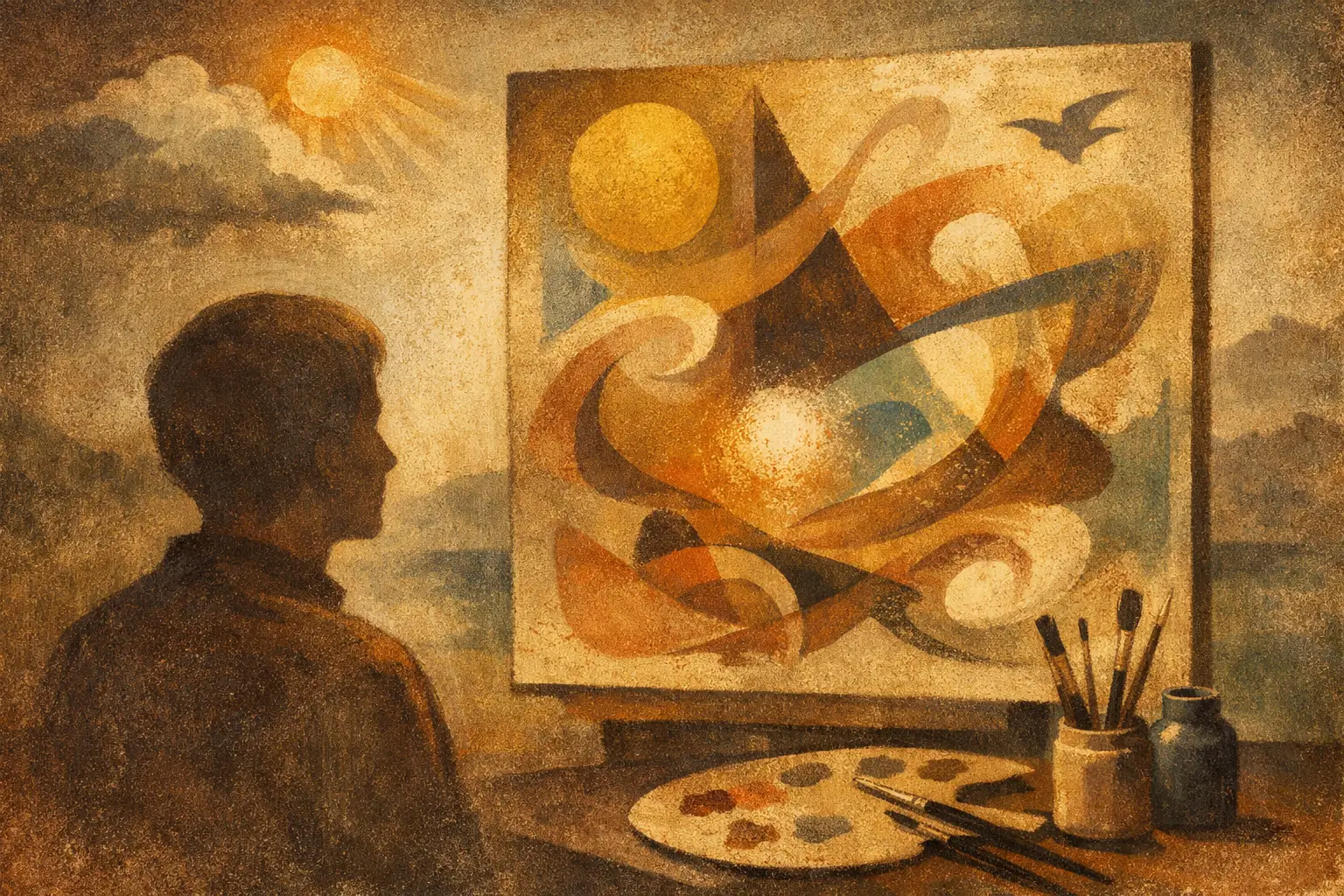
Some artworks fill a wall. Others alter the atmosphere of a room. Spiritual abstract painting belongs to the second category. It does not explain itself in literal terms, and that is often its power. Through color, gesture, texture, and space, it creates a field of feeling – one that can calm, unsettle, center, or quietly open the viewer to reflection.
For design-conscious collectors, this genre offers something increasingly rare: visual restraint with emotional depth. It can hold its own in a minimal interior, yet it rarely feels cold. It speaks in suggestion rather than statement, which makes it especially resonant in homes and spaces shaped by simplicity, contemplation, and personal taste.
What makes a painting feel spiritual
A spiritual painting is not defined by religious imagery alone. In abstract art, spirituality often appears through mood, rhythm, and the artist’s handling of presence and absence. A canvas may contain no recognizable figure, symbol, or sacred reference, yet still feel meditative, transcendent, or inward.
This quality often comes from a subtle balance. Repetition can suggest ritual. Open space can evoke silence. Layered surfaces can carry a sense of time, memory, or impermanence. In some works, a single concentrated form becomes an anchor, much like a breath in meditation. In others, dissolving edges and muted tones create the feeling of something emerging and receding at once.
That is why spiritual abstract painting is so often aligned with Eastern aesthetics, especially Zen and Wabi-Sabi. These philosophies do not rely on spectacle. They value emptiness, asymmetry, weathered beauty, and the quiet dignity of what is unfinished. In painting, those qualities can feel intimate and expansive at the same time.
Why spiritual abstract painting works in modern interiors
Not every meaningful artwork lives well in a contemporary space. Some pieces are visually compelling but too insistent for everyday living. Spiritual abstraction tends to work differently. It can transform a room without dominating it.
In a bedroom, it may create softness and stillness. In a living area, it can become a visual pause between harder architectural lines. In entryways, reading corners, wellness spaces, and hospitality settings, it offers emotional tone before a single word is spoken. This is especially true when the work uses restrained palettes, organic mark-making, or balanced negative space.
There is also a practical reason buyers are drawn to it. Abstract work allows interpretation to remain open. A collector does not need to match a painting to a narrative scene or period style. Instead, the piece can relate to material, light, and mood. That flexibility makes it easier to place within layered interiors while still feeling original.
How to read spiritual abstract art
The first response should not be analytical. It should be sensory. Stand with the work and notice what changes in your body. Does it slow you down? Does it sharpen attention? Does it feel spacious, dense, tender, austere?
After that, look at structure. Where does the eye rest? Where does it move? Is the composition built around tension or release? Spiritual abstraction often asks the viewer to notice what is withheld as much as what is shown. A quiet corner of untouched ground may matter more than the boldest gesture.
Color also carries meaning here, though not in fixed formulas. Earth tones can suggest grounding, but they can also feel heavy if overworked. White can imply clarity, though in some paintings it reads as distance or erasure. Deep indigo, charcoal, ochre, rust, ash, and faded mineral hues often appear in works shaped by contemplative or elemental themes because they feel connected to nature, aging, and inner life.
Choosing a piece for your space
The best spiritual abstract painting is not necessarily the most serene one. It is the one that creates the right kind of presence for the room. Some spaces need quiet. Others need gravity, movement, or emotional contrast.
Scale matters more than many buyers expect. A small, intimate work can feel devotional in a private setting. A large-scale piece can establish a whole room’s emotional architecture. Framing matters too. A minimal frame can sharpen the work’s stillness, while a more tactile presentation may emphasize materiality and warmth.
Quality should never be an afterthought, especially online. Surface nuance, tonal variation, and edge detail are essential in abstract art because so much meaning lives in those subtleties. Whether collecting an original work or a museum-quality Giclée print, buyers should look for faithful color reproduction, strong materials, and a presentation that respects the artwork’s atmosphere. At Taygeta Gallery, this curatorial standard is part of what allows contemplative art to retain its presence beyond the screen.
A genre that asks for attention, not noise
Spiritual abstraction does not compete well with visual clutter. Its strength is cumulative. The more time spent with it, the more it reveals. That makes it particularly rewarding for collectors who want art that lasts beyond first impression.
In a culture crowded with images demanding instant reaction, this kind of painting offers another pace. It invites looking without urgency. It asks less for agreement than for presence. And that, perhaps, is why it continues to resonate so deeply in contemporary interiors – not as decoration alone, but as a form of atmosphere, reflection, and quiet companionship.
Leave a Reply