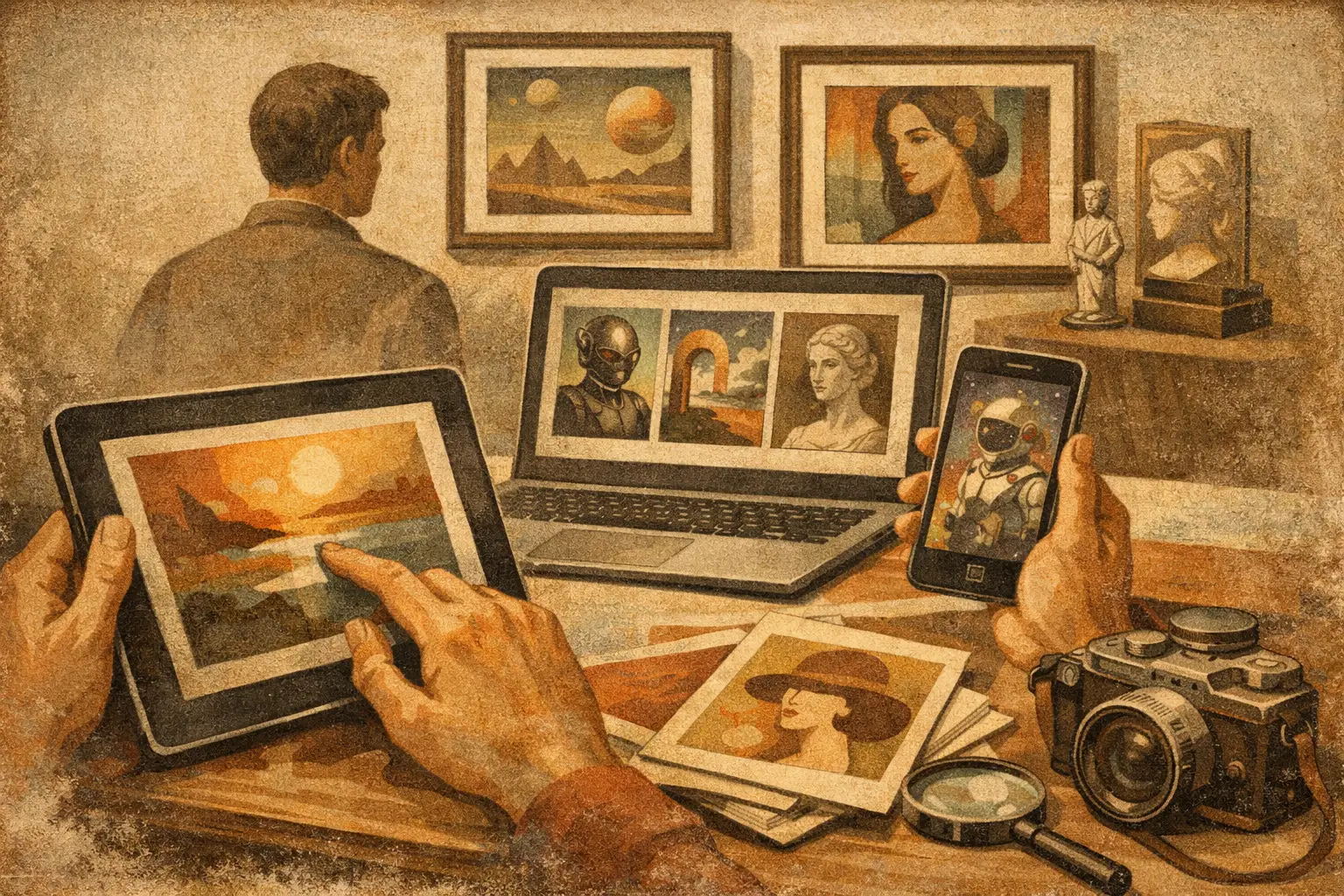
A few years ago, buying digital art still felt like a niche gesture – interesting, often experimental, and slightly outside the language of traditional collecting. That has changed. Digital art collecting trends now reveal something more mature: buyers are not only chasing novelty, but building spaces and collections around mood, meaning, and permanence. The shift is less about technology alone and more about taste.
For collectors, designers, and thoughtful homeowners, this matters. Digital art has moved beyond the screen-bound image and into the realm of material presence – framed editions, museum-quality prints, and carefully produced works that live with the same authority as painting or photography. The most interesting changes are happening where visual culture, interior atmosphere, and collectibility meet.
Digital art collecting trends are moving toward material presence
One of the clearest shifts is a return to the object. While digital art was once discussed mainly in terms of format or platform, many buyers now want something tangible: a limited-edition print, a framed piece with archival quality, or a collector edition that brings digital creation into physical space.
This is not a contradiction. It is a sign of maturity. Collectors may admire the fluidity of digital practice, but they still live among walls, light, texture, and scale. A work has to hold its own in a room. It has to change the feeling of a hallway, a bedroom, a quiet office, or a hospitality setting.
That is why production quality has become central to value. Paper, pigment, framing, edition size, and presentation are no longer afterthoughts. They shape trust. A digital artwork that is beautifully produced can feel intimate, lasting, and complete. A poorly produced one still feels disposable, no matter how compelling the image might be.
Buyers are collecting atmosphere, not only images
The strongest collections are rarely built around isolated visuals. They are built around a sensibility. In digital art, this has opened space for collectors who are less interested in spectacle and more drawn to calm, ambiguity, and emotional depth.
Minimal abstraction, meditative compositions, surreal but restrained imagery, and works influenced by Zen or Wabi-Sabi aesthetics are finding a natural audience. These pieces do not compete with an interior. They create a field of feeling around it. They allow a room to breathe.
This is one of the more meaningful digital art collecting trends because it reflects a change in buyer intention. Many people are no longer buying art simply to fill a blank wall or signal trend awareness. They want art that creates stillness, tension, softness, or introspection. They want a piece to participate in the life of a space.
For design-conscious buyers, that often means choosing work with tonal subtlety, conceptual clarity, and enough restraint to remain compelling over time. Loudness can be seductive in the short term. Living with art is different. The best digital works for collecting tend to reveal themselves slowly.
The rise of the quiet statement
There is a growing preference for art that feels distinct without feeling performative. In practical terms, that means muted palettes, layered forms, contemplative negative space, and compositions that suggest rather than explain.
This does not mean collectors have abandoned bold work. It means boldness itself is being redefined. A quiet piece can be more commanding than an overt one if it is placed well and produced with care.
Editions and scarcity are becoming more thoughtful
Scarcity still matters in collecting, but buyers are becoming more discerning about what kind of scarcity feels credible. Artificial urgency has worn thin. A large promised edition that feels endlessly reproducible does not offer much reassurance, even in digital media.
Instead, collectors are responding to editions that are clearly defined, well documented, and supported by curatorial context. They want to understand why a work exists in a certain number, how it was produced, and what distinguishes one release from another.
This is especially true for first-time collectors entering the category through accessible price points. Limited editions give structure to the purchase. They make the work feel considered rather than mass-issued. But editioning alone is not enough. The artwork itself still has to earn attention.
There is a useful tension here. Digital media makes replication easy, yet collecting depends on distinction. The galleries and artists who navigate this well tend to focus on integrity rather than hype: strong authorship, transparent editioning, museum-quality output, and a clear sense of the work’s place within a broader practice.
Curation matters more than endless choice
The internet made art widely available. It also made it exhausting. For many buyers, the challenge is no longer access but filtration. Too much digital art is presented without hierarchy, story, or context, which leaves buyers sorting through visual noise.
That is why curation has become one of the decisive forces shaping the market. People are drawn to collections that feel edited by a human eye with aesthetic conviction. They want to see relationships between works, not just inventory. They want to understand how a piece sits within a theme, a movement, a mood, or an interior language.
This is particularly relevant in digital art, where the medium itself can be misunderstood as broad and impersonal. Thoughtful curation restores intimacy. It says: this work belongs here, in conversation with these ideas, these forms, this emotional register.
For galleries with a clear point of view, this creates a real advantage. Taygeta Gallery, for example, speaks to buyers who want digital and contemporary works that feel serene, intentional, and spatially refined rather than generic or trend-chasing.
Why curated context builds confidence
Collectors often need more than a product description. They need a frame of meaning. When a work is placed within an aesthetic philosophy or a carefully shaped collection, the buyer can imagine living with it more clearly.
That confidence is not abstract. It affects purchasing decisions, especially online, where physical viewing is limited. A curated presentation reduces uncertainty and makes quality legible.
Interior designers are influencing digital art collecting trends
Another major shift is the growing overlap between art collecting and interior specification. Designers, stylists, hospitality groups, and project buyers are shaping demand in subtle but significant ways. They often seek work that is visually distinctive yet flexible enough to sit within a broader material palette.
Digital art is especially well suited to this environment because it can be produced at different scales and in editions that support residential and commercial projects alike. But scale alone is not the reason for its growth. The appeal lies in control and cohesion. Designers can source pieces that feel contemporary, emotionally intelligent, and aligned with a space’s architecture.
This has pushed collecting toward a more spatial mindset. Buyers now ask different questions: How will this piece read across a room? What happens under natural versus artificial light? Does the framing support the architecture? Will the work still feel balanced when the room evolves?
Those are collector questions as much as design questions. The line between the two has become thinner.
Authenticity now means authorship and emotional clarity
In digital media, authenticity can be misunderstood. It does not simply mean that a file exists first or that a work uses a certain tool. For serious buyers, authenticity comes from authorship. It comes from whether the work bears a real artistic intelligence, a recognizable visual language, and an emotional logic that cannot be reduced to trend.
This is why narrative has become so important. Not inflated storytelling, but genuine context. Who made the work? What sensibility does it belong to? Why does this image feel necessary rather than merely possible?
Collectors are increasingly capable of sensing the difference. They do not need every work to be loud with theory, but they do want to feel intention. The market is rewarding art that has both aesthetic immediacy and depth of origin.
What collectors should watch next
The next phase of digital art collecting will likely be less obsessed with novelty and more focused on longevity. Expect continued demand for works that bridge digital creation with physical permanence, especially limited editions made to museum-quality standards. Expect stronger interest in art that supports calm, layered interiors rather than visual excess. And expect curation to become even more valuable as buyers turn away from endless undifferentiated platforms.
There will always be segments of the market driven by speculation, speed, or trend cycles. But for many collectors, the more lasting movement is quieter. It is about choosing work that holds atmosphere, not just attention. It is about finding art that feels contemporary without becoming disposable.
A good digital artwork should still feel alive after the novelty fades – when the room is dim, the day is long, and you are no longer looking for something new, only something true.
Leave a Reply