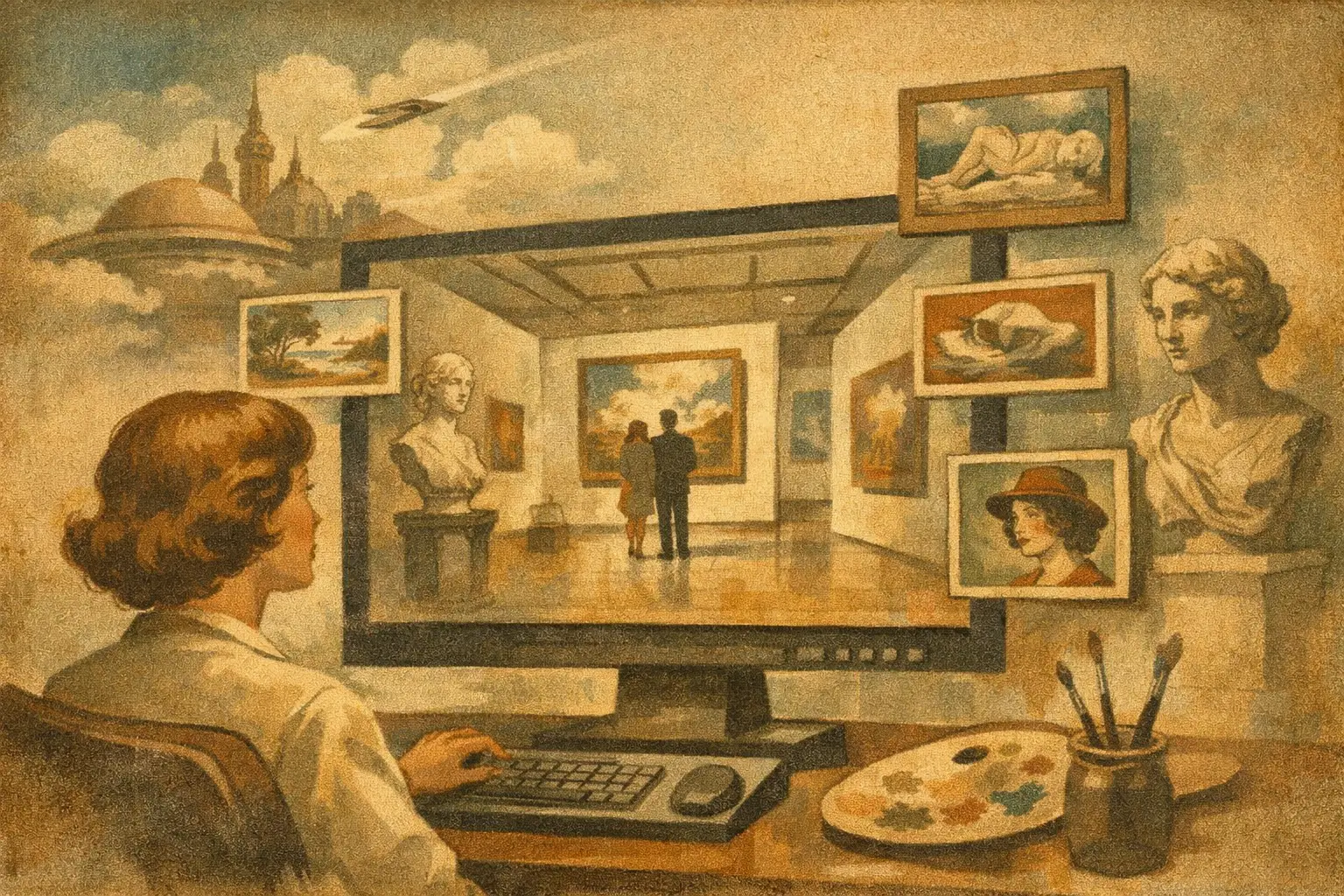
A quiet shift is already underway. The future of online art exhibitions will not be defined by flashy technology alone, but by something more enduring – how thoughtfully art is presented, felt, and remembered through a screen.
For years, digital exhibitions were treated as substitutes for physical shows, useful but secondary. That view is fading. Online exhibitions are becoming their own curatorial form, with distinct strengths: global access, slower viewing, richer context, and a direct path from emotional connection to acquisition. For collectors, homeowners, and design professionals, this change matters because it alters not only where art is discovered, but how taste is formed.
Why the future of online art exhibitions feels different now
The early digital gallery often mimicked a white-wall room. A grid of artworks, a few installation views, a brief curatorial statement. It served a purpose, but rarely created atmosphere. What buyers increasingly want is not a database of available works. They want orientation. They want to understand why these pieces belong together, what mood they hold, and how they might live inside a real space.
This is where the next phase is becoming more sophisticated. The strongest online exhibitions are moving away from the simple act of display and toward the art of framing perception. That includes better storytelling, stronger visual pacing, more meaningful artist context, and a clearer sense of how a work exists beyond the browser window.
For a gallery with a refined point of view, this is an advantage. Curation becomes more visible online, not less. A carefully built exhibition can guide the eye with remarkable precision, inviting the viewer into stillness rather than asking them to scroll past endless options.
The future of online art exhibitions is more curatorial, not less
There is a common assumption that digital space makes curation looser. In practice, the opposite is true. Because attention online is fragile, selection must be sharper. Every image, sequence, and line of text carries more weight.
The most compelling exhibitions of the coming years will feel edited with restraint. Instead of overwhelming viewers with hundreds of works, galleries will present tighter groupings with stronger conceptual coherence. Themes such as impermanence, silence, memory, or spatial tension translate especially well online when supported by thoughtful visual rhythm.
This matters for buyers who are furnishing a home, shaping a hospitality project, or collecting with intention. They are not only looking for a work they like. They are looking for a visual language they can trust. In that sense, the online exhibition becomes a filter for quality and sensibility.
A well-curated digital show can also collapse the distance between editorial and commerce. The exhibition does not need to feel like a sales page to support collecting. In fact, the more intelligently it is framed, the more confidence it creates. When viewers understand the curatorial logic, the purchase feels less impulsive and more considered.
From static pages to immersive atmosphere
Immersion will remain part of the conversation, but not every exhibition needs a simulated 3D museum. That format can be useful, especially for design clients who need a spatial sense of scale, but it is not always the most elegant solution. Sometimes it slows the experience or distracts from the work itself.
The future is likely to be more selective. Galleries will use immersive tools where they deepen understanding, not simply because they exist. Room views, framing previews, close-up texture details, audio narration, and cinematic transitions can all help a viewer feel nearer to the work. The key is discretion.
Atmosphere online is built through pacing as much as technology. A sequence of spare installation imagery, a concise curatorial text, and generous negative space can create more emotional presence than an overbuilt virtual environment. This is especially true for minimal, abstract, and contemplative work, where silence is part of the experience.
Context will become part of the artwork’s value
As online art buying matures, context will matter even more. Buyers want to know what they are looking at, but also why it matters. They want the story of a series, the philosophy behind a collection, the process of an artist, and the material quality of the final piece.
This is one of the clearest opportunities in the future of online art exhibitions. A digital format can hold layers of interpretation without crowding the visual field. Viewers can move from image to statement to detail to edition information at their own pace. That freedom supports both new collectors and experienced ones.
It also supports design professionals, who often need practical clarity alongside aesthetic inspiration. Dimensions, framing options, edition sizes, lead times, and placement suggestions are not secondary details. They are part of how confidence is built. The future exhibition will blend emotion and specification more gracefully, serving both the heart and the project schedule.
Online exhibitions will shape interiors more directly
The relationship between art and interior design is becoming more integrated. Increasingly, buyers do not discover art after a room is finished. They use art to set the emotional register of the space from the beginning.
This is why online exhibitions have such influence ahead of them. They can present not just individual works, but whole aesthetic worlds. A collector may enter through a theme such as Wabi-Sabi or Surrealist stillness and begin to imagine a room around that mood. A hotel group may view a digital exhibition and see a complete visual direction for a property.
In this sense, exhibitions are becoming tools for specification as much as appreciation. That does not reduce the art to decor. It acknowledges a truth many serious buyers already understand: art changes the psychological temperature of a space. The best digital exhibitions make that effect legible.
For galleries like Taygeta Gallery, this creates a particularly natural path. A strong curatorial identity can speak to private collectors and trade clients at the same time, provided the presentation remains elevated and clear.
Trust, transparency, and quality will matter more than novelty
New formats attract attention, but trust closes the distance. As more collectors buy online, they are becoming more discerning about production quality, edition integrity, and presentation standards. A beautiful exhibition means little if the buyer is left uncertain about what will arrive.
That is why the future of online art exhibitions will also be shaped by quieter signals: precise photography, faithful color representation, museum-quality print details, clear provenance language, secure purchasing, and reliable global fulfillment. These are not glamorous features, but they are essential.
There is also a broader cultural shift here. The online art buyer is no longer assumed to be casual or purely price-driven. Many are serious, visually literate, and willing to invest when the work feels distinctive and the gallery feels credible. The digital exhibition must meet that level of seriousness.
The role of AI and personalization
Personalization will expand, though it comes with trade-offs. Galleries can use intelligent recommendations to guide viewers toward works aligned with their taste, room size, or collecting history. That can be genuinely helpful, especially in larger inventories.
Still, there is a risk when personalization becomes too predictive. Art should surprise us. It should interrupt preference as often as it confirms it. If every exhibition is optimized only to show viewers what they already tend to like, discovery narrows.
The better approach is a balanced one. Let technology assist with relevance, but let curators preserve friction, contrast, and nuance. A meaningful exhibition often introduces an unexpected work that reveals a new appetite the viewer did not yet have language for.
A slower, more intentional digital culture
Perhaps the most interesting part of this future is not speed, but slowness. Online space is often blamed for compressing attention, yet art can resist that pressure when presented with care. A digital exhibition can invite lingering. It can create a pocket of calm inside the noise of commerce and media.
That may be its deepest promise. Not to replace the physical encounter, which still holds its own irreplaceable power, but to create another kind of intimacy. One that is accessible across distance, open across time zones, and generous to viewers who want to return more than once before they decide.
The future of online art exhibitions will belong to galleries that understand this difference. Not every visitor wants spectacle. Many want clarity, beauty, and a sense that someone thoughtful has already done the hard work of selection.
The screen is no longer the obstacle it once seemed. In the right hands, it becomes a quiet room – one where art can still meet the eye slowly, and stay with it after the page is closed.
Leave a Reply