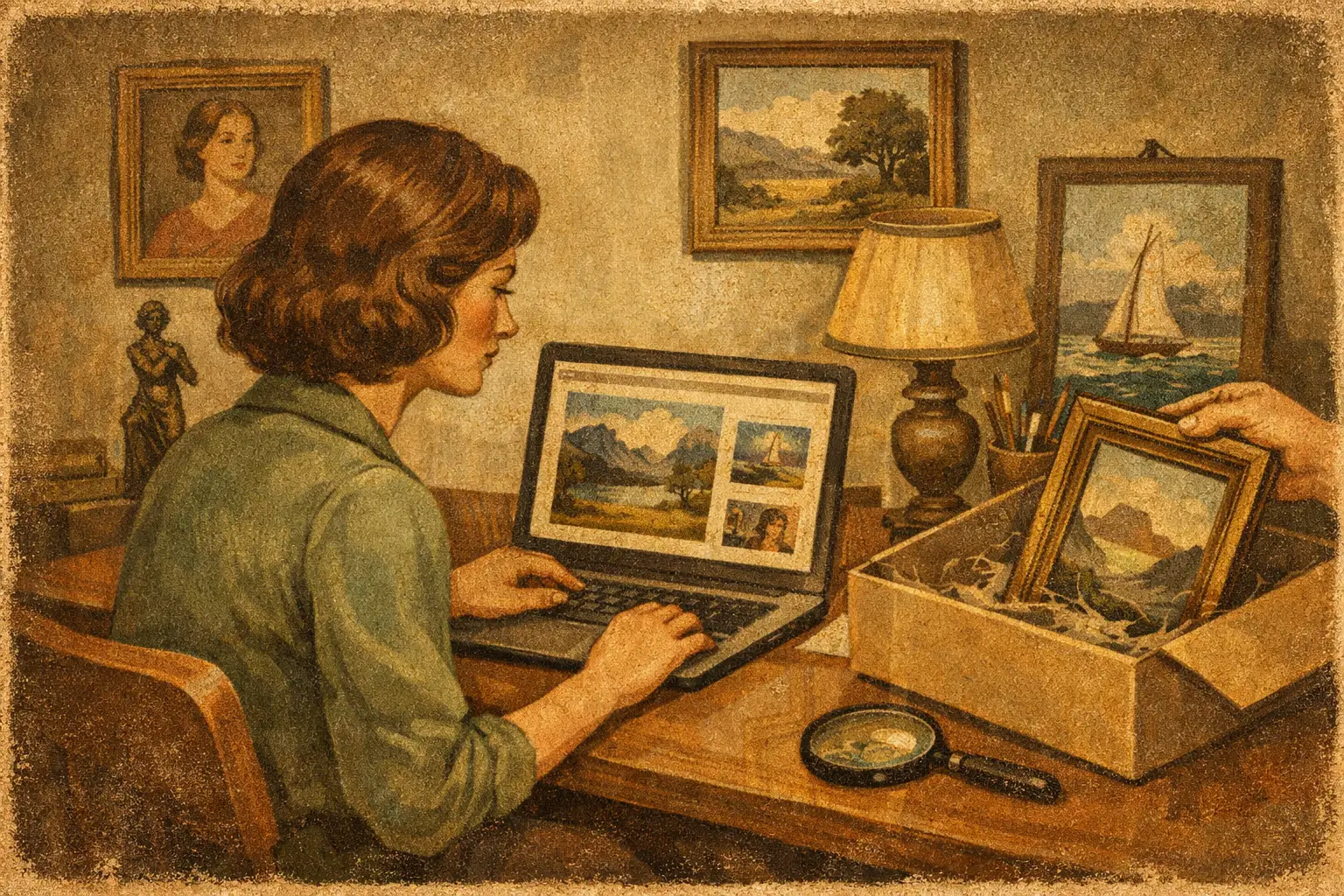
A screen can make almost any image look convincing. The real question is whether the work carries an identifiable artistic origin, material integrity, and the quiet presence that remains once it enters your room. When buying authentic artworks online, you are not simply choosing an image. You are choosing a relationship with an artist’s idea, a particular edition, and an object that will shape the atmosphere of your daily life.
For collectors and design-minded buyers, the online gallery has become an unusually rich place to find work beyond the predictable. It can offer direct access to emerging artists, curated editions, and museum-quality prints that would be difficult to encounter locally. Yet access also asks for discernment. Authenticity is not a mood or a marketing adjective. It is a set of clear, meaningful details that should be available before you purchase.
What Makes an Artwork Authentic?
Authenticity does not mean that every work must be a one-of-one original painting. An original drawing, a signed limited-edition print, a photograph produced in a fixed edition, and a licensed artist print can all be authentic artworks. What matters is that the work is honestly represented, traceable to its creator or authorized publisher, and produced in the format the gallery describes.
A useful distinction is between originality and authenticity. An original is typically a unique object: a painting with visible brushwork, a hand-built sculpture, a collage, or a drawing. Authentic editions are intentionally reproduced under the artist’s direction or through an authorized partnership, often in a limited quantity. Both can hold artistic and emotional value. They simply offer different forms of ownership.
This distinction is especially relevant for contemporary digital and abstract art. A digital composition may originate as a singular artwork but be made available as a signed, numbered collector edition or as an open edition. The image is not less real because it began digitally. Its value rests on authorship, production standards, edition transparency, and the care with which it is presented.
How to Verify Authentic Artworks Online
The best online galleries make verification feel straightforward rather than mysterious. Before you fall in love with a piece, read beyond the image. Look for a complete work description that identifies the artist, medium, dimensions, year or release, and whether the work is original, limited edition, or open edition.
Look for a clear chain of authorship
An artwork should have a credible connection to its maker. This may appear as an artist biography, an artist statement, exhibition history, a gallery profile, or a description of the collaboration between the artist and publisher. You are looking for specificity. Vague claims such as “inspired by” or “exclusive art” do not establish authorship on their own.
For an original work, ask whether it is signed, whether a certificate of authenticity is included, and whether the gallery can confirm its condition and provenance. Provenance simply means the documented history of ownership or origin. For newer works purchased directly from an artist or gallery, that history may be brief. That is normal. The essential point is that it is clear.
For editions, confirm who authorized the reproduction. A legitimate edition should name the artist or rights holder and explain its status. If the edition is limited, the total number should be stated, along with the number of the individual work when applicable, such as 12/75.
Understand the difference between limited and open editions
A limited edition has a defined production cap. Once the full edition is produced, no further prints should be released in that same edition, size, and format unless the terms clearly allow for an artist’s proof or a distinct later version. This finite nature can appeal to collectors who value rarity and a close connection to a specific release.
An open edition has no predetermined cap. It can still be authentic, beautifully produced, and deeply considered. It is simply intended to make an artwork more accessible. For a home, apartment, or hospitality project where visual coherence matters more than scarcity, an open edition may be the wiser choice.
Neither format is automatically superior. A limited edition may suit a collector building a focused body of work, while an open edition may allow a buyer to invest more generously in scale, framing, or a pair of complementary pieces.
Ask about materials, not just the image
A refined artwork is also a physical object. The quality of paper, ink, mounting, and frame changes how a piece receives light and how it endures over time. Museum-quality Giclée printing generally refers to high-resolution inkjet printing using archival pigment inks and fine-art paper or canvas. The term is meaningful only when supported by details about the actual materials.
Look for information about archival or acid-free paper, pigment-based inks, canvas quality, and protective finishing. If the work is framed, the gallery should be able to describe the frame material, glazing, matting if used, and hanging hardware. These details are not decorative footnotes. They determine whether a quiet field of color looks velvety and dimensional or flat and disposable.
Read the Artwork in the Context of Your Space
Online viewing has one limitation: scale is difficult to feel through a screen. A work that appears intimate on a product page may become commanding at 40 inches wide. Another may disappear above a sofa despite its strong presence in a close-up image.
Start with the wall, not the empty room. Measure the available width and height, then consider the furniture below or beside it. Above a sofa, a work or grouping often feels balanced when it occupies roughly two-thirds of the sofa’s width. In a narrow entry or beside a bed, a vertical composition can create calm without competing with the architecture.
Then consider the emotional temperature of the piece. A Wabi-Sabi-inspired composition with weathered textures, softened neutrals, and deliberate irregularity can bring stillness to a polished interior. Surrealist work may introduce tension, curiosity, or a welcome moment of visual escape. Art need not match every finish in a room. Often, its purpose is to create the thoughtful contrast that makes a space feel lived in rather than staged.
Screens also alter color. Calibrate expectations by reviewing detail images, room views, and any written notes about tones. A warm gray can read blue on one monitor and taupe on another. If a specific color match is critical for a design project, request additional information before ordering rather than relying on a single image.
Choose a Seller That Respects the Work
A trustworthy gallery does more than process a transaction. It gives the work context, makes production information accessible, and communicates clearly about pricing, fulfillment, returns, packaging, and international shipping. These practical elements matter because they reveal whether the gallery treats art as an object of care.
For framed work, secure packaging and insured delivery are particularly important. For large-scale projects, ask about lead times, volume purchasing, framing consistency, and whether the gallery can help curate a group of works with a unified visual language. A hotel lobby, residential development, or restaurant does not need identical art on every wall, but it does need a coherent rhythm.
It is also reasonable to ask direct questions before buying: Is this edition signed? Is the certificate included? What paper is used? Is the frame ready to hang? What happens if the work arrives damaged? A considered gallery will answer without making you feel that your questions are inconvenient.
Let Meaning Guide the Final Choice
There is a temptation to buy art online as if it were a finishing touch, selected only after the furniture and paint have been settled. But the most memorable interiors often work in the opposite direction. The artwork becomes a point of orientation. Its color, silence, energy, or strangeness gives the room a center.
Taygeta Gallery approaches this idea through curated works informed by stillness, impermanence, and contemporary visual culture. That perspective is valuable whether you are beginning a collection or specifying art for a larger project: choose what continues to offer something after the first glance.
A certificate, an edition number, and archival materials can help you purchase with confidence. The final measure is more personal. Choose the work that makes a pause feel worthwhile, and give it enough space to be seen.
Leave a Reply