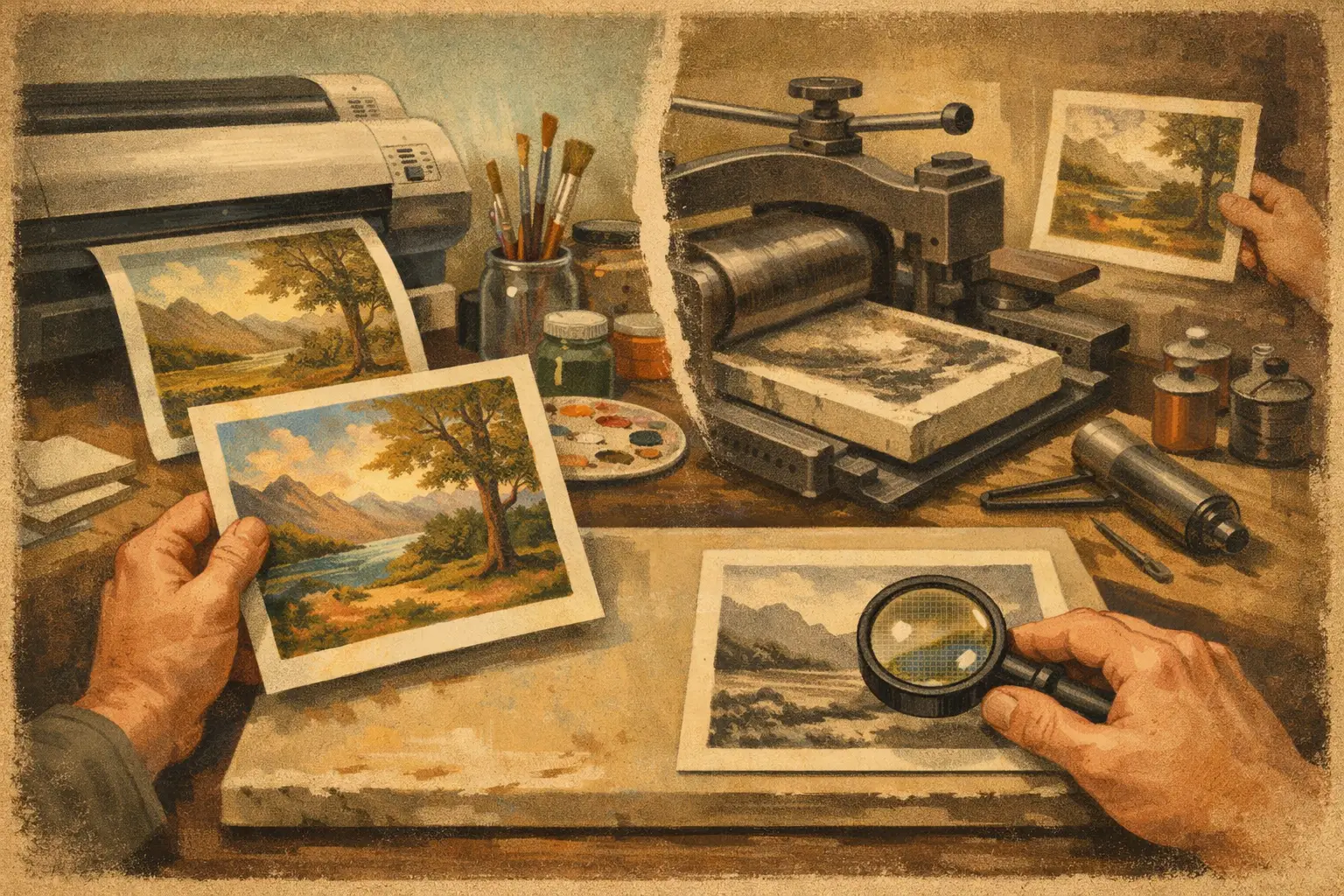
A print can hold the same quiet power as an original work when it has been made with intention. Yet the terms used to describe art prints are often treated as interchangeable, leaving collectors unsure what they are actually bringing into a room. In the question of giclee print vs lithograph, the meaningful distinction is not simply old versus new. It is about process, material presence, edition integrity, and the relationship you want with the artwork.
For a serene apartment wall, a layered hospitality project, or the first considered piece in a growing collection, both formats can be beautiful choices. The right one depends on what you value: the tactile history of a traditional printmaking method, the exceptional color nuance of contemporary pigment printing, or the particular hand of an artist behind an edition.
Giclee Print vs Lithograph: The Essential Difference
A Giclée print is a high-resolution inkjet print, usually produced with archival pigment inks on fine art paper or canvas. The French-derived term refers to the spraying of ink, though in the art world it has come to describe a carefully managed digital reproduction or digital artwork printed to archival standards. A Giclée can reproduce subtle tonal shifts, delicate textures, and dense areas of color with striking fidelity.
A lithograph, by contrast, originates in a printmaking process based on the natural resistance between grease and water. Traditionally, an artist draws on a prepared limestone or metal plate. The image is chemically processed, inked, and transferred to paper under pressure. Each color generally requires its own stone or plate, making traditional color lithography a demanding, layered practice.
One point requires care: the word lithograph is also used for commercial offset printing. A poster described as a lithograph may be a mechanically reproduced image printed in large quantities, rather than a hand-pulled fine art lithograph. These are not equivalent objects. When considering a lithograph, ask whether it is an original lithograph, a signed limited edition, or an offset reproduction.
What Makes a Giclée Print Distinctive
Giclée printing is especially suited to contemporary digital art, photography, and paintings with nuanced surfaces. A well-produced Giclée can preserve a misty gradient, the grain of a scanned brushstroke, or the restrained variations within an almost-monochrome field. This sensitivity makes it compelling for interiors shaped by calm, simplicity, and close looking.
Color, detail, and surface
The best Giclée prints use pigment-based inks rather than less stable dye inks. Combined with acid-free, archival paper, these inks can resist fading for decades when displayed and cared for thoughtfully. The paper itself matters as much as the printer. Smooth cotton rag can lend a refined, photographic clarity; textured watercolor paper can bring a more tactile, painterly presence; canvas can suggest the physicality of an original painting.
This flexibility is one of Giclée’s great strengths. An artist or publisher can select a surface that supports the emotional character of the image rather than treating paper as a neutral afterthought. A restrained abstract may feel more meditative on a softly textured matte paper, while a surreal digital composition may call for precise detail and rich black density.
Editions and authenticity
Giclée does not automatically mean limited edition, signed, or museum quality. Those qualities must be stated and supported by the work’s production details. A collectible Giclée edition is commonly numbered, signed by the artist, and limited to a defined quantity. It may also include a certificate of authenticity, edition information, and a record of the paper and inks used.
An open-edition Giclée can still be a lovely and well-made artwork, particularly when the goal is accessible art for a complete interior. Its value lies less in scarcity and more in the quality of the image, the materials, and the atmosphere it creates. For collectors seeking a closer relationship to an artist’s practice, a signed limited edition provides a different kind of significance.
What Gives a Lithograph Its Character
A traditional lithograph carries evidence of a physical process. The artist’s marks are translated through stone or plate, ink, pressure, and paper. Slight variation can occur from one impression to another, and that variation is part of the medium’s life. It is not a flaw to be corrected but a trace of making.
A medium with history and hand
Lithography has been embraced by many major artists because it allows for expressive drawing, velvety blacks, translucent layers, and a range of marks that can feel immediate rather than reproductive. In an original lithograph, the image was made specifically for printmaking. It is not merely a copy of a painting, even if it relates to one.
That distinction affects how a collector experiences the work. A lithograph can offer the intimacy of an artist’s drawn gesture at a more accessible price than a unique painting. It often suits collectors who are drawn to print history, process, and the quiet irregularities of handmade work.
Scarcity, value, and condition
Because traditional lithographs require specialized labor and equipment, editions are often relatively limited. Their market value may be shaped by the artist’s reputation, edition size, signature, provenance, rarity, and condition. Foxing, mat burn, light exposure, tears, and previous restoration can all influence value.
But a lithograph is not inherently more valuable than a Giclée simply because it is traditional. A contemporary artist’s carefully produced, signed Giclée edition may be more relevant to your collection than an unsigned commercial lithograph. Value is never only a matter of technique. It also rests in authorship, integrity, condition, and the work’s ability to remain meaningful over time.
Which Print Is Better for Your Space?
Choose a Giclée when you want exceptionally faithful color, fine detail, and a broad range of scale and paper options. It is often the natural format for digital works and for reproductions approved by the artist or estate. It can also be an excellent choice when you are building a considered collection gradually, pairing visual sophistication with a more approachable entry point.
Choose a traditional lithograph when the physical history of printmaking is central to the appeal. It may be right for a room that benefits from depth, material character, and a visible sense of the artist’s hand. In a minimal interior, a lithograph’s subtle paper tone or inky mark can provide warmth without introducing visual noise.
Framing has a major role in either choice. A generous white mat can give a small work room to breathe. Float mounting may emphasize the deckled edge of handmade paper. For contemporary Giclée prints, a clean frame in natural oak, black, or soft white often lets the artwork hold the visual center. Use UV-filtering glazing when possible, especially in brighter rooms, and avoid direct sunlight or high-humidity areas.
Questions Worth Asking Before You Buy
The language around prints can be beautiful, but clarity is part of good collecting. Before purchasing, ask these practical questions:
- Is the work a traditional hand-pulled lithograph, an offset lithographic reproduction, or a Giclée print?
- Is it an open edition or a numbered limited edition, and what is the total edition size?
- Has the work been signed by the artist, and is a certificate of authenticity included?
- What inks, paper, canvas, and archival standards were used?
- What are the image dimensions and framed dimensions, and how will they relate to the wall and surrounding furnishings?
These details do not diminish the romance of choosing art. They protect it. They allow you to buy with an understanding of the object itself, rather than relying on a label that may be incomplete.
A work of art earns its place slowly: in the change of morning light, in the pause before a conversation begins, in the way a room starts to feel more like its inhabitants. Whether you choose the luminous precision of a Giclée or the tactile tradition of a lithograph, choose the piece that continues to offer something when the room is quiet.
Leave a Reply