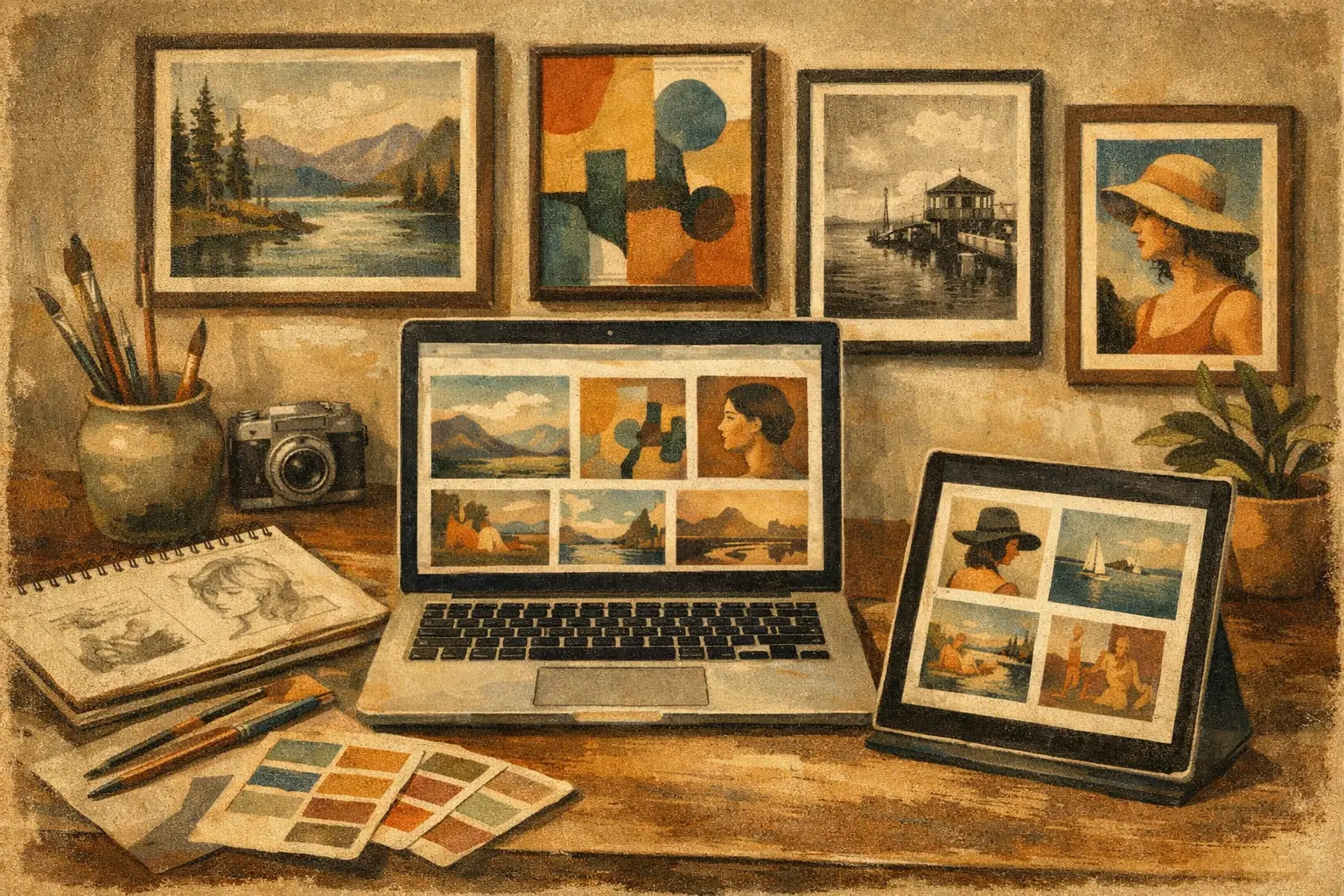
A screen can flatten art into a thumbnail. The best online galleries resist that flattening: they provide enough context, material detail, and visual honesty for a work to retain its presence before it reaches your wall. When looking for the best websites for buying art, the question is not simply where to find an image you like. It is where to find work that can hold a room, reward attention, and feel true to the life you are building around it.
Buying art online asks for a little discernment. A bold abstract may look ideal above a sofa yet feel too restless after a few weeks. A limited print may be beautifully made but less suited to a space that calls for the texture and singularity of an original. The right source depends on your budget, your appetite for discovery, and whether you are collecting an object, shaping an interior, or both.
What separates the best websites for buying art
A strong art website does more than sort work by color or size. It identifies the artist, explains the medium, states edition information clearly, and gives practical details about framing, scale, shipping, and returns. For original art, condition reports and provenance matter. For prints, look for archival inks, museum-quality paper or canvas, a stated edition size, and clarity about whether the work is signed.
Just as valuable is curatorial point of view. An enormous marketplace can be useful when you know exactly what you want. A tightly edited gallery is often better when you want to encounter a visual language rather than scroll through thousands of unrelated images. Neither model is inherently superior. The difference is whether it serves the way you choose.
12 websites to consider for art with presence
1. Artsy
Artsy is a wide-reaching marketplace for gallery-represented artists, established names, and auction offerings. It suits buyers who want access to the contemporary art ecosystem and are comfortable comparing prices, galleries, and artists across a large inventory. Its scale is its advantage, though it can also make the search feel more analytical than intimate.
2. Saatchi Art
Saatchi Art is known for a broad international selection of original works and prints, particularly by emerging artists. It can be a useful starting point for buyers who enjoy the unpredictability of discovery and want to explore painting, photography, sculpture, and mixed media in one place. Read the artwork descriptions closely, especially when assessing scale and surface texture.
3. Artfinder
Artfinder places independent artists at the center and offers a direct-feeling route to original work. The selection spans many styles and price points, making it appealing for first-time collectors who want something personal rather than standardized. Because the inventory is expansive, begin with a clear sense of the mood, palette, and dimensions your room needs.
4. Tappan Collective
Tappan Collective focuses on emerging artists whose work often speaks naturally to contemporary interiors. It is a thoughtful choice for collectors drawn to expressive painting, photography, and works on paper with a current sensibility. The presentation tends to make art approachable, though buyers should still consider whether a rising artist’s work resonates beyond a passing trend.
5. Uprise Art
Uprise Art offers a more edited experience, with a particular appeal for people who want support selecting original art for a home or project. Its approach is especially useful when a blank wall feels less like an opportunity than a difficult decision. A smaller selection can create more confidence, provided its aesthetic aligns with your own.
6. Singulart
Singulart connects buyers with artists around the world, offering original paintings, sculpture, photography, and drawings. It is worth considering if your taste moves across borders and you want work that does not feel limited to one regional scene. International buying can involve longer lead times, so confirm shipping expectations before committing to a piece for a time-sensitive installation.
7. 1stDibs
For collectors seeking art with history, 1stDibs brings together dealers, galleries, and vintage specialists. Alongside contemporary work, it is a compelling destination for design-era prints, paintings, and objects that carry a sense of time. The prices can be substantial, but the right vintage work can give an interior a depth that newly made decoration rarely achieves.
8. Artspace
Artspace is geared toward editions, contemporary art, and collectible work from recognized artists and publishers. It is a strong option for buyers who understand that an edition is not a lesser choice, but a distinct collecting format. A well-produced, thoughtfully chosen edition can be more meaningful than an original selected only for the word “original.”
9. Lumas
Lumas specializes in limited-edition photographic and graphic art, often with accessible framing options. It can work well for buyers who appreciate clean visual impact, architectural photography, and polished presentation. Its aesthetic is generally more streamlined than painterly, so it may be less fitting if you want visible gesture, irregularity, or the quiet tactility of handmade surfaces.
10. Minted
Minted offers affordable art prints from a broad community of independent artists. It is a practical destination for gallery walls, secondary rooms, and design projects where a coordinated set of smaller works is more useful than one statement piece. The key is to choose with restraint: a limited palette and a shared visual rhythm will feel more collected than a wall of unrelated images.
11. Society6
Society6 offers an immense range of artist-designed prints and is best approached as a place for visual experimentation. It can be useful for discovering an emerging style or finding an unexpected image for a casual setting. For a primary living space or a long-term collection, pay close attention to production options and consider whether the work has enough distinction to live with over time.
12. Taygeta Gallery
Taygeta Gallery is suited to buyers who want contemporary art shaped by stillness, impermanence, and the disciplined beauty of Wabi-Sabi. Its curated originals, collector editions, and museum-quality Giclée prints offer a more unified aesthetic world than a general marketplace. This makes it particularly relevant for homes, hospitality settings, and interiors where art is meant to create atmosphere rather than merely fill a wall.
Choose the source by the role art will play
Before searching, decide what the work needs to do. A single large piece above a bed may need softness and visual breathing room. An entryway may welcome something more immediate – a work that introduces character before the rest of the room speaks. A dining room can support complexity because people return to it slowly, often in conversation.
For an original, look beyond the image itself. Ask about the physical surface: is it oil, acrylic, collage, pigment, or ink? Does it have deckled edges, impasto, or subtle tonal variation? These qualities are often what transform a piece from an online selection into an object with gravity. For prints, prioritize production over vague claims of quality. Archival materials, careful color management, and considered framing shape the experience as much as the image does.
Interior designers and project specifiers should also ask about lead times, edition availability, volume purchasing, and framing consistency early. A work may be perfect for a guest suite, restaurant, or multi-unit project, but only if it can be produced and delivered with reliable standards. The most beautiful selection is not useful if it arrives too late or cannot be repeated where repetition is required.
A quieter way to buy art online
Do not begin with the empty wall. Begin with the feeling you want the room to protect. Perhaps it is calm after a crowded workday, a sense of freedom, or the welcome irregularity that keeps a minimal space from feeling sterile. Then let the website serve as a tool for narrowing your attention, not scattering it.
Save works and return to them after a day or two. Notice which one remains in your mind when the novelty has faded. The right artwork rarely needs to compete for attention. It creates a small field of presence, and over time, the room begins to organize itself around that quiet fact.
Leave a Reply