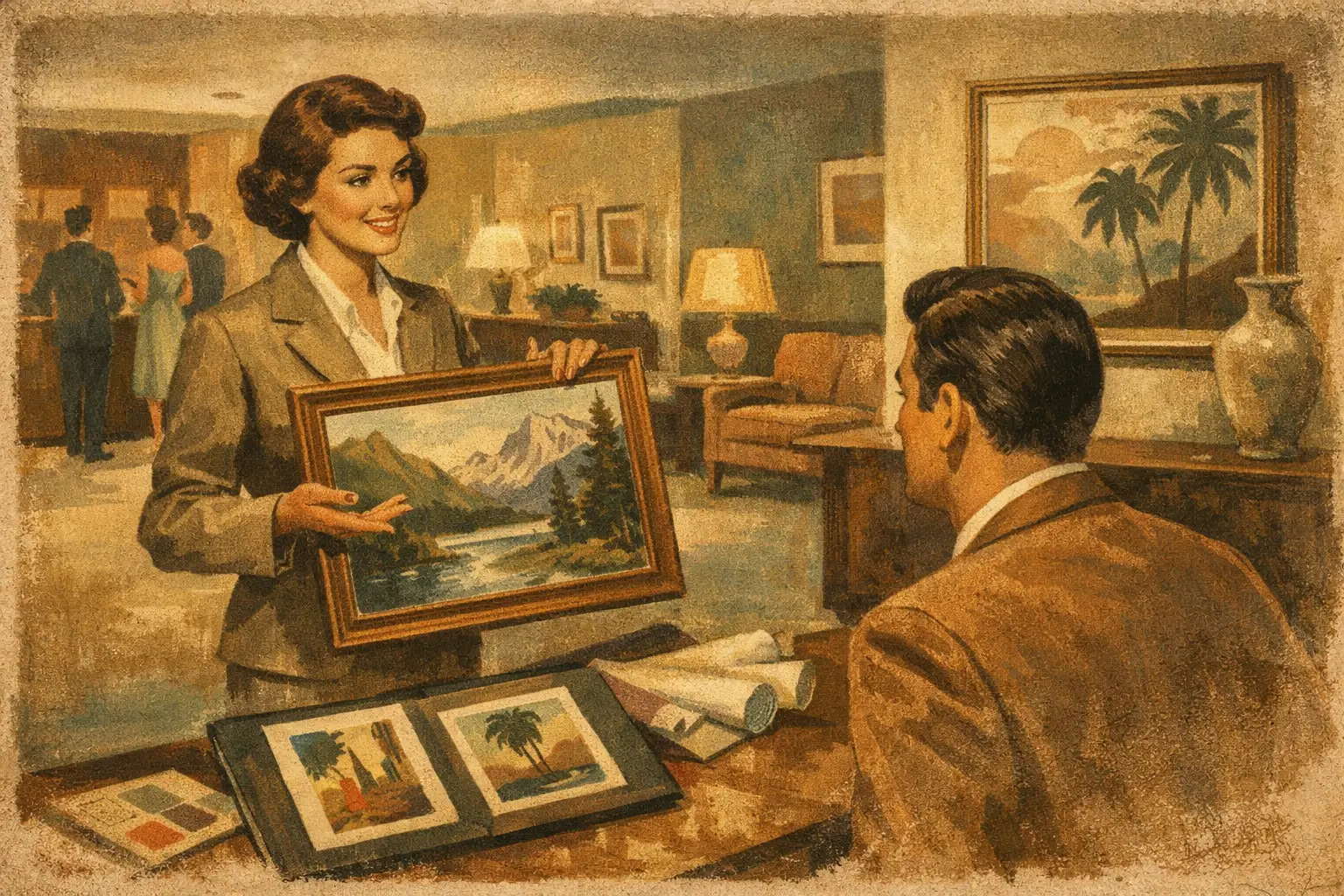
A guest rarely says, “the art was specified well.” What they remember is subtler than that. They remember the lobby that felt composed rather than staged, the corridor that held quiet interest, the suite that seemed to breathe. Hospitality art procurement sits inside that impression. Done well, it does not shout for attention. It gives a property its inner tone.
For hotels, resorts, restaurants, and branded residences, art is not a finishing touch applied at the end. It is part of the atmosphere itself. It shapes pace, emotional temperature, and memory. It can soften a minimalist interior, deepen a heritage narrative, or bring stillness to a space designed for constant movement. The challenge is that art in hospitality must do several jobs at once. It must feel distinctive, support the concept, withstand public life, and remain financially and logistically realistic.
What hospitality art procurement is really solving
At a surface level, hospitality art procurement is the process of sourcing, curating, producing, and delivering artwork for guest-facing environments. In practice, it is a question of alignment. The art must align with the brand story, the architecture, the guest demographic, the budget, the project timeline, and the operational realities of the site.
That is why the best procurement process begins before anyone asks for “something for the walls.” A luxury urban hotel and a wellness retreat may both want contemporary art, yet the emotional brief is entirely different. One may need tension, edge, and metropolitan energy. The other may need restraint, spaciousness, and a sense of return. If the emotional brief is vague, the result often becomes generic – visually pleasant, commercially safe, and instantly forgettable.
Strong hospitality projects treat art as part of placemaking. The work does not merely match the upholstery or echo the accent color. It interprets the identity of the property in a more subtle language. Sometimes that means a coherent collection running throughout public and private spaces. Sometimes it means a quieter strategy, where a few carefully placed works shift the entire rhythm of the interior.
The difference between decoration and curation
Not every hotel needs a blue-chip collection, and not every restaurant benefits from dramatic statement pieces. But every hospitality setting benefits from intention. This is the line between decoration and curation.
Decoration fills a visual gap. Curation creates a relationship between space, artwork, and viewer. In hospitality, that relationship matters because guests are not standing in front of a piece in gallery silence. They are checking in after a long flight, meeting someone for dinner, moving through a hallway late at night, waking slowly in unfamiliar surroundings. Art meets them in motion, in fatigue, in anticipation, in solitude.
This is where mood becomes central. A work grounded in Wabi-Sabi sensibility, for example, can bring uncommon calm to a room without becoming cold. Textured abstraction can suggest depth without dictating interpretation. Limited editions and museum-quality prints can offer consistency across multiple rooms while preserving a curated character. Original works may anchor signature spaces where a property wants stronger distinction. There is no single right format. It depends on where the piece lives, how many are needed, and what kind of experience the property wants to create.
How to approach hospitality art procurement with clarity
The most successful projects tend to move through a clear curatorial sequence. First comes the concept, then the spatial strategy, then the medium, then the production details. Teams often rush into image selection too early, when the more useful first questions are atmospheric.
What should a guest feel within the first thirty seconds of arrival? Where should the property feel animated, and where should it feel quiet? Which areas call for visual continuity, and which deserve contrast? Is the design language rooted in locality, minimalism, historical reference, nature, or cosmopolitan polish?
Once that is clear, the art brief becomes more precise. A lobby may call for one commanding focal work or a restrained group of pieces that support rather than dominate. Guest rooms often benefit from art that restores rather than overstimulates. Corridors need repetition with variation, so the experience feels intentional but not monotonous. Restaurants and lounges can usually tolerate more personality, though even there the art should not compete with the social energy of the room.
This stage is also where procurement becomes practical. Originals bring singularity and collector value, but they can be harder to scale across large properties. Editions and Giclée prints offer consistency, cost control, and production flexibility, especially when quality standards are high. Framed digital art can be especially effective when the visual language is sophisticated and the printing and finishing are handled with care. The real question is not which format is more prestigious. It is which format best serves the space.
Budget, scale, and why cheaper often costs more
Hospitality budgets are rarely limitless, even at the high end. That reality does not weaken the case for art. It simply means procurement must be disciplined.
The common mistake is treating art as a line item to compress once construction or FF&E costs expand. The immediate result may look acceptable on installation day, but low-grade printing, weak framing, and generic imagery age quickly. Guests may not identify the technical flaw, yet they sense the lack of conviction. In spaces where every material choice is working to signal quality, poor art becomes unexpectedly loud.
A more intelligent approach balances hero moments with scalable solutions. Invest where guests pause longest or where the property creates its visual identity – reception, lounge, restaurant, VIP suites. In more repetitive zones, use editioned or print-based works that maintain the curatorial language without overextending the budget. Good hospitality art procurement is not about spending indiscriminately. It is about knowing where uniqueness matters most and where consistency carries the project.
Production quality is part of the artwork
In hospitality, artwork is never just the image. Substrate, paper, frame, glazing, scale, and installation method all affect how the piece is received. Museum-quality production matters because these are public interiors with changing light, frequent cleaning, and constant occupancy.
A quiet abstract work can lose all nuance if printed flatly. A refined composition can feel mass-produced if the frame is too thin, too shiny, or out of proportion to the architecture. Large-scale pieces need not only visual presence but physical confidence. They must arrive correctly packed, fabricated to spec, and ready for site conditions.
This is one reason curatorial sourcing and production should not be separated too sharply. The artwork may be beautiful in concept, but if it cannot be executed well at the required scale or within the project timeline, it is not yet a workable specification. Art procurement at this level asks for both sensitivity and control.
Why guests respond to art with emotional depth
Hospitality environments are increasingly designed around experience rather than utility alone. Art plays a quiet but powerful role in that shift. It can humanize a polished interior. It can create moments of pause in highly managed spaces. It can suggest that the property values culture, not only image.
Guests are more visually literate than many brands assume. They know when a space feels copied, trend-driven, or hollow. They also know when it carries an authentic point of view. Art with emotional depth does not need to be difficult or overtly conceptual. It simply needs to feel chosen rather than purchased in bulk as decoration.
This is especially true in projects influenced by minimalism, Japanese aesthetics, or contemporary wellness design. In those settings, every visible object carries more weight. Fewer elements mean fewer places to hide indifference. A restrained artwork with texture, asymmetry, or contemplative force can hold a room more effectively than something louder but less considered.
For this reason, many designers and specifiers now look for art partners who understand both atmosphere and execution. A gallery with a clear curatorial perspective can help a project avoid the flattened look of mass-market hospitality packages. Taygeta Gallery, for example, approaches art through a lens of stillness, material nuance, and contemporary collecting, which can be especially resonant in interiors seeking calm, depth, and distinction.
A thoughtful close to the process
The best hospitality art procurement does not begin with inventory. It begins with attention. Attention to the property’s rhythm, to the guest’s state of mind, to the cultural tone of the interior, and to the practical life the artwork must live once installed.
When that attention is present, art stops behaving like décor and starts shaping memory. A guest may not recall the title of a piece or the method of print production. They may simply remember that the space felt grounded, rare, and complete. That is often the clearest sign that the art was right.
Leave a Reply